Freedom251 › Alert Management Software
SEC (Simple Event Correlator)
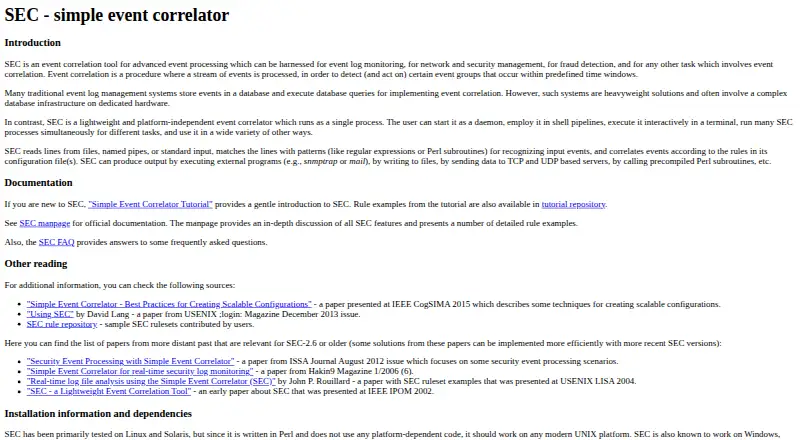
What SEC (Simple Event Correlator) is
SEC (Simple Event Correlator) is a free event-processing tool that watches streams of log or other events and responds when defined combinations occur within a time window. It reads lines from files, named pipes, or standard input, then applies patterns such as regular expressions or Perl subroutines. Rule files define how events are correlated; documented rules include threshold, event group, suppression, calendar, and pair types. SEC can launch external programs, write to files, send data to TCP or UDP servers, and call precompiled Perl subroutines. Documentation examples include invoking snmptrap or mail and sending an email for a matching SSH failed-login rule. It runs as one process, either as a daemon, in a shell pipeline, or interactively in a terminal. Listed uses include event log monitoring, network and security management, and fraud detection. SEC is written in Perl and recommends Perl 5.8 or later; other dependencies are standard Perl modules, with Sys::Syslog and JSON::PP optional. It is distributed under GPL-2.0. The site lists version 2.9.4 as a download dated February 12, 2026.
Who it suits
SEC suits people configuring event monitoring, network or security management, or fraud-detection workflows through rule files. It is aimed at users comfortable with Perl-based software and Linux or Unix environments.
What it does well
- Free software distributed under GPL-2.0.
- Rules support threshold and suppression conditions.
- Can send data to TCP or UDP servers.
- Runs as a daemon, pipeline process, or terminal program.
What to know first
- Windows disables some Unix-native functionality.
- Perl 5.8 or newer is recommended.
- Usage questions are directed to the users mailing list.
Plans
| Plan | Billed and limits | Price |
|---|---|---|
| SEC (GNU GPL-2.0) | Open-source software distributed under the GNU General Public License | Free |
As simple-evcorr.github.io lists them, read 7 Oct 2026. The maker's own page has the final word.
Getting started
- Open the SEC website.
- Choose Linux, Windows, or self-hosted deployment.
- Install Perl 5.8 or newer as recommended.
- Download SEC 2.9.4, listed February 12, 2026.
- Configure event correlations in rule files and run SEC as a daemon, in a shell pipeline, or interactively.
Verdict
SEC offers configurable event correlation and several ways to trigger actions, with no plan charge. Windows users should account for the disabled Unix-native functionality.
Questions
How much does SEC cost?
SEC is free. The listed plan is free.
Which platforms does SEC support?
It is listed for Linux, Windows, and self-hosted use. The project has primarily been tested on Linux and Solaris, and some Unix-native functionality is disabled on Windows.
What does SEC need to run?
SEC is written in Perl and recommends Perl 5.8 or newer. Its other dependencies are modules included in standard Perl installations; Sys::Syslog and JSON::PP are optional.
What license does SEC use?
SEC is distributed under the GNU General Public License, identified as GPL-2.0.
How can I get usage support?
The maker directs usage questions to the SEC users mailing list and asks users not to contact the author with usage questions.
Facts from SEC (Simple Event Correlator)'s own pages
- Deployment limit
- On Windows, some functionality native to Unix is disabled. · simple-evcorr.github.io, 7 Oct 2026
- Founded
- 2001 · simple-evcorr.github.io, 28 Sept 2026
- How it runs
- SEC is a lightweight, platform-independent correlator that runs as a single process and can run as a daemon, in shell pipelines, or interactively in a terminal. · simple-evcorr.github.io, 7 Oct 2026
- Inputs and matching
- SEC reads lines from files, named pipes, or standard input and matches events using patterns such as regular expressions or Perl subroutines. · simple-evcorr.github.io, 7 Oct 2026
- Integrations
- The documentation gives examples of invoking snmptrap and mail and shows an SSH failed-login rule that emails an alert. · simple-evcorr.github.io, 7 Oct 2026
- License
- The project repository states that SEC is distributed under the GNU General Public License and identifies the license as GPL-2.0. · github.com, 7 Oct 2026
- Outputs
- SEC can execute external programs, write to files, send data to TCP or UDP servers, and call precompiled Perl subroutines. · simple-evcorr.github.io, 7 Oct 2026
- Platform support
- SEC has primarily been tested on Linux and Solaris, is known to work on Windows with some Unix-native functionality disabled, and is expected to work on modern Unix platforms. · simple-evcorr.github.io, 7 Oct 2026
- Purpose
- SEC correlates event streams to detect and act on groups of events that occur within defined time windows. · simple-evcorr.github.io, 7 Oct 2026
- Release
- The site lists SEC 2.9.4 as a download dated February 12, 2026. · simple-evcorr.github.io, 7 Oct 2026
- Requirements
- SEC is written in Perl, recommends Perl 5.8 or newer, and otherwise depends only on modules included in standard Perl installations, with Sys::Syslog and JSON::PP optional. · simple-evcorr.github.io, 7 Oct 2026
- Rules
- Event correlation is configured with rule files, and the man page documents rule types including threshold, event group, suppression, calendar, and pair rules. · simple-evcorr.github.io, 7 Oct 2026
- Security capabilities
- The man page documents an option to drop root privileges by switching to a specified user and group when SEC starts with effective user ID 0. · simple-evcorr.github.io, 7 Oct 2026
- Support
- The maker directs usage questions to the SEC users mailing list and asks users not to contact the author with usage questions. · simple-evcorr.github.io, 7 Oct 2026
- Use cases
- The site identifies event log monitoring, network and security management, and fraud detection as use cases. · simple-evcorr.github.io, 7 Oct 2026
Where SEC (Simple Event Correlator) stands on Freedom251
- Alert Management Software#12 of 36