Freedom251 › Resource Management Software
Rapla
by Rapla
What Rapla is
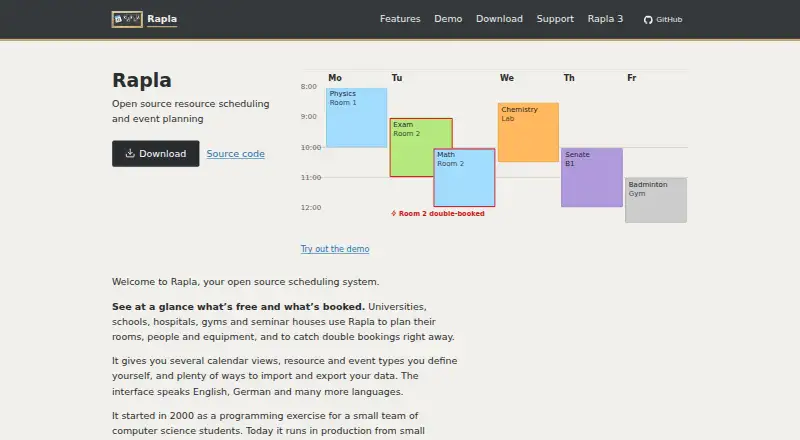
Rapla is a free, open-source system for scheduling resources and planning events, including rooms, people, and equipment. Its calendar offers month, week, day, and specialized views, with repeating appointments and conflict detection before saving. Administrators can define resource, person, and event types, then organize them with categories and attributes and set fine-grained permissions. Rapla can export to PDF and iCal, and can email users when a resource is allocated. Data may be stored in a file or in MySQL, PostgreSQL, or HSQLDB. Rapla 2 is labeled stable and can run as a standalone application or in client-server mode; its desktop client supports Linux, Windows, and macOS using Java and OpenWebStart. The interface is available in English and German, with translations of varying completeness in French, Dutch, Polish, Spanish, Finnish, Brazilian Portuguese, and Czech. Rapla 3 describes Exchange sync to booked persons’ Outlook calendars, a GraphQL API, OAuth 2.0 with PKCE, and sign-in with Microsoft, Google, or Keycloak. Rapla 3 nightly builds are self-signed, untested, and not for production. The software is available under AGPL-3.0-or-later or Apache-2.0.
Who it suits
Rapla suits organizations that need to schedule shared rooms, people, and equipment, including universities, schools, hospitals, gyms, and seminar houses. It can also suit teams that want an open-source scheduling system they can run as a standalone application or in client-server mode.
What it does well
- Calendar views cover month, week, day, and specialized schedules.
- Repeating appointments and conflict detection are supported.
- Fine-grained permissions and configurable resource types are available.
- PDF and iCal export are supported.
- Free and open source under AGPL-3.0-or-later or Apache-2.0.
What to know first
- Rapla 3 nightly builds are labeled untested and not for production.
- Translations beyond English and German have varying completeness.
- The desktop client requires Java and OpenWebStart.
Plans
| Plan | Billed and limits | Price |
|---|---|---|
| Rapla (open-source software) | Open source under AGPL-3.0-or-later or Apache-2.0 · no paid plans listed | Free |
As rapla.org lists them, read 8 Oct 2026. The maker's own page has the final word.
Getting started
- Visit https://rapla.org/.
- Choose the stable Rapla 2 release for use as a standalone application or in client-server mode.
- For the desktop client, use Linux, Windows, or macOS with Java and OpenWebStart.
- Choose a file, MySQL, PostgreSQL, or HSQLDB for data storage.
- Consult the wiki, documentation overview, FAQ, or GitHub issues for support.
Rapla is free, open-source software for planning events and scheduling rooms, people, and equipment. It is best suited to organizations that need configurable resource calendars and can manage a standalone or client-server deployment. Its stable Rapla 2 release covers the core scheduling job; Rapla 3’s newer capabilities come in nightly builds the maker considers untested and unsuitable for production.
Overview
Rapla brings resource booking and event planning into one system, with daily planning granularity and checks for conflicts before appointments are saved. That is a useful combination for institutions coordinating rooms, equipment, and people against the same calendar. The main trade-off is deployment: Rapla 2 runs standalone or in client-server mode, and its desktop client depends on Java and OpenWebStart rather than offering a broadly accessible hosted web service.
Key features
- Flexible scheduling: Month, week, day, and specialized calendar views, along with repeating appointments, cover recurring commitments as well as one-off events. Conflict detection helps prevent a resource clash before a booking is saved.
- Configurable administration: Administrators can define resource, person, and event types, categories, and attributes, then assign fine-grained permissions. This suits organizations with distinct booking rules, though it also means someone must shape and maintain that configuration.
- Sharing and alerts: PDF and iCal exports help users circulate schedules, and email notifications can alert users when a resource is allocated. These are practical handoffs, though they do not amount to a broader integration suite in the stable release.
- Storage choices: Data can be stored in a file or in MySQL, PostgreSQL, or HSQLDB. That gives administrators deployment flexibility, but makes the setup a better fit for organizations prepared to manage their chosen storage environment.
- Newer integrations: Rapla 3 describes Exchange synchronization to booked people’s Outlook calendars, a GraphQL API, OAuth 2.0 with PKCE, sign-in through Microsoft, Google, or Keycloak, and scoped API keys. These capabilities may matter to organizations planning integrations, but nightly builds are self-signed, untested, and not for production. iCal subscription and import are planned rather than available.
Pricing
Rapla (open-source software): free. The software is open source under AGPL-3.0-or-later or Apache-2.0, and no paid plans are listed. That makes it a straightforward option for organizations seeking a no-license-fee scheduler; the trade-off is taking responsibility for deployment and administration rather than buying a paid hosted tier.
Platforms
Rapla is listed for Linux, macOS, Windows, and self-hosted use. Rapla 2’s desktop client supports Linux, Windows, and macOS and uses Java and OpenWebStart; it can run standalone or in client-server mode. The interface is available in English and German, with translations of varying completeness in French, Dutch, Polish, Spanish, Finnish, Brazilian Portuguese, and Czech.
The maker says rapla.org and its demo run on EU-located infrastructure under a data processing agreement. Demo entries are visible to other visitors and removed in a nightly reset, so the demo is not appropriate for confidential scheduling.
Who it's for
The maker identifies universities, schools, hospitals, gyms, and seminar houses as users of Rapla for scheduling rooms, people, and equipment. It is a strong fit where those resource types need configurable calendars, permissions, and exportable schedules, and where an organization can operate a desktop or client-server installation. It is a weaker fit for teams that need a production-ready web service with modern integrations immediately: Rapla 3’s integration features are still in nightly builds.
Support paths include a wiki, documentation overview, FAQ, GitHub issues, and third-party professional support providers. That gives administrators several ways to seek help, though the need to configure and run the system remains part of choosing it.
Pros and cons
- Pro: No-cost open-source licensing avoids per-seat software fees while supporting scheduling for rooms, people, and equipment.
- Pro: Conflict checks, repeating appointments, configurable resource types, and fine-grained permissions address the practical complexities of institutional booking.
- Pro: File and database storage options, plus PDF and iCal export, give administrators flexibility in how they operate and share schedules.
- Con: Rapla 2’s Java and OpenWebStart desktop client, or its client-server deployment, requires more operational ownership than a hosted scheduling service.
- Con: Rapla 3’s Exchange sync, API, and identity features are not production-ready, limiting their value for organizations that need those integrations now.
- Con: Translation completeness varies, which may make the interface less suitable for teams relying on some of the supported languages.
Alternatives
Consider Teamdeck if you want a freemium option with Android, iOS, web, and desktop platform coverage; its free Startup plan is capped at six team members. Choose Ganttic if a free resource-planning option with Gantt charts, reports, and Kanban boards is a better fit; its free plan allows up to 10 resources with unlimited users and projects.
LibrePlan is another open-source, self-hosted option, with a Community Edition and a separate commercial Enterprise Edition. SAVIOM is a paid alternative with Power and Lite license options. Tempo Portfolio Manager may suit teams focused on project portfolios: its free plan allows 10 members, 3 projects, and 300 tasks. Mosaic is a paid alternative. Napta is another paid alternative. Retain is a paid alternative whose cloud plan is priced by quote.
For a wider comparison, browse Resource Management Software or Calendar apps.
Verdict
Choose Rapla if your organization needs free, open-source scheduling for rooms, people, or equipment and values configurable calendars, permissions, and exports. Its stable Rapla 2 release is the safer choice for operational use; look elsewhere if you need a hosted service or production-ready integrations beyond its current stable capabilities.
Verdict
Choose Rapla if you need free, open-source scheduling for rooms, people, or equipment and want configurable calendars, permissions, and exports. Rapla 2 is labeled stable; organizations considering Rapla 3 should account for its nightly builds being described as untested and unsuitable for production.
Questions
Is Rapla free?
Yes. Rapla is listed as free, with no paid plans listed.
Is Rapla open source?
Yes. It is available under AGPL-3.0-or-later or Apache-2.0.
Which platforms does Rapla support?
The desktop client supports Linux, Windows, and macOS using Java and OpenWebStart. Rapla 2 can run standalone or in client-server mode.
Can Rapla export calendars?
Yes. It supports PDF and iCal export.
What is the status of Rapla 3?
Rapla 3 nightly builds are described as self-signed, untested, and not for production. Rapla 2 is labeled stable.
Who makes Rapla?
The maker is Rapla. The site’s legal notice identifies erdkante GmbH in Köln, Germany as the entity responsible for the site.
Facts from Rapla's own pages
- Administration
- Users can define resource, person and event types, categories, attributes, and fine-grained permissions. · rapla.org, 8 Oct 2026
- API and identity
- Rapla 3 describes a GraphQL API, OAuth 2.0 with PKCE, sign-in with Microsoft, Google or Keycloak, and scoped API keys. · rapla.org, 8 Oct 2026
- Audience
- The maker says universities, schools, hospitals, gyms and seminar houses use Rapla to schedule rooms, people and equipment. · rapla.org, 8 Oct 2026
- Deployment
- Rapla 2 can run as a standalone application or in client-server mode, with a desktop client for Linux, Windows and macOS using Java and OpenWebStart. · rapla.org, 8 Oct 2026
- Exports and notifications
- Rapla supports PDF and iCal export and can email users when a resource is allocated. · rapla.org, 8 Oct 2026
- Founded
- 2000 · rapla.org, 28 Sept 2026
- Free plan
- Yes · rapla.org, 20 Sept 2026
- Integrations
- Rapla 3 is described as supporting Exchange sync to booked persons’ Outlook calendars and iCal export; iCal subscription and import are listed as planned. · rapla.org, 8 Oct 2026
- Language support
- The interface is available in English and German, with translations of varying completeness in French, Dutch, Polish, Spanish, Finnish, Brazilian Portuguese and Czech. · rapla.org, 8 Oct 2026
- Purpose
- Rapla is an open-source system for scheduling resources and planning events, including rooms, people and equipment. · rapla.org, 8 Oct 2026
- Release status
- Rapla 2 is labeled stable, while Rapla 3 nightly builds are described as self-signed, untested and not for production. · rapla.org, 8 Oct 2026
- Scheduling
- It offers month, week, day and specialized calendar views, repeating appointments, and conflict detection before saving. · rapla.org, 8 Oct 2026
- Security and privacy
- The maker states that rapla.org and its demo are hosted on EU-located infrastructure under a data processing agreement, and that demo entries are visible to other visitors and erased in a nightly reset. · rapla.org, 8 Oct 2026
- Storage
- Rapla can store data in a file or in MySQL, PostgreSQL or HSQLDB. · rapla.org, 8 Oct 2026
- Support
- The maker points users to a wiki, documentation overview, FAQ and GitHub issues, and lists third-party professional support providers. · rapla.org, 8 Oct 2026
Where Rapla stands on Freedom251
- Resource Management Software#4 of 25
- Calendar apps#62 of 194