Freedom251 › Retrieval-Augmented Generation Tools
RAGStack
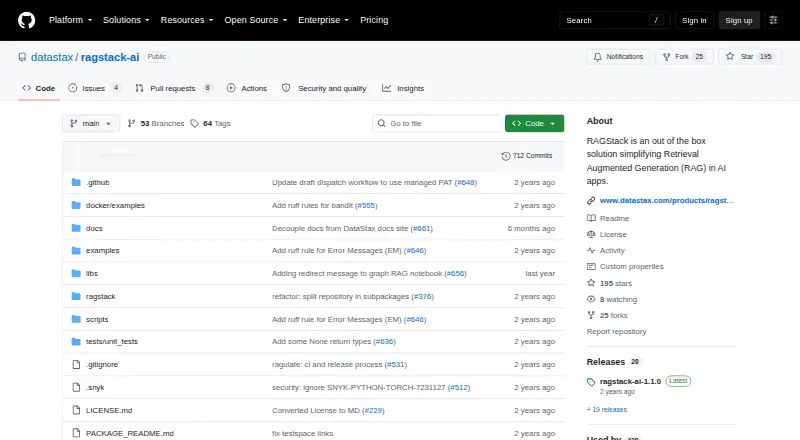
What RAGStack is
RAGStack is a free, open-source software stack for building retrieval-augmented generation applications. Its Python packages install with `pip install ragstack-ai`, and it uses the LangChain ecosystem. For vector storage, projects can use Astra DB Serverless or Apache Cassandra. The documentation names RAG fusion and FLARE as available advanced techniques, and describes an example that combines RAGStack, Astra DB, and OpenAI. RAGStack is compatible with LangSmith for monitoring AI deployments. DataStax selects component versions and checks them together for compatibility, performance, and security, and says it scans components for known vulnerabilities. The documentation also describes caching AI calls and Astra DB parallelism as ways to help performance, scalability, and cost. Enterprise support and SLAs, plus support for HIPAA, TRUSTe, and SOC 2, apply when running RAGStack in Astra DB. The TypeScript package includes only part of LangChain's libraries, so projects may need to keep other `@langchain/*` packages. The listed plan costs nothing.
Who it suits
RAGStack suits developers building RAG applications who want a curated LangChain-based stack and can use Astra DB Serverless or Apache Cassandra. Teams running it in Astra DB may also use the stated enterprise support and compliance offerings.
What it does well
- Open-source RAG package is listed as free.
- Supports Astra DB Serverless or Apache Cassandra as vector stores.
- Includes RAG fusion and FLARE techniques.
- Compatible with LangSmith for deployment monitoring.
What to know first
- TypeScript package includes only a subset of LangChain libraries.
- Enterprise support and compliance offerings apply when run in Astra DB.
Plans
| Plan | Billed and limits | Price |
|---|---|---|
| RAGStack | Open-source RAG package; uses Astra DB Serverless or Apache Cassandra as a vector store | Free |
As github.com lists them, read 8 Oct 2026. The maker's own page has the final word.
Getting started
- Open the RAGStack project website on GitHub.
- Install the Python packages with `pip install ragstack-ai`.
- Choose Astra DB Serverless or Apache Cassandra as the vector store.
- Use the LangChain ecosystem and documented RAG techniques to build an application.
RAGStack is a curated, open-source foundation for teams building retrieval-augmented generation applications with Python and the LangChain ecosystem. It suits developers who want a tested combination of RAG components rather than assembling and checking every dependency themselves. Its strongest case is controlled, self-hosted RAG development; teams needing a visual builder or broader TypeScript coverage should look elsewhere.
Overview
RAGStack packages a production-oriented RAG stack whose components are selected and tested together by DataStax for compatibility, performance, and security. You install the Python packages with pip install ragstack-ai, then build within LangChain and monitor deployments with LangSmith. That approach reduces dependency-selection work, but it remains a developer framework, not a point-and-click application.
The documented workflow uses RAGStack with Astra DB and OpenAI. Astra DB Serverless and Apache Cassandra are the stated vector-store choices, giving teams a clear path if they already use either database. Projects standardised on another vector store will need to assess the integration effort themselves.
Key features
Curated compatibility and security
DataStax selects component versions and tests them as a set, including performance and security checks. It also scans every RAGStack component with industry-standard tools for known vulnerabilities. This is a practical advantage for production teams that want a maintained baseline instead of independently validating a changing collection of packages.
Advanced retrieval techniques
The stack documents RAG fusion and FLARE, giving experienced teams options beyond a basic retrieve-and-generate loop. These techniques are useful when answer quality or retrieval robustness justifies additional engineering complexity; they are not a substitute for designing and evaluating your own pipeline.
Performance and operations
Caching AI calls can reduce repeated work and cost, while Astra DB parallelism can improve scalability and throughput. LangSmith compatibility supports monitoring of AI deployments, so the stack is better suited to teams operating measurable services than to casual experiments.
TypeScript boundary
The TypeScript package covers only a subset of LangChain libraries. A TypeScript project may therefore need to retain additional @langchain/* packages, weakening the convenience of a single curated dependency set.
Pricing
| Plan | Price | Includes |
|---|---|---|
| RAGStack | free | Open-source RAG package using Astra DB Serverless or Apache Cassandra as a vector store |
There is no paid RAGStack tier or seat quota in the stated plan. The software itself is free and open source, making it suitable for individual developers, prototypes, and organisations able to operate their own infrastructure. Enterprise support, SLAs, and support for HIPAA, TRUSTe, and SOC 2 apply when RAGStack runs in Astra DB; those service conditions are tied to that deployment choice rather than to a separate RAGStack subscription.
Platforms
RAGStack supports Linux, macOS, Windows, and self-hosted deployment. Its package-oriented model fits teams comfortable managing Python environments, databases, model providers, and monitoring rather than users seeking a hosted workspace.
Who it's for
Choose RAGStack when you are building a custom RAG service and value a compatibility-tested open-source baseline, especially if Astra DB or Apache Cassandra is already part of your architecture. It is also a sensible starting point for teams that want documented advanced retrieval methods and a route to enterprise support through Astra DB.
It is a weaker fit for non-developers, teams wanting a visual workflow builder, or TypeScript projects that depend on the full LangChain library family. The absence of a RAG workflow builder means orchestration remains your responsibility.
Pros and cons
- Pro: DataStax tests component versions together, reducing compatibility work in a production stack.
- Pro: Vulnerability scanning across components provides a clearer security baseline than an uncurated dependency mix.
- Pro: Astra DB Serverless and Apache Cassandra offer two defined vector-store paths, with enterprise support and compliance support available on Astra DB.
- Con: The TypeScript package is incomplete, so migrations may still require separate LangChain packages.
- Con: There is no workflow builder; teams must implement and operate the RAG application themselves.
- Con: The documented vector-store options are limited to Astra DB Serverless or Apache Cassandra.
Alternatives
AnythingLLM is the better choice when you want a freemium product spanning Android, web, desktop, API, and self-hosted use, with a Docker-based open-source deployment option.
Flowise fits teams seeking a visual, freemium builder with a free tier capped at two flows and assistants, 100 predictions per month, and 5MB of storage.
PrivateGPT is a free, open-source alternative for teams prioritising a self-hosted RAG application across API, web, and desktop platforms.
txtai is a free Apache 2.0 option installable with pip or Docker for developers who want a more general-purpose self-hosted stack.
I3K RAG Enterprise suits organisations wanting a freemium self-hosted product with a free AGPL-3.0 Community plan and paid custom Pro tier.
RAGFlow is preferable when a hosted-style product model and team quotas matter; its free plan allows five apps, one team member, 0.1GB of dataset storage, and 500 credits monthly.
Dify is a better fit for teams wanting a web-based workspace, with a free Sandbox plan covering one member, five apps, 50 knowledge documents, and 50MB storage.
Haystack Enterprise Platform is an alternative for teams wanting a cloud Studio workspace with one user, 100 pipeline hours, 50 files, and two development pipelines on its free tier.
Verdict
RAGStack is a strong choice for developers building custom, self-hosted RAG systems who want DataStax-curated compatibility and security checks at no software cost. Choose it when Astra DB or Cassandra fits your architecture and you value framework control. Look elsewhere if you need a visual builder, a broad TypeScript package, or vector-store flexibility beyond its two stated options.
Verdict
RAGStack combines RAG components with version compatibility and vulnerability checks, while supporting two stated vector-store options. Check the TypeScript package limits and Astra DB conditions against your project needs.
Questions
How much does RAGStack cost?
The listed RAGStack plan costs nothing. The project is open source.
Which vector stores does RAGStack support?
It supports Astra DB Serverless or Apache Cassandra as a vector store.
Which platforms are listed?
Linux, macOS, Windows, and self-hosted are listed.
Does RAGStack support enterprise SLAs and compliance?
Enterprise support and SLAs, along with support for HIPAA, TRUSTe, and SOC 2, apply when running RAGStack in Astra DB.
Can a TypeScript project use RAGStack by itself?
The TypeScript package includes only a subset of LangChain libraries, so a project may need to keep additional `@langchain/*` packages.
Who makes RAGStack?
DataStax selects component versions and checks their compatibility, performance, and security together. The project lists its headquarters as Santa Clara, California, United States, and its founding year as 2010.
Facts from RAGStack's own pages
- Compatibility checks
- DataStax selects component versions and tests their compatibility, performance, and security together. · docs.datastax.com, 8 Oct 2026
- Compliance
- The documentation says enterprise support and SLAs, and support for HIPAA, TRUSTe, and SOC 2, apply when running RAGStack in Astra DB. · docs.datastax.com, 8 Oct 2026
- Founded
- 2010 · github.com, 28 Sept 2026
- Framework
- RAGStack leverages the LangChain ecosystem and is compatible with LangSmith for monitoring AI deployments. · docs.datastax.com, 8 Oct 2026
- Headquarters
- Santa Clara, California, United States · github.com, 28 Sept 2026
- Install
- The Python packages can be installed with `pip install ragstack-ai`. · github.com, 8 Oct 2026
- Migration limit
- The TypeScript package includes only a subset of LangChain libraries, so projects may need to retain other `@langchain/*` packages. · docs.datastax.com, 8 Oct 2026
- Performance
- The documentation says caching AI calls and Astra DB parallelism can help with performance, scalability, and cost. · docs.datastax.com, 8 Oct 2026
- Purpose
- RAGStack is a curated stack of open-source software for building production-ready retrieval-augmented generation applications. · docs.datastax.com, 8 Oct 2026
- RAG techniques
- The documentation names RAG fusion and FLARE as advanced techniques available with RAGStack. · docs.datastax.com, 8 Oct 2026
- Security scans
- DataStax says it scans all RAGStack components with industry-standard tools for known vulnerabilities. · docs.datastax.com, 8 Oct 2026
- Support
- The documentation describes enterprise support and SLAs for RAGStack when running in Astra DB. · docs.datastax.com, 8 Oct 2026
- Usage example
- DataStax documents a RAG example using RAGStack, Astra DB, and OpenAI. · docs.datastax.com, 8 Oct 2026
- Vector stores
- RAGStack supports Astra DB Serverless or Apache Cassandra as a vector store. · docs.datastax.com, 8 Oct 2026
Where RAGStack stands on Freedom251
- Retrieval-Augmented Generation Tools#16 of 26