Freedom251 › LLM Application Development Frameworks
Flowise
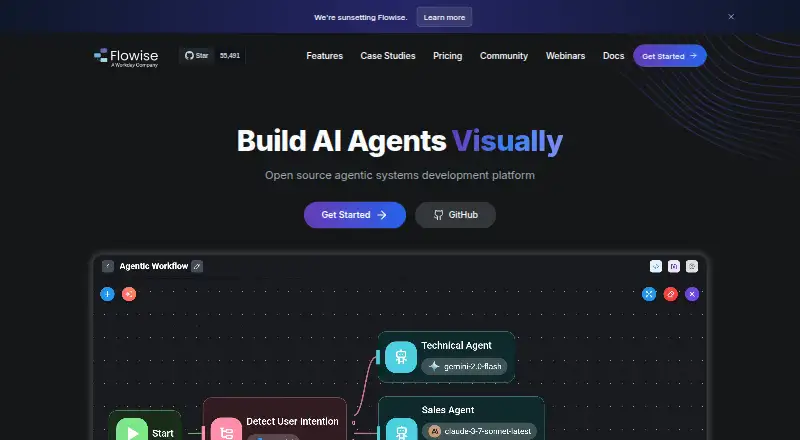
What Flowise is
Flowise is an open-source platform for building generative AI agents and large language model workflows. Its Assistant, Chatflow, and Agentflow visual builders cover assistants, chatbots, single- and multi-agent systems, and workflow orchestration. Listed tools include execution logs, visual debugging, evaluations, human review, and retrieval-augmented generation indexing pipelines. Documentation describes connections to more than 100 sources, tools, vector databases, and memories, with integrations including LangChain, LlamaIndex, and Zapier Zaps. Developers can use APIs, an embedded chat widget, and TypeScript and Python SDKs. Deployment options include cloud, on-premises, and self-hosted setups. Security controls listed in documentation include role-based access, single sign-on, encrypted credentials, secret managers, rate limiting, and restricted domains. Flowise is winding down: feature development ceased July 29, 2026, repository archival is listed for August 10, and end of life for August 31, 2026. The source remains under Apache 2.0. The Free plan costs nothing; Starter is $35 a month.
Who it suits
Flowise suits developers and teams building AI assistants, chatbots, and LLM workflows who want visual builders and deployment choices. The announced wind-down makes it particularly important for prospective users to consider project maintenance and support timelines.
What it does well
- Visual builders cover single- and multi-agent workflows.
- Documentation lists connections to 100+ sources and tools.
- Offers cloud, on-premises, and self-hosted deployment.
- Free plan costs nothing.
- Source remains under Apache 2.0.
What to know first
- Active feature development ceased July 29, 2026.
- End of life is listed for August 31, 2026.
- Starter costs $35 a month.
- Official core team presence concluded August 31, 2026.
Limits
The Free plan includes 2 Flows and Assistants, 100 Predictions per month, and 5MB of storage. Starter costs $35 a month and includes 10,000 Predictions per month and 1GB of storage.
Plans
| Plan | Billed and limits | Price |
|---|---|---|
| Free | 2 Flows & Assistants · 100 Predictions / month · 5MB Storage · Evaluations & Metrics · Custom Embedded Chatbot Branding · Community Support | Free |
| Starter | Everything in Free · Unlimited Flows & Assistants · 10,000 Predictions / month · 1GB Storage · Community Support | $35 a month |
| Pro | Everything in Starter · 50,000 Predictions / month · 10GB Storage · Unlimited Workspaces · 5 Users+ $15/user/month · Admin Roles & Permissions · Priority Support | $65 a month |
As flowiseai.com lists them, read 1 Oct 2026. The maker's own page has the final word.
Getting started
- Visit the Flowise website.
- Choose a cloud, on-premises, or self-host deployment approach.
- Use the repository's npm or Docker installation instructions for self-hosting.
- Build with Assistant, Chatflow, or Agentflow.
- Connect through an API, embedded chat widget, or SDK.
Flowise is an open-source platform for building AI agents and LLM workflows with visual tools. It is best suited to developers and teams comfortable running or forking software; its breadth is useful, but its wind-down makes it a risky choice for new production work.
Overview
Assistant, Chatflow and Agentflow builders address assistants, chatbots, single- and multi-agent systems, and workflow orchestration. That range lets teams use one platform for everything from a focused chatbot to coordinated workflows. The trade-off is decisive: feature development stopped on July 29, 2026, repository archival is scheduled for August 10, and end of life for August 31, 2026.
The source remains on GitHub under the Apache 2.0 license, and Flowise encourages teams to fork it. That may suit organizations able to take responsibility for ongoing maintenance, but it does not preserve active upstream development or official core-team support.
Key features
Execution logs, visual debugging, evaluations, human review and RAG indexing pipelines complement the visual builders. In practice, teams can inspect runs, assess outputs and include review steps rather than only connecting workflow components. Support for knowledge grounding and multi-agent systems broadens the kinds of applications it can accommodate.
Flowise connects to more than 100 sources, tools, vector databases and memories, including LangChain, LlamaIndex and Zapier Zaps. APIs, an embedded chat widget, and TypeScript and Python SDKs give developers several ways to integrate their work. Security controls include RBAC, SSO, encrypted credentials, secret managers, rate limiting and restricted domains. For production, its guidance recommends queue mode, PostgreSQL at scale, AWS S3 storage and AWS Secret Manager for credential key management.
Deployment can be cloud or on-premises, with npm, Docker and self-hosting options. The platform lists Linux, macOS and Windows as well as web, API and self-hosted availability. These options are useful for teams that need control over deployment, but a new installation should account for deprecated npm packages and Docker images after repository archival.
Pricing
The Free plan costs nothing and includes two Flows and Assistants, 100 predictions per month, 5MB of storage, evaluations and metrics, custom embedded-chatbot branding, and community support. It is suitable for small experiments, but the flow, prediction and storage caps constrain ongoing use.
Starter costs $35 a month. It adds unlimited Flows and Assistants, 10,000 predictions per month and 1GB of storage while retaining community support. It fits modest workloads that outgrow the free quotas, though it does not include the higher limits or administrative controls in Pro.
Pro costs $65 a month and raises the allowance to 50,000 predictions and 10GB of storage, with unlimited workspaces, admin roles and permissions, and priority support. It includes five users, with additional users at 15 USD per user per month. That makes it the more capable option for teams needing separate workspaces and access controls, but the user charge adds to the monthly cost. The free plan, paid tiers and a free trial are offered; given the announced wind-down, committing to a paid plan for long-term use deserves particular caution.
Platforms
Flowise supports web and API access, Linux, macOS and Windows, plus cloud, on-premises and self-hosted deployment. This combination suits teams that want to connect workflows programmatically or run them on infrastructure they manage.
Who it's for
Flowise is most appropriate for developers evaluating visual agent and LLM workflow construction, or organizations prepared to maintain a fork after upstream development ends. Its builders, integrations, debugging and deployment choices make it capable for experimentation and internal projects. It is a poor fit for buyers who need an actively maintained vendor-backed platform for a new long-lived production service.
Pros and cons
- Pros: Three visual builders cover assistants, chatbots and single- or multi-agent workflows, giving teams flexibility within one platform.
- Pros: More than 100 integrations, developer interfaces, evaluation tools and security controls support connected, inspectable workflows.
- Pros: Apache 2.0 source and self-hosting give capable teams the option to continue independently.
- Cons: Feature development has ceased and end of life is scheduled for August 31, 2026, undermining its suitability as a new production foundation.
- Cons: Official core-team presence in Discord and GitHub concluded on August 31, 2026, limiting the support path as the project winds down.
- Cons: The free tier's two-flow, 100-prediction and 5MB limits are narrow for sustained use; higher quotas require paid plans.
Alternatives
For readers comparing broader AI Agent Platforms or focused Retrieval-Augmented Generation Tools, the right choice depends on whether agent orchestration or retrieval is the priority. AnythingLLM is another freemium option spanning web, desktop, mobile, API and self-hosted use. RAGFlow offers a free plan with five apps, one team member, 0.1 GB dataset storage and 500 monthly credits, making those caps relevant to smaller evaluations. I3K RAG Enterprise has a free, self-hosted Community plan under AGPL-3.0 for Linux or Windows. Dify offers a free Sandbox with 200 message credits, one workspace, one member and five apps. Haystack Enterprise Platform has a free Studio plan with one workspace, one user and 100 pipeline hours, plus a free trial. OpenRAG provides an AGPL-3.0 self-hosted plan with no features held back. Ragen offers self-hosted use without license fees, with users paying for infrastructure and models. Google Cloud Agent Evaluation is a paid service with a free trial and usage-based charges for evaluation metrics.
Verdict
Choose Flowise if you need visual construction for agents and LLM workflows and can accept responsibility for a fork or a short-lived project. Its combination of builders, integrations, evaluation tools and deployment choices is compelling, but the end-of-life schedule and concluded core-team support are strong reasons to look elsewhere for a production system expected to last.
Verdict
Flowise offers visual workflow construction, integrations, and deployment options, but its wind-down is a central consideration. Active development has ceased, and the listed end-of-life date is August 31, 2026.
Questions
Is Flowise open source?
Yes. The sunset notice says its source code remains on GitHub under the Apache 2.0 license.
Does Flowise have a free plan?
Yes. Free costs nothing and includes 2 Flows and Assistants, 100 Predictions per month, and 5MB of storage.
How much do paid plans cost?
Starter costs $35 a month, and Pro costs $65 a month.
Where can Flowise be deployed?
The product site describes cloud and on-premises deployment. The repository also provides npm and Docker installation instructions and self-host options.
What integrations and developer tools are listed?
Documentation describes connections to 100+ sources, tools, vector databases, and memories, including LangChain, LlamaIndex, and Zapier Zaps. The homepage lists APIs, an embedded chat widget, and TypeScript and Python SDKs.
What is the project's sunset status?
Flowise says feature development ceased July 29, 2026, the repository was archived August 10, 2026, and end of life is August 31, 2026.
Facts from Flowise's own pages
- Deployment
- The product site describes cloud and on-premises deployment, while the repository provides npm and Docker installation instructions and self-host deployment options. · github.com, 1 Oct 2026
- Developer access
- The homepage lists APIs, an embedded chat widget, and TypeScript and Python SDKs. · flowiseai.com, 1 Oct 2026
- Features
- Its listed capabilities include visual orchestration, execution logs, visual debugging, evaluations, human review, and RAG indexing pipelines. · docs.flowiseai.com, 1 Oct 2026
- Integrations
- Flowise documentation says it connects to 100+ sources, tools, vector databases, and memories, and lists LangChain, LlamaIndex, and Zapier Zaps integrations. · docs.flowiseai.com, 1 Oct 2026
- License
- The sunset notice says Flowise source code remains on GitHub under the Apache 2.0 license and encourages teams to fork it. · flowiseai.com, 1 Oct 2026
- Maintenance limit
- The sunset notice says active feature development ceased on July 29, 2026, and that npm packages and Docker images would be marked deprecated after repository archival. · flowiseai.com, 1 Oct 2026
- Product
- Flowise is an open source generative AI development platform for building AI agents and LLM workflows. · docs.flowiseai.com, 1 Oct 2026
- Production guidance
- Production documentation recommends queue mode, PostgreSQL at scale, AWS S3 storage, and AWS Secret Manager for credential key management. · docs.flowiseai.com, 1 Oct 2026
- Security
- Documentation lists RBAC, SSO, encrypted credentials, secret managers, rate limiting, and restricted domains as security controls. · docs.flowiseai.com, 1 Oct 2026
- Sunset
- Flowise says it is winding down operations; its site lists a July 29, 2026 code freeze, August 10 repository archival, and August 31 end of life. · flowiseai.com, 1 Oct 2026
- Support
- The documentation lists community support and vendor support including SLA support and consultations; the sunset notice says official core team presence in Discord and GitHub concluded on August 31, 2026. · flowiseai.com, 1 Oct 2026
- Visual builders
- The platform provides Assistant, Chatflow, and Agentflow visual builders for assistants, chatbots, single-agent and multi-agent systems, and workflow orchestration. · docs.flowiseai.com, 1 Oct 2026
Where Flowise stands on Freedom251
- LLM Application Development Frameworks#3 of 49
- AI Agent Platforms#7 of 73
- Multi Agent Systems#2 of 19
- Ai Agent Automation#3 of 24
- Retrieval-Augmented Generation Tools#4 of 26
- Ai Development Tools#5 of 26
- Ai Automation#6 of 28
- Tool Agents#6 of 26
- AI Orchestration Software#5 of 20
- Tool Calling#7 of 21