Freedom251 › AI Agent Evaluation Tools
Google Cloud Agent Evaluation
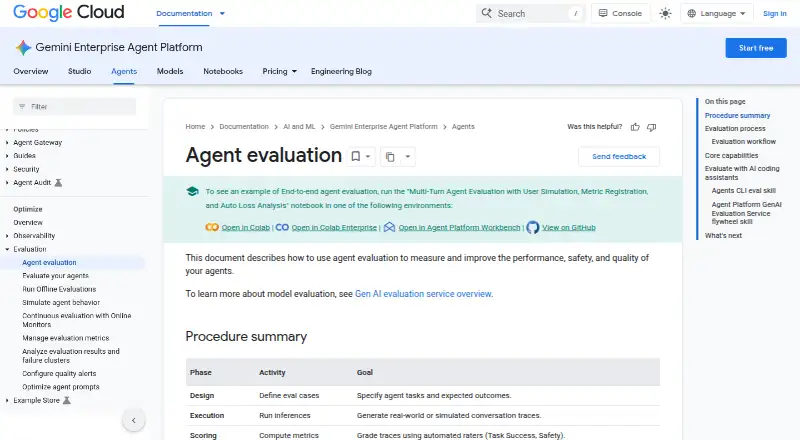
What Google Cloud Agent Evaluation is
Google Cloud Agent Evaluation measures an AI agent’s performance, safety and quality, then supports improvement through a workflow of test cases, inferences, behavior traces, metrics and result analysis. It can generate multi-turn synthetic scenarios from agent instructions and tool definitions. During evaluation, it can intercept tool calls and insert custom behavior, mocked data or simulated problems such as HTTP 503 errors and latency spikes. Prebuilt or custom raters can score traces with reference-based Exact Match or reference-free Helpfulness metrics. Teams can also evaluate traces from production traffic or external logs without setting up a managed test environment. Prompt optimization identifies failure points and proposes targeted changes to system instructions. The service supports tool-call checks, safety evaluations, regression runs, trace ingestion and custom models, with API access and automated optimization. Notebook launch options include Colab, Colab Enterprise, Agent Platform Workbench and GitHub. Usage pricing lists $0.00003 per 1k input characters and $0.00009 per 1k output characters for computation-based metrics; model-based metric charges include underlying autorater prediction costs. New Google Cloud customers receive $300 in credits.
Who it suits
This service suits teams evaluating AI agents with test cases, production traces or external logs. It also fits teams seeking prompt optimization or evaluation of supported partner models.
What it does well
- Generates multi-turn scenarios from instructions and tool definitions.
- Can evaluate production traces and external logs.
- Includes safety evaluations and regression runs.
- New customers receive $300 in Google Cloud credits.
What to know first
- No free plan is listed.
- Model-based metrics also incur autorater prediction costs.
- Default quota limits concurrent runs to 20 per project per region.
Limits
There is no free plan. The documented default quotas are 1,000 evaluation service requests per project per region per minute and 20 concurrent evaluation runs per project per region.
Plans
| Plan | Billed and limits | Price |
|---|---|---|
| Pay-as-you-go usage | $0.00003 per 1k input characters and $0.00009 per 1k output characters for computation-based metrics; model-based metrics are charged for underlying autorater model prediction costs. · Pricing is usage-based; model-based metric charges depend on dataset input tokens and autorater output · Third-party model evaluation also incurs model inference charges | Free |
As docs.cloud.google.com lists them, read 2 Oct 2026. The maker's own page has the final word.
Getting started
- Open the Google Cloud Agent Evaluation website.
- Choose the web console or API route.
- Use the free trial; new Google Cloud customers receive $300 in credits.
- Start from an evaluation notebook through Colab, Colab Enterprise, Agent Platform Workbench, or GitHub.
- Define evaluation cases, run inferences, and review the resulting traces and metrics.
Google Cloud Agent Evaluation is a Google Cloud service for measuring and improving the performance, safety, and quality of AI agents. It fits engineering teams that need repeatable checks across generated tests, tool behavior, and production traces. The strongest case is an end-to-end evaluation and optimization workflow; usage billing and concurrency quotas demand planning for sustained workloads.
Overview
The service links evaluation-case definition, inference runs, behavior-trace capture, metric computation, result analysis, and agent optimization. That connected process is valuable when evaluation must feed directly into development rather than produce an isolated score. Hybrid evaluation methods, safety evaluations, regression runs, prompt testing, trace ingestion, and tool-call checks cover both quality and operational risk.
It is delivered through API and web interfaces, with SDK support for both listed language categories and custom model support. Google Cloud was founded in 1998 and is headquartered in Mountain View, California.
Key features
- Synthetic scenarios: The service generates diverse, multi-turn test cases from agent instructions and tool definitions. This can expand coverage quickly, while teams remain responsible for deciding whether generated cases reflect their highest-risk situations.
- Environment simulation: Tool calls can be intercepted and supplied with custom behavior, mocked data, HTTP 503 errors, or latency spikes. That makes resilience testing possible without waiting for every failure to occur in a live dependency.
- Trace scoring: Prebuilt and custom raters score traces with reference-based Exact Match and reference-free Helpfulness metrics. Production traffic and external logs can also be scored without a managed test environment, which suits teams that already collect useful operational traces.
- Prompt optimization: Automated optimization identifies failure points and proposes targeted changes to system instructions. It is a practical bridge from diagnosis to iteration, although proposed changes still require review before adoption.
- Integrations and assistants: Notebook launches are provided for Colab, Colab Enterprise, Agent Platform Workbench, and GitHub. Evaluation skills for Gemini CLI and other AI coding assistants add workflow guidance, dataset schemas, metric advice, and failure-analysis steps.
- Model coverage: The console tutorial supports evaluation of Anthropic and Llama partner models through Agent Platform Model Garden, rather than limiting evaluation to one model family.
Pricing
Google Cloud Agent Evaluation has no free plan, but a free trial is available. New Google Cloud customers receive $300 in credits for running, testing, and deploying workloads.
Pay-as-you-go usage
The listed plan costs nothing before usage. Computation-based metrics are billed at $0.00003 per 1k input characters and $0.00009 per 1k output characters. Model-based metrics add the underlying autorater model prediction costs, with charges depending on dataset input tokens and autorater usage. This structure can suit irregular evaluation, but large datasets, frequent regression runs, or model-based scoring can make the eventual bill less predictable than a fixed subscription.
Documented default quotas allow 1,000 evaluation service requests per project per region per minute and 20 concurrent evaluation runs per project per region. Those ceilings are reasonable for controlled pipelines but can become a scheduling constraint for broad parallel test suites. Basic Support includes documentation, community forums, billing assistance, and Active Assist; tailored technical support requires an upgrade.
Platforms
API and web access support both automation and console-based work. Notebook launch options extend the workflow into Colab, Colab Enterprise, Agent Platform Workbench, and GitHub.
Who it's for
This is a strong fit for teams building agents in Google Cloud that need scenario generation, simulated tool failures, trace-based scoring, safety checks, regression runs, and automated prompt improvement in one workflow. It is less suitable for occasional experimentation where usage accounting and regional concurrency limits outweigh the value of an integrated service.
Pros and cons
Pros
- End-to-end workflow: Case design, inference, tracing, scoring, analysis, and optimization are connected.
- Realistic failure testing: Mocked responses, latency spikes, and HTTP 503 errors expose tool-dependency weaknesses.
- Flexible evidence: Production traces and external logs can be evaluated without a managed test environment.
- Automated prompt iteration: Failure-focused instruction proposals shorten the path from findings to changes.
- Compliance posture: Google Cloud states that its services undergo independent verification and achieve certifications against global standards.
Cons
- Usage uncertainty: Autorater model costs sit on top of character-based computation charges.
- Concurrency ceiling: Twenty simultaneous runs per project and region can limit large parallel campaigns.
- No permanent free tier: Trial credits help new customers, but ongoing use is paid.
- Support upgrade: Tailored technical assistance is not part of Basic Support.
Alternatives
Choose Vellum when a freemium product with Android, iOS, desktop, web, extension, and self-hosted options is more suitable.
PromptWizard is the better direction for a free, self-hosted or API-based Microsoft Research project.
Pick OpenPrompt for a free, open-source prompt-learning framework running on Linux, macOS, Windows, or self-hosted systems.
Agenta suits teams wanting a free tier with two members, 5,000 agent runs per month, 20 evaluations per month, and one-week trace retention.
Use ChainForge when a free, open-source self-hosted or web option is the priority.
Latitude is an alternative for teams seeking freemium API, web, and self-hosted access with a free 20K-credit monthly tier.
Prompt Engine fits smaller prompt libraries that can start with a free hobby tier.
PromptEval is worth considering for a freemium API and web service with a free allowance for web evaluations and API linting.
Browse AI Prompt Generators, AI Agent Evaluation Tools, and Retrieval-Augmented Generation Tools for broader category choices.
Verdict
Choose Google Cloud Agent Evaluation if your team needs a single Google Cloud workflow that generates scenarios, evaluates test and production traces, probes tool failures, and turns findings into prompt revisions. Look elsewhere if you need a permanent free plan, fixed predictable pricing, or higher default parallel-run capacity for large evaluation campaigns.
Verdict
Google Cloud Agent Evaluation covers scenario generation, trace scoring and prompt optimization in one evaluation workflow. Its usage charges and quota limits are worth reviewing before running evaluations at scale.
Questions
Is Google Cloud Agent Evaluation free?
There is no free plan. New Google Cloud customers receive $300 in credits, and usage is billed based on evaluation activity; model-based metrics also incur underlying autorater model prediction costs.
What platforms does it support?
It is available through web and API.
Can it evaluate production data?
Yes. It can score traces captured from production traffic or external logs without a managed test environment.
Which models can it evaluate?
The console tutorial says the Gen AI evaluation service can evaluate Anthropic and Llama partner models through Agent Platform Model Garden.
What are its default quotas?
The listed defaults are 1,000 evaluation service requests per project per region per minute and 20 concurrent evaluation runs per project per region.
Facts from Google Cloud Agent Evaluation's own pages
- Coding assistant support
- Evaluation skills for Gemini CLI or other AI coding assistants provide workflows, dataset schemas, metric guidance, and failure analysis steps. · docs.cloud.google.com, 2 Oct 2026
- Compliance
- Google Cloud states that its services undergo independent verification of security, privacy, and compliance controls and achieve certifications against global standards. · cloud.google.com, 2 Oct 2026
- Environment simulation
- It can intercept tool calls to inject custom behavior, mocked data, or simulated errors such as HTTP 503 errors and latency spikes. · docs.cloud.google.com, 2 Oct 2026
- Evaluation workflow
- The workflow defines evaluation cases, runs inferences, captures behavior traces, computes metrics, analyzes results, and optimizes the agent. · docs.cloud.google.com, 2 Oct 2026
- Founded
- 1998 · docs.cloud.google.com, 28 Sept 2026
- Headquarters
- Mountain View, California, United States · docs.cloud.google.com, 28 Sept 2026
- Integrations
- Google provides evaluation notebook launch options for Colab, Colab Enterprise, Agent Platform Workbench, and GitHub. · docs.cloud.google.com, 2 Oct 2026
- Metrics
- Prebuilt or custom raters score traces, including reference-based Exact Match and reference-free Helpfulness metrics. · docs.cloud.google.com, 2 Oct 2026
- Production traces
- Evaluation can score traces captured from production traffic or external logs without a managed test environment. · docs.cloud.google.com, 2 Oct 2026
- Prompt optimization
- Prompt optimization identifies failure points and iteratively proposes targeted updates to system instructions. · docs.cloud.google.com, 2 Oct 2026
- Purpose
- Agent evaluation measures and helps improve agents' performance, safety, and quality. · docs.cloud.google.com, 2 Oct 2026
- Quota limit
- The documented default quotas include 1,000 evaluation service requests per project per region per minute and 20 concurrent evaluation runs per project per region. · docs.cloud.google.com, 2 Oct 2026
- Support
- Google Cloud Basic Support includes documentation, community forums, billing assistance, and Active Assist; customers can upgrade for tailored technical support. · cloud.google.com, 2 Oct 2026
- Synthetic scenarios
- It can automatically generate diverse, multi-turn synthetic test scenarios from agent instructions and tool definitions. · docs.cloud.google.com, 2 Oct 2026
- Third-party models
- The console tutorial says the Gen AI evaluation service can evaluate Anthropic and Llama partner models through Agent Platform Model Garden. · docs.cloud.google.com, 2 Oct 2026
- Trial credits
- New Google Cloud customers get $300 in free credits to run, test, and deploy workloads. · docs.cloud.google.com, 2 Oct 2026
Where Google Cloud Agent Evaluation stands on Freedom251
- AI Agent Evaluation Tools#26 of 28