Freedom251 › AI Prompt Generators
OpenPrompt
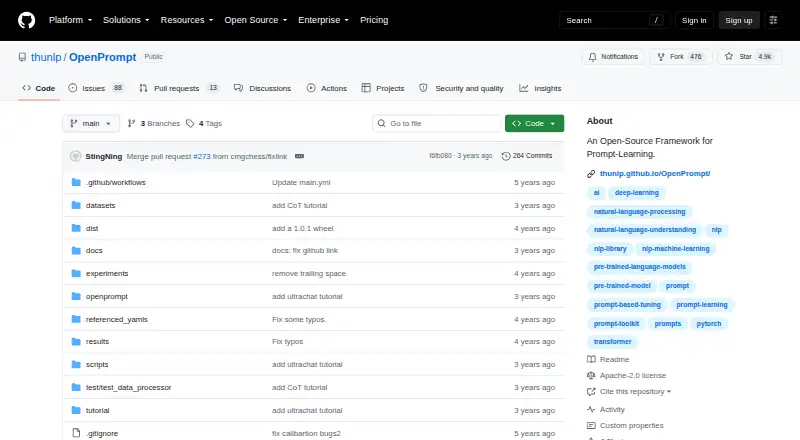
What OpenPrompt is
OpenPrompt is a free, open-source framework for building prompt-learning pipelines for downstream natural language processing tasks. It brings prompt templating, verbalizing, and optimization methods together, and is designed for users who want to develop or experiment with their own prompt-learning approaches. It can load pretrained language models from Hugging Face Transformers. A PromptModel combines a pretrained model with one or more templates and verbalizers for training and inference. Documented data processors cover text classification, entity typing, relation classification, language inference, and conditional generation. Template options include manual, prefix, P-tuning, PTR, and mixed formats. Verbalizer choices include one-to-one, manual, automatic, knowledgeable, PTR, generation, and soft options. The project also provides scripts for downloading benchmark datasets. Installation is available through pip or from the GitHub source. Its listed tested runtime requirements are Python 3.8+ and PyTorch 1.8.1+. OpenPrompt is licensed under Apache-2.0 and supports Linux, macOS, Windows, and self-hosted use. Some documentation may be outdated following major changes to the project.
Who it suits
OpenPrompt suits developers, educators, and science or research users building or studying prompt-learning methods for NLP tasks. It is a fit for people working with pretrained Hugging Face models who want options for templates, verbalizers, and custom methods.
What it does well
- Free framework under the Apache-2.0 license.
- Loads pretrained language models from Hugging Face Transformers.
- Supports five documented NLP task categories.
- Provides multiple template and verbalizer options.
- Includes scripts for downloading benchmark datasets.
What to know first
- The listed tested requirements are Python 3.8+ and PyTorch 1.8.1+.
- Some documentation may be outdated after major project changes.
- No free trial is offered.
Plans
| Plan | Billed and limits | Price |
|---|---|---|
| OpenPrompt | Open-source prompt-learning framework · Python 3.8+ and PyTorch 1.8.1+ listed as tested requirements | Free |
As github.com lists them, read 7 Oct 2026. The maker's own page has the final word.
Getting started
- Use Linux, macOS, Windows, or a self-hosted environment.
- Check that your runtime uses Python 3.8+ and PyTorch 1.8.1+, the listed tested requirements.
- Install with `pip install openprompt` or install from the GitHub source.
- Use the provided scripts to download benchmark datasets if needed.
- Load a pretrained model from Hugging Face Transformers and combine it with templates and verbalizers in a PromptModel.
OpenPrompt is an open-source framework for building prompt-learning pipelines for downstream NLP work. It best suits developers, educators, and researchers who want to develop or compare prompt methods. Its unified set of components is useful for experimentation, though the project warns that some documentation may be outdated after major changes.
Overview
OpenPrompt brings prompt templating, verbalization, and optimization together in a framework built around pretrained language models. A PromptModel combines a model with templates and verbalizers for training and inference, giving practitioners a common structure for trying different prompt designs and creating their own methods.
It loads pretrained models from Hugging Face Transformers and provides scripts to download benchmark datasets. Installation is available through pip install openprompt or from the GitHub source. The project uses the Apache-2.0 license and says it is tested with Python 3.8+ and PyTorch 1.8.1+.
Key features
- Prompt design options: Templates include manual, prefix, P-tuning, PTR, and mixed approaches. Verbalizers include one-to-one, manual, automatic, knowledgeable, PTR, generation, and soft approaches. This range makes OpenPrompt a strong fit for comparing methods or building new ones; it calls for users who want a framework to work in, rather than a finished prompt-authoring app.
- Documented NLP tasks: Data processors cover text classification, entity typing, relation classification, language inference, and conditional generation. That gives researchers several downstream tasks to work with, while keeping the framework focused on NLP.
- Model integration: Hugging Face Transformers support lets users load pretrained language models into their prompt-learning pipelines. The documented requirements—Python 3.8+ and PyTorch 1.8.1+—give development teams a concrete baseline for their environments.
- Room for custom methods: OpenPrompt is designed for users to develop and experiment with their own prompt-learning methods. That flexibility matters in research and method development, but teams seeking a ready-made end-user application should choose a different kind of tool.
Pricing
OpenPrompt is free and open source. Its free plan costs free and includes the prompt-learning framework; there is no free trial because access is already free. The plan is a good fit for individual developers, educators, and research groups who can build around the framework. It does not present a paid tier for users who need a packaged application instead.
Platforms
OpenPrompt supports Linux, macOS, Windows, and self-hosted use. Its Python and PyTorch requirements make it a fit for users comfortable managing a development environment on those platforms.
Who it's for
OpenPrompt is aimed at developers, education, and science or research. It is most appropriate for people building downstream NLP pipelines, studying prompt methods, or prototyping their own approaches. The unified model, template, and verbalizer structure helps when experimentation is the job; readers who want a turnkey prompt writing experience should look elsewhere.
Pros and cons
- Pro: A single framework covers templating, verbalization, and optimization, which helps users explore prompt-learning methods in a consistent setup.
- Pro: Multiple documented task processors, template types, and verbalizer types support varied NLP experiments.
- Pro: Free access and an Apache-2.0 license make it available for development and research without a subscription.
- Con: Some documentation may be outdated after major project changes, which can make setup or implementation decisions less dependable.
- Con: Its focus is building prompt-learning pipelines, so it is not suited to readers looking for a finished prompt generation product.
Alternatives
Choose Vellum if you want a freemium option with a free starting plan and pay-as-you-go credits for early tasks. PromptWizard is another free alternative for readers comparing prompt-focused projects. Agenta may suit teams that want a freemium option with a free Hobby plan covering two team members, 5,000 agent runs per month, 20 evaluations per month, and one-week trace retention. ChainForge is a free, open-source alternative for self-hosted or web use. Google Cloud Agent Evaluation is worth considering for readers seeking a paid, usage-based evaluation service with a free trial. Latitude offers a freemium alternative whose Starter plan includes 20K credits per month, 30-day data retention, unlimited seats, and general-channel Slack support. Prompt Engine may fit users who want a web-based freemium prompt tool with a limited free Hobby plan. PromptEval offers a freemium alternative with a free plan capped at three web evaluations per month and ten API lint runs per month. Browse more options in AI Prompt Generators.
Verdict
Choose OpenPrompt if you need a free framework for developing or studying prompt-learning methods across its documented NLP tasks. Its strongest reason to choose it is the unified set of models, templates, and verbalizers, which supports systematic experimentation. Look elsewhere if you need current, dependable setup guidance or a finished prompt-generation application.
Verdict
Choose OpenPrompt if you need a free framework for prompt-learning research or development across its documented NLP tasks and methods. Look elsewhere if you need documentation that is fully current, since some material may be outdated after major changes.
Questions
How much does OpenPrompt cost?
OpenPrompt is free. Its listed plan is free.
Is there a free trial?
No. OpenPrompt has no free trial; it is offered as a free framework.
Which platforms does it support?
It supports Linux, macOS, Windows, and self-hosted use.
What license does it use?
The repository identifies its license as Apache-2.0.
What runtime requirements are listed?
The project says it is tested on Python 3.8+ and PyTorch 1.8.1+.
Who maintains OpenPrompt?
THUNLP identifies itself as the Natural Language Processing Lab at Tsinghua University in Beijing.
Facts from OpenPrompt's own pages
- Core components
- A PromptModel combines a pretrained language model with one or more templates and verbalizers for training and inference. · github.com, 7 Oct 2026
- Custom research
- The framework is designed to let users develop and experiment with their own prompt-learning methods. · github.com, 7 Oct 2026
- Datasets
- The project provides scripts for downloading benchmark datasets. · github.com, 7 Oct 2026
- Documentation caveat
- The README says some documentation may be outdated following major changes to the project. · github.com, 7 Oct 2026
- Founded
- 2021 · github.com, 28 Sept 2026
- Installation
- The README provides pip installation with `pip install openprompt` and instructions to install from the GitHub source. · github.com, 7 Oct 2026
- Intended users
- The package metadata lists developers, education, and science or research as intended audiences. · github.com, 7 Oct 2026
- License
- The repository identifies its license as Apache-2.0. · github.com, 7 Oct 2026
- Maintainer organization
- THUNLP identifies itself as the Natural Language Processing Lab at Tsinghua University in Beijing. · github.com, 7 Oct 2026
- Model integration
- OpenPrompt supports loading pretrained language models from Hugging Face Transformers. · github.com, 7 Oct 2026
- Prompt methods
- It implements prompting methods for templating, verbalizing, and optimization in a unified framework. · github.com, 7 Oct 2026
- Purpose
- OpenPrompt is an open-source framework for building prompt-learning pipelines for downstream NLP tasks. · github.com, 7 Oct 2026
- Runtime requirements
- The README says the repository is tested on Python 3.8+ and PyTorch 1.8.1+. · github.com, 7 Oct 2026
- Task support
- The documentation lists data processors for text classification, entity typing, relation classification, language inference, and conditional generation. · thunlp.github.io, 7 Oct 2026
- Template options
- The documentation lists manual, prefix, P-tuning, PTR, and mixed templates. · thunlp.github.io, 7 Oct 2026
- Verbalizer options
- The documentation lists one-to-one, manual, automatic, knowledgeable, PTR, generation, and soft verbalizers. · thunlp.github.io, 7 Oct 2026
Where OpenPrompt stands on Freedom251
- AI Prompt Generators#4 of 28