Freedom251 › AI Prompt Generators
Latitude
What Latitude is
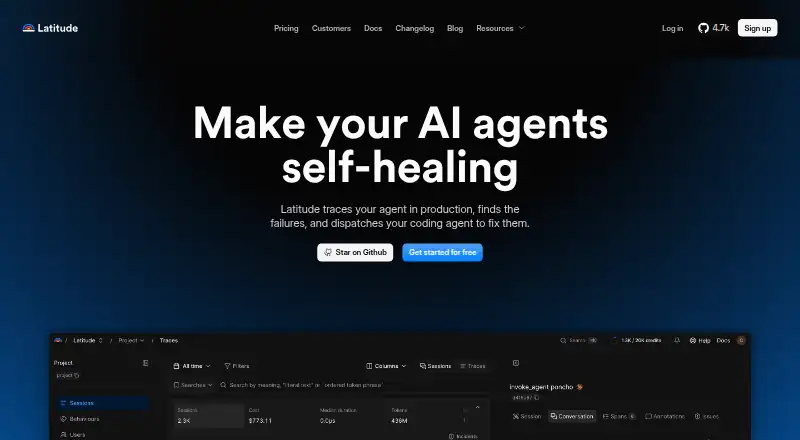
Latitude is an open-source, MIT-licensed platform for monitoring and improving production AI agents. It records agent interactions as spans and organizes related traces into sessions, helping teams inspect multi-turn conversations. Its Observe tools surface model providers and models alongside token use, latency, cost, errors, tool calls, user activity, and agent memory. Semantic search, behavior clustering, and signals help identify repeated failure patterns. Monitors can track signals, saved searches, or raw traffic and send notifications in the app, email, or Slack. Teams can convert failed traces into datasets for local simulation and regression testing, while evaluations can monitor live traffic for regressions. Setup documentation names TypeScript and Python SDKs and recommends an OpenTelemetry exporter for other languages. Latitude is offered as managed cloud or self-hosted software, including Docker Compose and Kubernetes deployments. Starter is free with 20K credits per month and 30-day retention. Pro costs $99.00 per month, with 100K monthly credits, 90-day retention, unlimited seats, and priority support. Latitude says hosted customer data and managed inference are processed in AWS eu-central-1 in Frankfurt.
Who it suits
Latitude suits teams building AI infrastructure or collaborative AI products that need to observe agent traffic and follow recurring failures. Its deployment options also address teams choosing managed cloud or self-hosting.
What it does well
- Groups agent traces into sessions.
- Surfaces cost, latency, errors, and tool calls.
- Alerts can be sent in-app, by email, or Slack.
- Turns failing traces into regression test datasets.
- Starter includes unlimited seats.
What to know first
- Starter retains data for 30 days.
- Pro costs $99.00 per month.
- Other languages are directed to an OpenTelemetry exporter.
Limits
Starter includes 20K credits per month and 30-day data retention. Pro includes 100K credits per month and 90-day retention; extra credits cost $20 per 10K.
Plans
| Plan | Billed and limits | Price |
|---|---|---|
| Starter | 20K credits/month · 30d data retention · unlimited seats · general-channel Slack support | Free |
| Pro | /month · 100K credits/month · 90d data retention · unlimited seats · priority support · extra credits $20 per 10K · SOC2 & ISO27001 reports | $99 a month |
| Enterprise | custom credit volume · custom retention · custom on-premises or cloud deployment · RBAC · team training · SAML SSO · SOC2 & ISO27001 reports · uptime/support SLA · dedicated support | On request |
As latitude.so lists them, read 15 Oct 2026. The maker's own page has the final word.
Getting started
- Open the Latitude website.
- Choose managed cloud or a self-hosted deployment.
- Use the TypeScript or Python SDK, or an OpenTelemetry exporter for another language.
- Connect a coding agent such as Claude Code, Cursor, Codex, OpenCode, or Hermes during setup.
- Choose the free Starter plan or review Pro at $99.00 per month.
Latitude is built for teams running AI agents in production and needing a disciplined way to investigate failures. It suits engineering and AI product groups that want observability tied directly to regression testing and remediation, rather than a standalone prompt editor. The trade-off is that meaningful production scale requires watching credit and retention allowances or moving to a custom deployment.
Overview
Latitude connects live agent traffic to diagnosis, monitoring, and repeatable testing. It captures interactions as traces, organizes multi-turn activity into sessions, and helps teams turn problematic examples into regression cases. Because it is MIT-licensed and offered as managed cloud or self-hosted software, it can fit both hosted workflows and infrastructure teams that need to run the platform themselves.
API access, multiple-model support, prompt testing, and collaboration make Latitude suitable for a shared engineering workflow. Its focus is operational improvement of deployed agents, not simply generating or polishing prompts.
Key features
Tracing and observability
Interactions are recorded as spans and grouped into sessions, giving reviewers a coherent view of multi-turn conversations. Observe surfaces providers, models, token use, latency, cost, errors, tool calls, user activity, and agent memory. That combination supports cost investigations and technical debugging in the same place, although teams interested only in prompt drafting may find the operational scope unnecessary.
Finding recurring failures
Semantic search, behavior clustering, and signals help identify repeated production failure patterns instead of forcing teams to inspect traffic one conversation at a time. Monitors can watch signals, saved searches, or raw traffic and notify users in the app, by email, or through Slack. This is useful for teams that need an alerting loop around agent quality; it also means someone must define useful searches and signals to avoid noisy monitoring.
Regression and remediation workflow
Failing traces can become dataset cases for local simulation and regression testing, while evaluations can watch live traffic for regressions. Latitude also says it can dispatch Claude Code or Cursor with issue context and sample traces to implement a fix and open a pull request. That closes more of the loop than an observability dashboard alone, particularly for teams already using those coding agents.
SDKs, integrations, and data controls
The setup guide names TypeScript and Python SDKs and recommends an OpenTelemetry exporter for other languages. Documented integrations include Slack and GitHub, and setup can connect Claude Code, Cursor, Codex, OpenCode, Hermes, or another coding agent. SDKs redact common security-sensitive attributes by default, with configurable additional patterns. Hosted customer data and Latitude-managed inference are processed in AWS eu-central-1 in Frankfurt. Latitude states it is SOC II certified; its security documentation says ISO 27001 audit work and GDPR readiness review were in progress, with completion expected by the end of May 2026.
Pricing
Starter
Starter is free at $0.00 per month and includes 20K credits per month, 30-day data retention, unlimited seats, and general channel Slack support. It is a sensible entry point for teams establishing AI infrastructure or evaluating the workflow, but the credit allowance and short retention window can constrain sustained production monitoring.
Pro
Pro costs $99.00 per month, billed monthly. It raises the allowance to 100K credits per month, keeps unlimited seats, extends retention to 90 days, and adds priority support. Extra credits cost $20 per 10K. Pro also includes SOC2 and ISO27001 reports, making it the practical tier for collaborative AI product teams that need longer history and faster support without per-seat pricing.
Enterprise
Enterprise uses custom pricing and custom credit volume and retention. It adds a choice of on-premises or cloud deployment, RBAC, team training, SAML SSO, SOC2 and ISO27001 reports, uptime and support SLAs, and dedicated support. High-volume products and organizations with formal access-control or deployment requirements are the clearest fit.
Platforms
Latitude runs as an API, web application, or self-hosted deployment. Managed cloud is available alongside documented single-machine Docker Compose and Kubernetes cluster deployments, giving infrastructure teams a path to operate it within their own environment.
Who it's for
Choose Latitude when your team operates production agents and needs one workflow for tracing, finding repeated failures, alerting, testing fixes, and collaborating on remediation. Starter suits early infrastructure work; Pro is better for active teams that need 90-day history and priority support; Enterprise is aimed at high-volume or tightly governed deployments. It is less appropriate if your requirement is limited to prompt creation without production telemetry.
Pros and cons
- Pros: Joins trace-level observability with semantic failure discovery and regression datasets, so investigations can lead directly to repeatable checks.
- Pros: Unlimited seats on Starter and Pro avoid seat-based expansion costs, while Slack, GitHub, and coding-agent connections support team workflows.
- Pros: MIT licensing, self-hosting, configurable redaction, and EU-based AWS processing provide deployment and data-control options.
- Cons: Starter's 20K credits and 30-day retention may be insufficient for busy production traffic.
- Cons: Extra Pro usage adds $20 per 10K credits, so heavy traffic can raise the monthly bill.
- Cons: The deepest governance and support features require custom-priced Enterprise.
Alternatives
Agenta is a better fit when a smaller free allowance with explicitly capped runs and evaluations is sufficient, or when its open-source option matches your deployment preference. Vellum suits readers seeking a broader multi-platform prompt and AI workflow product with a $30-per-month Mighty plan. Google Cloud Agent Evaluation is the alternative when pay-as-you-go evaluation through Google Cloud is preferable. PromptWizard is a free, self-hosted option for prompt optimization. OpenPrompt is a free open-source prompt-learning framework for Python and PyTorch environments. ChainForge is a free, open-source self-hosted and web alternative. Prompt Engine targets prompt optimization with a free hobby tier and low-cost Pro plan. PromptEval fits teams wanting bounded web evaluations and prompt-linting quotas. For a wider directory of prompt-focused tools, see AI Prompt Generators.
Verdict
Latitude is a strong choice for teams treating agent quality as an ongoing production engineering problem: it links observability, failure pattern discovery, alerts, regression evaluation, and fix handoff in one platform. Start with Starter for a low-risk evaluation, move to Pro when retention and support matter, and look elsewhere if you only need prompt authoring or want predictable high-volume costs without custom planning.
Verdict
Latitude combines agent observability with workflows for investigating and retesting production failures. Its free Starter plan offers a way to begin, while teams needing longer retention or priority support can consider Pro.
Questions
Is Latitude open source?
Yes. Latitude is open-source software licensed under MIT.
Is there a free plan?
Yes. Starter costs nothing and includes 20K credits per month, 30-day data retention, unlimited seats, and general channel Slack support.
What does Pro cost?
Pro costs $99.00 per month, billed monthly. It includes 100K credits per month, 90-day retention, unlimited seats, and priority support.
Can Latitude be self-hosted?
Yes. Latitude offers self-hosted software, with documented single-machine Docker Compose and Kubernetes cluster deployments.
Which languages have telemetry SDKs?
The setup guide names TypeScript and Python SDKs and recommends an OpenTelemetry exporter for other languages.
Where is hosted data processed?
Latitude says hosted customer data and Latitude-managed inference are stored and processed in AWS eu-central-1 in Frankfurt, Germany.
Facts from Latitude's own pages
- Agent dispatch
- When a signal appears or escalates, Latitude can send context and sample traces to Claude Code or Cursor and open a pull request. · latitude.so, 15 Oct 2026
- API and extensibility
- Latitude exposes an API, CLI, MCP server, SDKs, webhooks, and coding-agent skills for programmatic control. · docs.latitude.so, 15 Oct 2026
- Company profile
- LinkedIn lists Latitude as a privately held software-development company founded in 2022, headquartered in San Francisco, with 2–10 employees and an additional Barcelona location. · linkedin.com, 15 Oct 2026
- Compliance
- Latitude's security documentation states it is SOC II certified and says ISO 27001 audit work and GDPR readiness review were in progress, with completion expected by the end of May 2026. · docs.latitude.so, 3 Oct 2026
- Data minimization
- Latitude says its SDKs redact common security-sensitive attributes by default and customers can configure additional redaction patterns. · docs.latitude.so, 3 Oct 2026
- Datasets and regression
- Failing traces can become datasets for local simulation and regression testing before deployment. · docs.latitude.so, 15 Oct 2026
- Deployment
- Latitude is available as managed cloud or self-hosted software, with documented single-machine Docker Compose and Kubernetes cluster deployments. · docs.latitude.so, 3 Oct 2026
- Documentation depth
- The documentation covers tracing, providers, frameworks, agent harnesses, observability, signals, experiments, monitors, datasets, security, deployment, API, MCP, CLI, integrations, and development. · docs.latitude.so, 15 Oct 2026
- Experiments
- Experiments compare traffic slices to measure differences between releases, models, or user cohorts. · docs.latitude.so, 15 Oct 2026
- Failure clustering
- Latitude groups similar failing traces into signals with examples, trends, affected users, and lifecycle states. · docs.latitude.so, 15 Oct 2026
- Failure discovery
- Semantic search, behavior clustering, and signals help teams find and track recurring production failure patterns. · docs.latitude.so, 3 Oct 2026
- Human annotations
- Users can annotate traces, spans, and outputs, with annotations feeding structured signals and evaluations. · latitude.so, 15 Oct 2026
- Integrations
- Documented integrations include OpenAI, Anthropic, Amazon Bedrock, Vercel AI SDK, LangChain, Claude Code, Slack, GitHub, Linear, webhooks, and OpenTelemetry. · github.com, 15 Oct 2026
- Legal entity
- The terms identify the provider as LATITUDE DATA, S.L., incorporated in Spain with Tax ID B09930660 and a Barcelona registered address. · latitude.so, 15 Oct 2026
- License
- Latitude is fully open source under the permissive MIT license. · github.com, 15 Oct 2026
- Limit: ecosystem maturity
- MakerStack describes Latitude’s community as younger and smaller than Langfuse’s, with fewer integrations and tutorials. · makerstack.co, 15 Oct 2026
- Limit: traffic and telemetry
- DiscoverAI cautions that useful signals need representative production traffic, sensitive telemetry requires redaction and retention controls, and automated clustering needs human calibration. · discoverai.tools, 15 Oct 2026
- Limit: usage costs
- MakerStack says credit-based Pro metering and the $20 charge per additional 10K credits can become expensive for high-traffic agents. · makerstack.co, 15 Oct 2026
- MCP
- Its MCP server lets coding agents inspect and manage Latitude workspaces, projects, traces, annotations, and datasets. · github.com, 15 Oct 2026
- Monitoring
- Monitors can watch signals, saved searches, or raw traffic and notify users in-app, by email, or in Slack. · docs.latitude.so, 3 Oct 2026
- Monitors and alerts
- Monitors watch signals, searches, or raw traffic and notify in the app, by email, or through Slack. · docs.latitude.so, 15 Oct 2026
- Notable release
- The changelog records Agent Score launching on September 23, 2026 as a 0–100 score based on five dimensions and evidence thresholds. · latitude.so, 15 Oct 2026
- Observability
- It records traces and spans for LLM calls, tool calls, retrieval, tokens, cost, latency, and errors, grouping related traces into sessions. · docs.latitude.so, 15 Oct 2026
- Praise: agent-focused tracing
- Independent reviewers repeatedly praise multi-turn session traces that include tool calls and complete execution paths. · makerstack.co, 15 Oct 2026
Where Latitude stands on Freedom251
- AI Prompt Generators#2 of 28