Freedom251 › AI Prompt Generators
PromptWizard
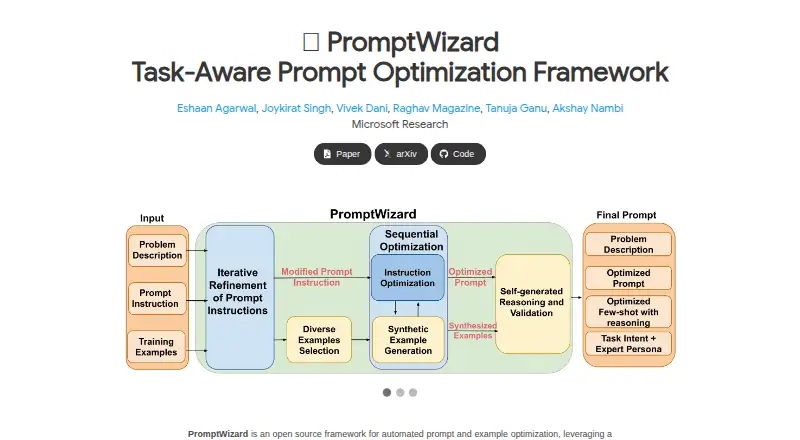
What PromptWizard is
PromptWizard is a free, MIT-licensed open-source framework for automated prompt and example optimization. It iteratively generates prompt variations, scores and critiques them, then refines the instructions. It can also optimize in-context examples and synthesize task-relevant ones. The README describes workflows with no examples, synthetic examples, or training data, including custom datasets. Listed supported datasets include GSM8k, SVAMP, AQUARAT, and Instruction Induction (BBII). Custom datasets use JSONL samples with question and answer fields and need dataset-specific answer extraction, evaluation functions, configuration, and data files. PromptWizard can generate chain-of-thought reasoning for examples, with an option to disable it to reduce prompt size. Installation is through its GitHub repository as a Python package in development mode, with instructions for Windows, macOS, and Linux. Model access setup supports OpenAI API keys and Azure OpenAI endpoints, so credentials are needed to use those services. The README reports average optimization times of around 20–30 minutes in experiments on the listed datasets, with timing dependent on the dataset. It also notes that human supervision can help tune generated prompts.
Who it suits
It suits developers and researchers optimizing prompts and examples with supported or custom datasets. Users should be comfortable setting up a Python package and supplying model API credentials.
What it does well
- Free, MIT-licensed open-source framework.
- Can refine prompts and optimize in-context examples.
- Supports Windows, macOS, and Linux installation.
- Custom datasets can be supplied in JSONL format.
What to know first
- Model access requires OpenAI or Azure OpenAI credentials.
- Custom datasets need task-specific extraction and evaluation functions.
- Generated prompts may benefit from human supervision.
Limits
The free plan is the MIT-licensed open-source software; model API access requires OpenAI or Azure OpenAI credentials. Custom datasets require task-specific answer extraction, evaluation functions, configuration, and data files.
Plans
| Plan | Billed and limits | Price |
|---|---|---|
| MIT-licensed open-source software | No paid plans listed; API access requires OpenAI or Azure OpenAI credentials | Free |
As microsoft.github.io lists them, read 3 Oct 2026. The maker's own page has the final word.
Getting started
- Open the PromptWizard project website and its linked GitHub repository.
- Create a Python virtual environment on Windows, macOS, or Linux.
- Install the package from the repository in development mode.
- Configure an OpenAI API key or Azure OpenAI endpoint for model access.
- Choose a listed dataset or prepare custom JSONL samples with question and answer fields.
- For custom data, provide the task-specific extraction, evaluation, configuration, and data files.
PromptWizard is a Python framework for developers and researchers who want to improve prompts against a specific task. Its iterative approach is most compelling when you can provide evaluation data and logic; those seeking a hosted prompt editor should look elsewhere. The bottom line: it offers a free, flexible way to refine prompts and examples, but requires technical setup and model credentials.
Overview
PromptWizard repeatedly produces prompt variations, scores them, critiques what works and what does not, then refines the instructions. It can also optimize in-context examples or synthesize task-relevant ones, making it more useful for structured experimentation than for simply drafting a prompt once.
Workflows can start without examples, use synthetic examples, or draw on training data. The framework can generate chain-of-thought reasoning for examples, with a setting to disable it when shorter prompts or lower token counts matter. Generated prompts may be detailed, so human review is a practical part of adapting them to a task.
Key features
Feedback-driven refinement
Generation, scoring, critique, and revision are combined in an automated loop, and prompt testing is supported. This gives technically equipped users a repeatable way to optimize against a task rather than rely only on wording intuition. It is not a turnkey editor: users still need to connect an LLM and judge whether the result suits their application.
Dataset-based optimization
Supported datasets include GSM8k, SVAMP, AQUARAT, and Instruction Induction (BBII). Custom datasets use JSONL samples with question and answer fields, but also require task-specific answer extraction and evaluation functions, configuration, and data files. That flexibility is valuable for a team's own tasks, though it shifts meaningful setup work to the user.
In experiments on the named datasets, optimization took around 20–30 minutes on average, with the actual time depending on the dataset. Teams should account for that iteration time rather than expect instantaneous prompt suggestions.
Model access and installation
Setup supports OpenAI API keys and Azure OpenAI endpoints. The project is installed from its GitHub repository as a Python package in development mode, with instructions for Windows, macOS, and Linux. That suits developers comfortable with Python environments; it is a barrier for users who want to start in a browser without configuring software or credentials.
Pricing
PromptWizard is MIT-licensed open-source software priced at $0. There are no paid plans listed. The software itself is free, but model access requires OpenAI or Azure OpenAI credentials, so users need to account for their chosen model access separately.
Platforms
PromptWizard supports API use and installation on Linux, macOS, and Windows, and can be self-hosted. The documented setup is Python-based; it is not presented as a hosted web app.
Who it's for
PromptWizard is best for developers and researchers who can work with Python, have access to a supported model API, and want to optimize prompts against datasets. It is a weaker fit for people who want a polished interface, a prompt library, or results without writing task-specific evaluation code.
Pros and cons
- Pro: Optimizes examples as well as prompt instructions, including synthetic examples, for tasks where demonstrations matter.
- Pro: Supports several established datasets and custom JSONL data, giving users room to work with task-specific material.
- Pro: MIT licensing and free software make it accessible to teams prepared to manage their own setup.
- Con: Custom data requires task-specific extraction and evaluation functions, configuration, and data files.
- Con: Users must install the package and provide model API credentials; this is less convenient than a hosted editor.
- Con: Generated prompts can be detailed and benefit from human supervision, so automation does not eliminate review.
Alternatives
AI Prompt Generators is a broader category to explore if you are comparing prompt-generation tools rather than looking specifically for a dataset-driven optimization framework.
Choose Vellum if you want a freemium option with a wider range of platforms, including web, mobile, and browser extension, and a free tier that includes initial tasks with pay-as-you-go credits.
Agenta may suit teams seeking a freemium, API or self-hosted evaluation tool; its Hobby plan includes two team members, 5,000 agent runs per month, 20 evaluations per month, and one-week trace retention.
Consider Google Cloud Agent Evaluation if you prefer usage-based evaluation through an API or web platform; its computation-based metrics are priced by input and output characters, while model-based metrics are charged separately.
Latitude is an option for readers who want a freemium API, self-hosted, or web platform, with a Starter plan offering 20K credits per month, 30-day data retention, and unlimited seats.
MLflow Prompt Optimization is another open-source choice for API or self-hosted use; its Apache 2.0 project can be self-hosted or managed through cloud providers, with optimization costs depending on the reflection model.
Prompt Engine may be a better fit if you want a web-based freemium tool: its Hobby tier is free forever and includes up to 10 prompts, basic AI optimization, and 25 optimization credits.
Choose PromptEval if you need a freemium API or web evaluation tool, with a free tier capped at three web evaluations and 10 API lint checks per month.
PromptForge is another freemium API and web option; its free tier allows one user, three projects, 200 test runs per month, and 1 GB of storage.
Verdict
Choose PromptWizard if you can set up Python, connect a model API, and want to refine prompts and examples against task data without paying for the software. Its strength is the feedback loop and dataset flexibility; look elsewhere if your priority is a hosted interface or avoiding the evaluation and setup work that makes those iterations useful.
Verdict
PromptWizard provides an iterative framework for optimizing prompts and examples, including support for custom datasets. It is free software, but model access requires credentials and custom data takes task-specific setup.
Questions
Is PromptWizard free?
Yes. The listed MIT-licensed open-source plan costs nothing.
What platforms does it support?
The listed platforms are API, Linux, macOS, self-hosted, and Windows. Installation instructions cover virtual environments on Windows, macOS, and Linux.
Which model APIs can I configure?
Setup supports OpenAI API keys and Azure OpenAI endpoints. Credentials for model access are required.
Can I use my own dataset?
Yes. Custom datasets are expected as JSONL samples with question and answer fields. They also require task-specific extraction and evaluation functions, configuration, and data files.
Is PromptWizard open source?
Yes. The project identifies its license as MIT.
Facts from PromptWizard's own pages
- Custom data requirements
- Custom datasets are expected in JSONL format with question and answer fields for each sample. · github.com, 3 Oct 2026
- Customization
- Custom datasets require dataset-specific answer extraction and evaluation functions, along with configuration and data files. · github.com, 2 Oct 2026
- Dataset format
- Custom datasets are expected as JSONL files with question and answer fields in each sample. · github.com, 2 Oct 2026
- Dataset support
- The README lists GSM8k, SVAMP, AQUARAT, and Instruction Induction (BBII) as supported training datasets. · github.com, 3 Oct 2026
- Example optimization
- It optimizes prompt instructions and few-shot examples together, including by synthesizing diverse, task-relevant examples. · github.com, 3 Oct 2026
- Founded
- 1975 · microsoft.github.io, 28 Sept 2026
- Headquarters
- Redmond, Washington, USA · microsoft.github.io, 28 Sept 2026
- Human review
- The README says generated prompts are usually detailed and that user supervision can help tune them for the task. · github.com, 2 Oct 2026
- Human supervision
- The README says generated prompts are usually detailed and that user supervision can help tune them further for a task. · github.com, 3 Oct 2026
- Installation
- The project is installed from its GitHub repository as a Python package in development mode, with setup instructions for Windows, macOS, and Linux. · github.com, 2 Oct 2026
- Installation platforms
- Installation instructions cover virtual environments on Windows, macOS, and Linux and package installation in development mode. · github.com, 3 Oct 2026
- License
- The repository includes an MIT License granting permission to use, copy, modify, distribute, sublicense, and sell copies subject to its terms. · github.com, 3 Oct 2026
- Maker
- The project page names Microsoft Research and lists Eshaan Agarwal, Joykirat Singh, Vivek Dani, Raghav Magazine, Tanuja Ganu, and Akshay Nambi as authors. · microsoft.github.io, 2 Oct 2026
- Model API integrations
- The README says the code requires LLM access through API calls and supports Azure endpoints or OpenAI keys. · github.com, 3 Oct 2026
- Optimization time
- The README reports that optimization took around 20–30 minutes on average in experiments on the listed datasets. · github.com, 3 Oct 2026
- Product
- PromptWizard is an open source framework for automated prompt and example optimization using a feedback-driven critique and synthesis process. · microsoft.github.io, 2 Oct 2026
- Prompt optimization
- It iteratively generates, scores, critiques, and refines prompt instructions. · github.com, 2 Oct 2026
- Prompt refinement
- It generates prompt variations, scores them, critiques their successes and failures, and refines prompts over iterations. · github.com, 3 Oct 2026
- Purpose
- PromptWizard is an open-source framework for automated, task-aware prompt and example optimization. · microsoft.github.io, 3 Oct 2026
- Reasoning
- It can generate chain-of-thought reasoning for in-context examples, and this option can be disabled to reduce prompt length or token count. · github.com, 2 Oct 2026
- Reasoning chains
- It can generate chain-of-thought reasoning for in-context examples, and its configuration can turn reasoning generation off to reduce prompt size. · github.com, 3 Oct 2026
- Security
- The repository links a security policy, but the pages opened do not state specific security controls or compliance certifications. · github.com, 2 Oct 2026
- Security reporting
- The repository security policy asks people to report vulnerabilities to the Microsoft Security Response Center rather than through public GitHub issues. · github.com, 3 Oct 2026
- Supported datasets
- The README lists GSM8k, SVAMP, AQUARAT, and Instruction Induction (BBII) as supported datasets. · github.com, 2 Oct 2026
Where PromptWizard stands on Freedom251
- AI Prompt Generators#11 of 28