Freedom251 › AI Prompt Generators
GEPAzilla
What GEPAzilla is
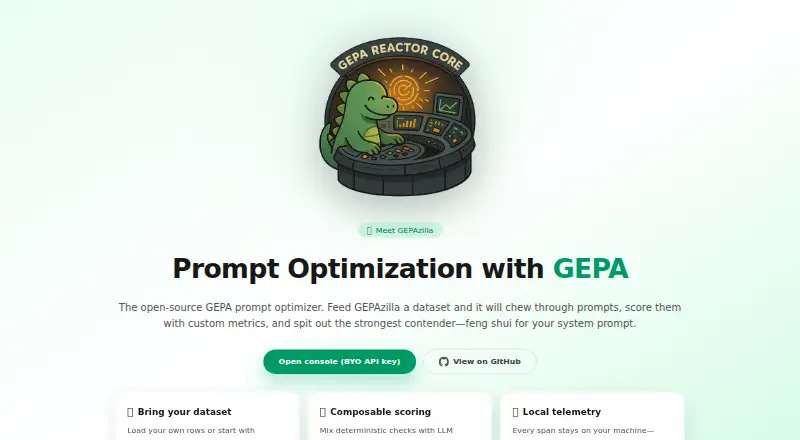
GEPAzilla is an open-source tool for iterating on system prompts using datasets and scorers. You can load your own dataset or start with the included sample, then combine deterministic checks with LLM judges and configure scorer weights and duplicates. Validation rows are kept out of reflection and used to rank candidate prompts on the Pareto frontier. Results include candidate prompts, iteration trends, scorer failure rates, averages, and common notes. GEPAzilla also optimizes request latency, which always appears as a metric in the Results tab. The maker says run telemetry stays on your machine, including tokens, routing, costs, and errors; events are not sent to a remote service and run data is not exfiltrated. GEPA runs, scorer previews, and model discovery require an AI Gateway API key, with the README specifying Vercel AI Gateway. Dataset tools currently support JSON payloads copied or pasted from the clipboard. The project is a standard Next.js application that can be built and started with pnpm, and is available for web, API, or self-hosted use. It is released under the MIT License.
Who it suits
GEPAzilla suits curious builders who want to experiment with prompt optimization using their own API key. It may also fit users who need to compare prompt candidates against datasets and scorers.
What it does well
- Combines deterministic checks with LLM judges.
- Validation rows rank candidates without entering reflection.
- Results include scorer diagnostics and iteration trends.
- Run telemetry stays on the user's machine.
- Released under the MIT License.
What to know first
- GEPA features require a Vercel AI Gateway API key.
- Dataset tools accept JSON payloads copied or pasted from the clipboard.
Limits
GEPA runs, scorer previews, and model discovery require an AI Gateway API key. Dataset tools currently support JSON payloads copied or pasted from the clipboard.
Getting started
- Open the GEPAzilla website
- Choose the web app, API, or self-hosted option
- For self-hosting, build and start the Next.js application with pnpm
- Provide a Vercel AI Gateway API key
- Load the included sample dataset or paste your own JSON dataset
- Configure scorer weights and duplicates, then run prompt optimization
Verdict
GEPAzilla offers prompt optimization with validation ranking, diagnostics, and latency metrics. Users need an AI Gateway key, and dataset import is currently limited to clipboard JSON.
Questions
Is GEPAzilla free?
Yes. GEPAzilla is free and open source under the MIT License.
Which platforms does GEPAzilla support?
It is available as a web application, API, or self-hosted project.
What key is required to run GEPAzilla?
The project requires an AI Gateway API key for GEPA runs, scorer previews, and model discovery. Its README specifies Vercel AI Gateway.
Can I use my own dataset?
Yes. You can load your own dataset or use the included sample. Current dataset tools accept JSON copied or pasted from the clipboard.
Where does run telemetry go?
The maker says telemetry stays on your machine, including tokens, routing, costs, and errors. Telemetry events are not sent to a remote service, and run data is not exfiltrated.
What does GEPAzilla show after optimization?
Results include candidate prompts, iteration trends, scorer failure rates, averages, common notes, and a latency metric.
Facts from GEPAzilla's own pages
- API key requirement
- The project README says an AI Gateway API key is required for GEPA runs, scorer previews, and model discovery. · github.com, 10 Oct 2026
- Built-in latency metric
- GEPA optimizes request latency internally, and the Results tab always includes a latency metric. · gepazilla.com, 10 Oct 2026
- Data handling
- The README says telemetry stays in the browser, telemetry events are not sent to a remote service, and run data is not exfiltrated. · github.com, 10 Oct 2026
- Data import limit
- Dataset tools currently support copying or pasting JSON payloads from the clipboard. · github.com, 4 Oct 2026
- Dataset format limit
- Dataset tools currently support copying or pasting JSON payloads from the clipboard. · github.com, 10 Oct 2026
- Dataset input
- Users can load their own rows or start with the sample dataset. · gepazilla.com, 10 Oct 2026
- Deployment
- The README describes the application as a standard Next.js project that can be built and started locally. · github.com, 10 Oct 2026
- Diagnostics
- Results include scorer failure rates, averages, and common notes, alongside candidate prompts and iteration trends. · github.com, 4 Oct 2026
- Gateway integration
- The README specifies a Vercel AI Gateway credential for the required API key. · github.com, 10 Oct 2026
- Intended users
- The maker describes the console as a way for curious builders to experiment with prompt optimization using their own API key. · github.com, 4 Oct 2026
- License
- The repository states that GEPAzilla is released under the MIT License. · github.com, 10 Oct 2026
- Model access
- The project requires users to supply an AI Gateway API key for GEPA runs, scorer previews, and model discovery; its README specifies Vercel AI Gateway. · github.com, 4 Oct 2026
- Purpose
- GEPAzilla is an open-source GEPA prompt optimizer that uses datasets and custom metrics to find stronger prompts. · gepazilla.com, 10 Oct 2026
- Scoring
- It supports combining deterministic checks with LLM judges and weighting or duplicating scorers. · gepazilla.com, 10 Oct 2026
- Telemetry
- The maker says telemetry stays local and includes tokens, routing, costs, and errors for inspection. · gepazilla.com, 10 Oct 2026
- Validation
- Validation rows are kept out of reflection and used to rank candidate prompts on the Pareto frontier. · gepazilla.com, 4 Oct 2026
- Validation data
- Validation rows are kept untouched during reflection and used to rank candidates on the Pareto frontier. · gepazilla.com, 10 Oct 2026
Where GEPAzilla stands on Freedom251
- AI Prompt Generators#8 of 28