Freedom251 › LLM Application Development Frameworks
DSPy
What DSPy is
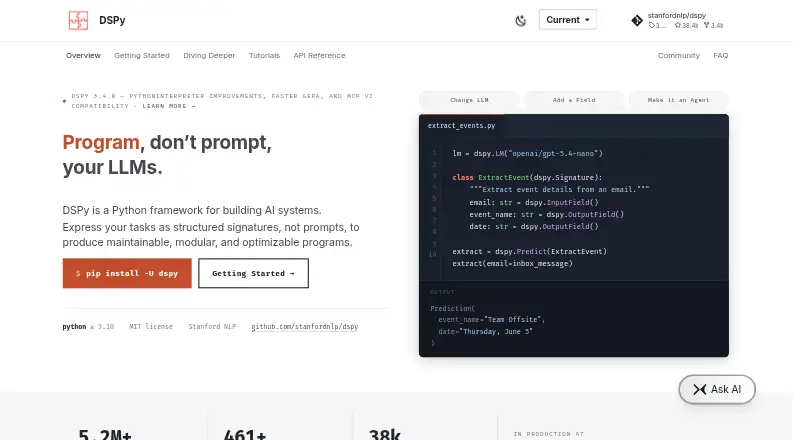
DSPy is a free, MIT-licensed Python framework for building AI programs, including agent, extraction, and multimodal tasks. It lets developers describe a task using a signature that sets typed inputs and outputs, then compose modules into a program rather than managing prompts directly. Modules support execution approaches such as step-by-step reasoning, tool use, and ensembles. DSPy optimizers tune program prompts using examples, a metric, and a scoring function.
For model access, DSPy uses LiteLLM and accepts its model strings; named provider options include OpenAI, Anthropic, Google, and OpenRouter. Agent workflows can use `dspy.ReAct`, `dspy.Tool`, or `dspy.ToolCalls`, and remote MCP tools can connect through the tool interface. Images can be signature fields for multimodal work. Community integrations include Weaviate, Qdrant, LangChain, Langfuse, and Weights & Biases Weave. DSPy runs in Python 3.10+ and is installed with pip or uv. Its documentation describes serving programs as REST APIs with FastAPI and deploying with FastAPI or MLflow. The project began at Stanford NLP and has been built in the open since December 2022.
Who it suits
DSPy suits Python developers building AI systems who want to define tasks through typed signatures and assemble reusable programs. It is relevant to agent, extraction, and multimodal work, especially when developers want to optimize prompts against examples and a scoring metric.
What it does well
- Free and MIT licensed.
- Typed signatures define task inputs and outputs.
- Optimizers tune prompts using examples and scoring metrics.
- Supports agent tools and remote MCP tools.
- Offers multiple model-provider options through LiteLLM.
- Can be served as a REST API with FastAPI.
What to know first
- Requires a Python 3.10+ environment.
- Community-maintained language ports lack official team support.
- Feature availability and API compatibility can vary for those ports.
Getting started
- Visit https://dspy.ai/ for the project and documentation.
- Use a Python 3.10+ environment.
- Install with `pip install dspy` or `uv add dspy`.
- Choose a model provider through LiteLLM, such as OpenAI, Anthropic, Google, or OpenRouter.
- Define a task signature and compose a DSPy program.
- Use FastAPI or MLflow for deployment, as described in the documentation.
Verdict
Choose DSPy if you are building AI programs in Python and want task signatures, composable modules, and prompt optimization. Its free, open-source model and support for agents and multimodal tasks make it a fit for development across several use cases. Look elsewhere if you need an officially supported language port outside its Python environment.
Questions
Is DSPy free?
Yes. DSPy is listed as free and open source, with an MIT license.
Which platforms does DSPy support?
It is available for API and self-hosted use.
Which Python versions can run DSPy?
DSPy works in Python 3.10+ environments.
Which model providers can DSPy connect to?
DSPy uses LiteLLM to normalize providers. Named options include OpenAI, Anthropic, Google, and OpenRouter.
Can DSPy build agents or multimodal programs?
Yes. Agent workflows can use `dspy.ReAct`, `dspy.Tool`, and `dspy.ToolCalls`; images can be signature fields for multimodal tasks.
Who maintains community language ports?
Some ports are community-maintained rather than officially supported by the DSPy team; their feature availability and API compatibility may vary.
Facts from DSPy's own pages
- Agent tools
- DSPy supports tool-using agents through `dspy.ReAct` and manual tool handling with `dspy.Tool` and `dspy.ToolCalls`. · dspy.ai, 8 Oct 2026
- API serving
- The deployment guide shows serving a DSPy program as a REST API with FastAPI. · dspy.ai, 9 Oct 2026
- Community integrations
- The community page lists integrations and providers including Weaviate, Qdrant, LangChain, Langfuse, and Weights & Biases Weave. · dspy.ai, 8 Oct 2026
- Community project limits
- The site says community-maintained language ports are not officially supported by the DSPy team and their feature availability and API compatibility may vary. · dspy.ai, 8 Oct 2026
- Community support
- The overview links to DSPy documentation, GitHub, and Discord community resources. · dspy.ai, 9 Oct 2026
- Deployment
- The documentation describes deploying DSPy programs with FastAPI or MLflow. · dspy.ai, 9 Oct 2026
- Founded
- 2022 · dspy.ai, 28 Sept 2026
- Install
- DSPy can be installed with `pip install dspy` or `uv add dspy` and works in Python 3.10+ environments. · dspy.ai, 8 Oct 2026
- Installation
- DSPy can be installed with pip or uv and works in Python 3.10+ environments. · dspy.ai, 9 Oct 2026
- Integrations
- DSPy uses LiteLLM to normalize inference providers and says it can connect to nearly any model and provider supported by LiteLLM. · dspy.ai, 8 Oct 2026
- License
- The project is listed as MIT licensed. · dspy.ai, 9 Oct 2026
- Model integrations
- DSPy uses LiteLLM to normalize inference providers and accepts LiteLLM model strings, including options from Anthropic, Google, and OpenRouter. · dspy.ai, 9 Oct 2026
- Modules
- DSPy modules provide different execution strategies, including reasoning, ensembles, tools, and REPL use. · dspy.ai, 9 Oct 2026
- Multimodal
- The overview describes images as a Signature field type for multimodal tasks. · dspy.ai, 8 Oct 2026
- Optimization
- DSPy optimizers compile programs against a metric using examples and a scoring function. · dspy.ai, 9 Oct 2026
- Origin
- DSPy says it started at Stanford NLP and was built in the open beginning in December 2022. · dspy.ai, 8 Oct 2026
- Project origin
- DSPy says it started at Stanford NLP and describes itself as built in the open since December 2022. · dspy.ai, 9 Oct 2026
- Provider examples
- The setup guide names OpenAI, Anthropic, Google, and OpenRouter as provider options. · dspy.ai, 8 Oct 2026
- Signatures
- Signatures define tasks as typed inputs and outputs. · dspy.ai, 9 Oct 2026
- Support
- The site links to a DSPy Discord community and GitHub repository. · dspy.ai, 8 Oct 2026
- Tool integrations
- DSPy can bridge remote MCP tools into its tool interface. · dspy.ai, 9 Oct 2026
- What it does
- DSPy is a Python framework for building AI systems by expressing tasks as structured signatures instead of prompts. · dspy.ai, 9 Oct 2026
- Who it is for
- The overview presents DSPy for building AI programs and systems, including agent, extraction, and multimodal tasks. · dspy.ai, 9 Oct 2026
Where DSPy stands on Freedom251
- LLM Application Development Frameworks#9 of 49
- AI Prompt Generators#12 of 28
- Llm Developer Tools#14 of 26
- AI Orchestration Software#13 of 20
- Prompt Engineering Tools#19 of 25