Freedom251 › LLM Application Development Frameworks
txtai
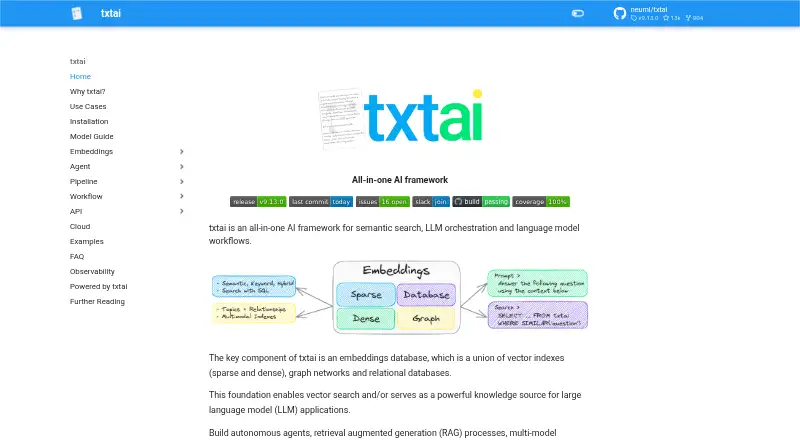
What txtai is
txtai is a free, open-source framework for semantic search, LLM orchestration, and language model workflows. Its embeddings database brings together sparse and dense vector indexes, graph networks, and relational databases, with vector search, SQL, object storage, topic modeling, graph analysis, and multimodal indexing. It can create embeddings from text, documents, audio, images, and video. Language model pipelines handle tasks such as question answering, labeling, transcription, translation, and summarization; workflows combine pipelines with business logic, while agents connect workflows, embeddings, and other agents to work autonomously. The framework provides Web and Model Context Protocol APIs, plus bindings for JavaScript, Java, Rust, and Go. It can run locally, on servers, clusters, or in serverless environments. Installation is documented through pip or Docker, and Python 3.11 or later is supported. txtai is licensed under Apache 2.0. Its API is open over HTTP by default; HTTPS and token authorization are documented options, and safeopen is enabled by default for API and application runs.
Who it suits
txtai suits developers building semantic search, language model workflows, or multimodal indexing. It may fit teams that want local operation or deployment across server and serverless environments.
What it does well
- Free under the Apache 2.0 license
- Embeddings cover text, documents, audio, images, and video
- Offers Web and Model Context Protocol APIs
- Supports local and serverless deployment
- safeopen enabled by default for API and application runs
What to know first
- Requires Python 3.11 or later
- API is open over HTTP by default
Plans
| Plan | Billed and limits | Price |
|---|---|---|
| txtai | Open-source under Apache 2.0 · Install via pip or run with Docker | Free |
As neuml.github.io lists them, read 5 Oct 2026. The maker's own page has the final word.
Getting started
- Open the txtai website and review the installation guide
- Prepare an environment with Python 3.11 or later
- Install through pip and PyPI, or use a Docker image for CPU or GPU
- Choose local, server, cluster, or supported serverless deployment
- Configure HTTPS and API-token authorization if needed
txtai is a free, open-source framework for developers building search and language-model applications. It is strongest when a project needs retrieval, pipelines and automation under one roof; teams seeking a ready-made hosted app may prefer a more managed product.
Overview
txtai combines sparse and dense vector indexes with graph networks and relational databases. Alongside vector search, it supports SQL, object storage, topic modeling, graph analysis and multimodal indexing. That breadth is useful when an application must connect different kinds of data and retrieval, but it also means teams will be building and operating a framework rather than adopting a finished end-user tool.
It can create embeddings for text, documents, audio, images and video. Local operation can avoid sending data to separate remote services, a meaningful option for teams with data-control needs. The framework can run locally or on a server, cluster or serverless platform; this flexibility puts deployment choices—and the work of configuring them—in the team's hands.
Key features
Search and pipelines
Hybrid search and result reranking complement txtai's vector, graph and relational capabilities. Language-model pipelines cover prompting, question answering, labeling, transcription, translation and summarization. This makes txtai a good fit for developers who want to compose retrieval and language tasks in one system, rather than assemble separate tools for each stage.
Workflows, agents and integrations
Workflows combine pipelines with business logic, while agents can connect embeddings, pipelines, workflows and other agents to address problems autonomously. Integrations include Hugging Face and llama.cpp models, as well as OpenAI, Claude and AWS Bedrock through LiteLLM. The Web and Model Context Protocol APIs, plus JavaScript, Java, Rust and Go bindings, offer ways to connect applications beyond Python, although installation and runtime still require Python 3.11 or later.
Deployment and security
Installation is through pip and PyPI, with Docker images for CPU and GPU use and environment-specific prerequisites for Linux, macOS and Windows. Documented serverless options include AWS Lambda, Google Cloud Functions, Azure Cloud Functions and Kubernetes with Knative. The API is open over HTTP by default, so deployments that need transport protection or access control should configure HTTPS and API-token authorization. The safeopen option is enabled by default for API and application runs, restricting local files to a configured directory and URLs to public addresses.
Pricing
txtai — free. The free plan is open source under Apache 2.0 and can be installed with pip or run with Docker. There are no published seat or usage caps in this plan. The cost advantage comes with the responsibility to install and operate the software yourself. txtai.cloud is a planned hosted offering, and implementation guidance, development support and AI consulting are offered by NeuML; custom pricing applies where no price is published.
Platforms
txtai supports API, Linux, macOS, Windows and self-hosted use. It can run locally, on a server or cluster, and in documented serverless environments. Local operation can keep data from being sent to separate remote services, but teams remain responsible for deployment and API configuration.
Who it's for
txtai suits developers and technical teams building semantic search, retrieval-augmented generation, language-model workflows or agents who want an open-source framework they can run on their own infrastructure. Its multimodal indexing and broad deployment options add room to shape a system around varied data and environments. It is a weaker fit for readers who want a turnkey hosted service, or who cannot take on Python-based installation and API security setup.
Pros and cons
- Broad retrieval in one framework: sparse and dense indexes, graph networks, relational data and SQL support can serve applications that need more than vector search alone.
- Wide task and media coverage: pipelines span common language tasks, and embeddings can be created for text, documents, audio, images and video.
- Deployment flexibility: local, server, cluster and serverless options let teams choose where workloads run.
- Technical setup is part of the deal: pip or Docker installation and Python 3.11+ make it a developer-oriented choice, not a no-setup app.
- Security needs attention: the API defaults to open HTTP, so teams should configure HTTPS and token authorization where needed.
Alternatives
For a broader directory of options, see Retrieval-Augmented Generation Tools.
- AnythingLLM is worth considering if you want Android or web access alongside self-hosted and API platforms; it also has a free self-hosted Docker option.
- Flowise may suit teams looking for a freemium visual workflow option with a stated free allowance of 2 Flows & Assistants, 100 Predictions / month and 5MB Storage.
- I3K RAG Enterprise is an alternative for teams seeking a self-hosted community edition under AGPL-3.0, with Linux x86_64, ARM64 or Windows support.
- RAGFlow offers a free plan with 5 apps, 1 team member, 0.1 GB dataset storage and 500 credits / month; its free plan does not include an API key.
- Dify is another option with a free Sandbox plan, including 200 message credits, one workspace, one member and five apps.
- Haystack Enterprise Platform may fit teams seeking a free Studio tier with one workspace, one user, 100 pipeline hours and cloud deployment.
- LlamaIndex is an alternative with a freemium offering; LlamaParse is described as commercial, while LlamaIndex and Workflows are open-source projects.
- OpenRAG offers a free AGPL-3.0 self-hosted option with no feature held back.
Verdict
Choose txtai if you want an open-source, self-hostable framework that brings search, language-model pipelines, workflows and agents together, and you can own the Python-based setup. Look elsewhere if you need a turnkey hosted product or prefer not to manage API security and deployment yourself.
Verdict
txtai brings search, language model pipelines, workflows, and agents into one open-source framework. Teams should account for its Python requirement and configure API security beyond the default HTTP setup where needed.
Questions
How much does txtai cost?
The listed plan is free. txtai is open-source under the Apache 2.0 license.
What platforms does txtai support?
Listed platforms are API, Linux, macOS, self-hosted, and Windows. Docker images are available for CPU and GPU installations.
Can txtai run locally?
Yes. It can run locally, on a server, on a cluster, or in serverless environments.
Which languages have bindings?
txtai provides bindings for JavaScript, Java, Rust, and Go, as well as Web and Model Context Protocol APIs.
Which model integrations are described?
Agent support is described for Hugging Face and llama.cpp models, and for OpenAI, Claude, and AWS Bedrock through LiteLLM.
What security options are documented?
The API is open over HTTP by default. HTTPS and API-token authorization are documented, and safeopen is enabled by default for API and application runs.
Facts from txtai's own pages
- APIs and bindings
- txtai provides Web and Model Context Protocol APIs, with bindings for JavaScript, Java, Rust, and Go. · neuml.github.io, 5 Oct 2026
- API security
- The API is open over HTTP by default; the security guide recommends enabling HTTPS and documents API-token authorization. · neuml.github.io, 5 Oct 2026
- Deployment
- txtai API instances and workflows can run locally, on a server, on a cluster, or serverless; documented serverless options include AWS Lambda, Google Cloud Functions, Azure Cloud Functions, and Kubernetes with Knative. · neuml.github.io, 5 Oct 2026
- Embeddings database
- Its embeddings database combines sparse and dense vector indexes, graph networks, and relational databases. · neuml.github.io, 5 Oct 2026
- Features
- It supports vector search, multimodal embeddings, language-model pipelines, workflows, and autonomous agents. · neuml.github.io, 5 Oct 2026
- Formats
- It can create embeddings for text, documents, audio, images, and video. · neuml.github.io, 5 Oct 2026
- Hosted offering
- The official pages describe txtai.cloud as a planned effort for hosted txtai applications, without listing plan pricing. · neuml.github.io, 5 Oct 2026
- Install and runtime
- The documented install is via pip and PyPI, Python 3.11+ is supported, and Docker images are available for CPU and GPU installs. · neuml.github.io, 5 Oct 2026
- Integrations
- The documentation describes agent support for Hugging Face and llama.cpp models, and OpenAI, Claude, and AWS Bedrock through LiteLLM. · neuml.github.io, 5 Oct 2026
- License
- txtai is open-source under the Apache 2.0 license. · neuml.github.io, 5 Oct 2026
- License and price
- txtai is open-source under the Apache 2.0 license; the official pages reviewed describe pip installation and self-hosting and do not list a software price. · neuml.github.io, 5 Oct 2026
- Local operation
- txtai can run locally, and its documentation says this avoids shipping data to disparate remote services. · neuml.github.io, 5 Oct 2026
- Local use
- The maker says txtai can run locally, avoiding the need to send data to separate remote services. · neuml.github.io, 5 Oct 2026
- Media support
- txtai can create embeddings for text, documents, audio, images, and video. · neuml.github.io, 5 Oct 2026
- Operating systems
- The installation guide provides environment-specific prerequisites for Linux, macOS, and Windows. · neuml.github.io, 5 Oct 2026
- Pipelines
- Language model pipelines can handle prompts, question answering, labeling, transcription, translation, and summarization. · neuml.github.io, 5 Oct 2026
- Product
- txtai is an all-in-one AI framework for semantic search, LLM orchestration, and language model workflows. · neuml.github.io, 5 Oct 2026
- Purpose
- txtai is an all-in-one AI framework for semantic search, LLM orchestration, and language model workflows. · neuml.github.io, 5 Oct 2026
- Requirements
- The installation guide says Python 3.11 or later is supported. · neuml.github.io, 5 Oct 2026
- Safe file and URL access
- The safeopen option, enabled by default for the API and applications, restricts local files to a configured directory and URLs to public addresses. · neuml.github.io, 5 Oct 2026
- Search and data
- Its embeddings database combines vector indexes, graph networks, and relational databases, and supports vector search with SQL, object storage, topic modeling, graph analysis, and multimodal indexing. · neuml.github.io, 5 Oct 2026
- Security
- The API is open over HTTP by default; the documentation describes HTTPS options, API-token authorization, and a safeopen option enabled by default for API and application runs. · neuml.github.io, 5 Oct 2026
- Support
- NeuML offers implementation guidance, development support, and AI consulting, with meetings or email as contact options. · neuml.com, 5 Oct 2026
- Workflows and agents
- Workflows join pipelines and business logic, while agents connect embeddings, pipelines, workflows, and other agents to solve problems autonomously. · neuml.github.io, 5 Oct 2026