Freedom251 › Retrieval-Augmented Generation Tools
PrivateGPT
What PrivateGPT is
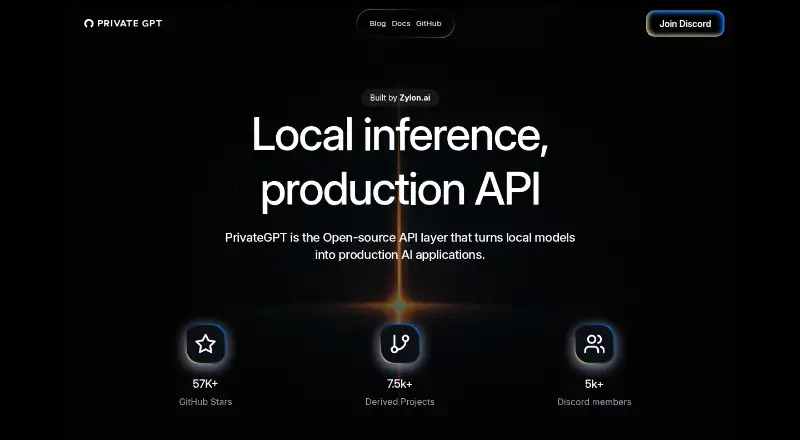
PrivateGPT is a free, open-source API layer for building private AI applications on your own infrastructure. It connects to a separate OpenAI-compatible inference server rather than running models itself; documented options include Ollama, LM Studio, llama.cpp, and vLLM. Its Messages API supports streaming, asynchronous processing, and token counting. Document workflows include file and artifact ingestion, retrieval, and citations, with additional tools for database queries and tabular data such as CSVs. Documented capabilities also include web search and extraction, code execution, custom tools, and MCP connectors. A browser workbench at `/ui` supports demos and inspection of API requests, but stores chats and settings in browser localStorage and has no access control; the documentation describes it as a local demonstrator. PrivateGPT runs as a local server and can be installed as a Python package, from source, or with Docker. Package installation requires Python 3.11; Python 3.10 and Python 3.12 or later are unsupported. The maker links to a community Discord and identifies Zylon as the maker.
Who it suits
PrivateGPT is intended for developers seeking an open-source application layer and API for AI workflows on their own infrastructure. It suits users prepared to connect a separate OpenAI-compatible inference server and meet the stated Python requirement if installing the package.
What it does well
- Messages API supports streaming and asynchronous processing.
- Document retrieval includes citations.
- Can connect to several OpenAI-compatible inference servers.
- Supports Docker, source, and package installation.
- Free and open source.
What to know first
- It does not run models itself.
- Package installation requires Python 3.11.
- The workbench has no access control.
- Skills are marked basic or in progress.
Limits
The free plan is an open-source API layer that runs self-hosted and connects to a separate OpenAI-compatible inference server. Package installation requires Python 3.11; Python 3.10 and Python 3.12 or later are unsupported.
Plans
| Plan | Billed and limits | Price |
|---|---|---|
| PrivateGPT | Open-source API layer; self-hosted; connects to a separate OpenAI-compatible inference server | Free |
As privategpt.dev lists them, read 9 Oct 2026. The maker's own page has the final word.
Getting started
- Choose a Python package, source or Docker installation route.
- For package installation, use Python 3.11.
- Install and run PrivateGPT as a local server.
- Connect it to an OpenAI-compatible inference server, such as Ollama, LM Studio, llama.cpp or vLLM.
- Open `/ui` to try demos and inspect API requests.
PrivateGPT is a free, open-source API layer for building AI applications around an inference server you choose. It suits developers who want document, data, and tool workflows on infrastructure they control. Its flexible API is the draw; operating a separate model server is part of the job.
Overview
PrivateGPT runs as a local server and can be installed as a Python package, from source, or with Docker. It connects to OpenAI-compatible servers such as Ollama, LM Studio, llama.cpp, and vLLM, but does not run models itself. That arrangement leaves model selection open while adding a separate service to set up and maintain.
Application data, including ingested documents, vector-store data, models, and caches, is stored under a local home directory by default. PrivateGPT can also connect to remote compatible servers, so developers need to account for where inference happens when designing a private deployment. Optional observability can trace LLM calls, embedding requests, and retrieval steps through the console, Arize Phoenix, or Opik.
Key features
The Messages API supports streaming, asynchronous processing, and token counting. Those capabilities give developers useful controls when building applications that handle longer tasks or need to report token use. File and artifact ingestion feed retrieval-augmented generation, with citations that help users follow answers back to source material.
PrivateGPT also supports database querying and analysis of tabular data such as CSVs. Documented tools include web search and extraction, code execution, custom tools, and MCP connectors, with MCP usage through the Messages API. The breadth makes it a capable application layer, though the compatibility table marks skills as basic or in progress; prompt caching and OAuth or organizations are unsupported.
A browser workbench at /ui supports testing, demos, and inspection of API requests. It stores chats and settings in browser localStorage and has no access control. That makes it suitable as a local demonstrator, not as a shared production interface where access needs to be restricted.
Pricing
PrivateGPT costs nothing. Its open-source plan is self-hosted and includes the API layer; users bring a separate OpenAI-compatible inference server. This fits developers who can operate their own stack and want to avoid depending on cloud AI APIs. The trade-off is responsibility for deployment and inference, rather than a turnkey hosted model service.
Platforms
PrivateGPT is available for API, Linux, macOS, self-hosted, web, and Windows use. The package installation guide requires Python 3.11 and does not support Python 3.10 or Python 3.12 or later, a narrow version requirement that may complicate installation in environments standardized on other Python releases. Docker is also documented as an installation route. Users can get community support through Discord.
Who it's for
PrivateGPT is a strong fit for developers building private AI products who want one API layer for retrieval, structured data, and tool use, and who can choose and run a compatible inference server. It is less suitable for teams seeking a managed model service, or anyone planning to expose its workbench to multiple users with access controls.
Pros and cons
- Pros: Streaming, asynchronous processing, and token counting give the Messages API more application control than a basic prompt endpoint.
- Pros: File and artifact retrieval with citations, database access, tabular analysis, MCP, and custom tools cover varied application workflows.
- Pros: Open-source, self-hosted deployment and local default storage support infrastructure control.
- Cons: A separate compatible inference server is required, adding setup and maintenance beyond PrivateGPT itself.
- Cons: The workbench has no access control and stores chats and settings in browser localStorage, limiting it to local demonstrations.
- Cons: Python package installation requires Python 3.11; Python 3.10 and 3.12 or later are unsupported.
- Cons: Skills are marked basic or in progress, while prompt caching and OAuth or organizations are unsupported.
Alternatives
For a broader set of retrieval-augmented generation tools, browse Retrieval-Augmented Generation Tools.
- AnythingLLM is an option for readers who want Android support or a freemium offering alongside self-hosted deployment.
- Flowise suits readers who want a free tier with 2 Flows & Assistants, 100 Predictions per month, and 5MB storage.
- txtai is another free, open-source option, installable with pip or Docker.
- I3K RAG Enterprise offers a free AGPL-3.0 self-hosted Community plan with community support.
- RAGFlow may suit readers who prefer a free hosted tier with 5 apps, one team member, and 0.1 GB of dataset storage.
- RAGStack is a free open-source RAG package that uses Astra DB Serverless or Apache Cassandra as a vector store.
- Dify offers a free Sandbox plan with 200 message credits, one workspace member, and five apps.
- Haystack Enterprise Platform is an alternative with a free Studio plan and a free trial.
Verdict
Choose PrivateGPT if you are a developer who wants an open-source API for retrieval, data, and tool workflows on infrastructure you control. Its central advantage is that it connects these capabilities to the compatible model server you select. Look elsewhere if you need inference included or an access-controlled workbench for shared use.
Verdict
PrivateGPT provides an API and workflow layer, while model inference comes from a separate compatible server. Its workbench is described as a local demonstrator without access control, so that limitation matters when choosing how to use it.
Questions
How much does PrivateGPT cost?
The listed PrivateGPT plan is free and is described as an open-source API layer.
Does PrivateGPT include its own model?
No. It connects to a separate OpenAI-compatible inference server, which can be local or remote.
Which platforms can I use?
The listed platforms are API, Linux, macOS, self-hosted, web and Windows. Installation routes include a Python package, source and Docker.
Which inference servers does it connect to?
Documented options include Ollama, LM Studio, llama.cpp and vLLM.
Who makes PrivateGPT?
The PrivateGPT site identifies Zylon as its maker.
Does it support document retrieval and citations?
Yes. It supports file and artifact ingestion, retrieval and citations.
Facts from PrivateGPT's own pages
- API
- Its Messages API supports streaming, asynchronous processing, and token counting. · privategpt.dev, 4 Oct 2026
- Data tools
- It provides structured access to databases and tabular data such as CSVs. · privategpt.dev, 4 Oct 2026
- Deployment
- PrivateGPT can be installed as a Python package, from source, or with Docker, and runs as a local server. · docs.privategpt.dev, 4 Oct 2026
- Developer integrations
- The maker lists Claude Code, OpenCode, VS Code, Cline, and n8n as compatible tools or workflow integrations. · privategpt.dev, 4 Oct 2026
- Document workflows
- It supports file and artifact ingestion, retrieval-augmented generation, and citation support. · privategpt.dev, 4 Oct 2026
- Inference
- PrivateGPT does not run models itself and connects to an external OpenAI-compatible inference server. · docs.privategpt.dev, 9 Oct 2026
- Inference providers
- The documentation lists Ollama, LM Studio, LlamaCPP, and vLLM as inference provider options. · docs.privategpt.dev, 9 Oct 2026
- Installation requirement
- The package installation guide requires Python 3.11 and says Python 3.10 and 3.12 or later are unsupported. · docs.privategpt.dev, 4 Oct 2026
- Install platforms
- The package installation guide provides instructions for macOS, Linux, and Windows, and the project also documents Docker installation. · docs.privategpt.dev, 9 Oct 2026
- Integrations
- Documented integration guides cover Claude Code, Claude Desktop, Claude for Microsoft 365, and OpenCode. · docs.privategpt.dev, 9 Oct 2026
- Intended user
- The maker recommends PrivateGPT for users who want an open-source local AI application layer and developer API. · docs.privategpt.dev, 4 Oct 2026
- Limitations
- The compatibility table marks skills as basic or in progress and prompt caching and OAuth or organizations as unsupported. · docs.privategpt.dev, 9 Oct 2026
- Maker
- The PrivateGPT site identifies Zylon as its maker and lists PriBAI Technology Corp in its copyright notice. · privategpt.dev, 9 Oct 2026
- MCP and tools
- It supports custom tools and MCP connectors, with MCP usage documented through the Messages API. · docs.privategpt.dev, 4 Oct 2026
- Messages API
- Its messages API supports streaming, asynchronous processing, and token counting. · privategpt.dev, 9 Oct 2026
- Observability
- Optional observability can emit traces for LLM calls, embedding requests, and retrieval steps, with console, Arize Phoenix, and Opik backends documented. · docs.privategpt.dev, 9 Oct 2026
- Privacy
- The maker says PrivateGPT lets developers build private AI products without depending on cloud AI APIs; it can connect to local or remote OpenAI-compatible servers. · docs.privategpt.dev, 4 Oct 2026
- Product
- PrivateGPT is an open-source API layer for building private AI applications on local models. · privategpt.dev, 4 Oct 2026
- Purpose
- PrivateGPT provides an open-source API layer for building private AI applications on your own infrastructure. · docs.privategpt.dev, 9 Oct 2026
- Python requirement
- The package guide requires Python 3.11 and says Python 3.10 and Python 3.12 or later are unsupported. · docs.privategpt.dev, 9 Oct 2026
- Retrieval
- The API supports file and artifact ingestion and retrieval with citations. · privategpt.dev, 9 Oct 2026
- Storage
- The package guide says application data, including the vector store, ingested documents, models, and caches, is stored under a local home directory by default. · docs.privategpt.dev, 9 Oct 2026
- Support
- The maker links to a community Discord for users. · privategpt.dev, 4 Oct 2026
- Tools
- Documented capabilities include database querying, CSV and tabular analysis, web search and extraction, MCP, code execution, and custom tools. · docs.privategpt.dev, 9 Oct 2026
Where PrivateGPT stands on Freedom251
- Retrieval-Augmented Generation Tools#11 of 26