Freedom251 › Boot Manager Software
OpenCore
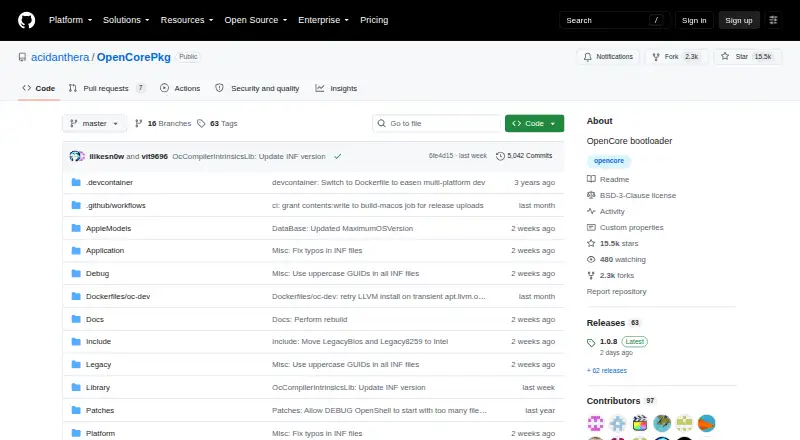
What OpenCore is
OpenCore is a free, open-source bootloader distributed with a development SDK. Its repository includes UEFI libraries for Apple-specific drivers, Apple disk image loading, and PNG image manipulation. Other libraries handle Apple PE image signature verification and supplemental Apple UEFI secure boot code. Kernel-related components support XNU driver injection and a patch engine, while plist parsing handles configuration files. OcGuardLib adds safe integral arithmetic, type-alignment checks, and a UBSan runtime. The project lists UEFI and BIOS support, multiboot, boot-entry editing, and boot-menu customization. Platforms listed for OpenCore include Linux, macOS, Windows, and self-hosted use. The repository identifies the license as BSD-3-Clause. Release source archives are available as ZIP and tar.gz files, including version 1.0.7. The README directs users to discussion forums in Russian, German, English, and Italian, including discussion of KVM configuration. Project documentation also lists third-party kernel extensions, noting that the list is informational and provided without warranty.
Who it suits
OpenCore may suit users looking for a free bootloader with UEFI libraries and a development SDK. Its listed features include boot-entry editing, boot-menu customization, and multiboot support.
What it does well
- Free and licensed under BSD-3-Clause.
- Includes UEFI and BIOS support.
- Supports boot-entry editing and boot-menu customization.
- Provides plist configuration parsing and a patch engine.
- Discussion forums are listed in four languages.
What to know first
- The project documentation says its kernel-extension list is informational and without warranty.
- The listed release archives are source archives.
Plans
| Plan | Billed and limits | Price |
|---|---|---|
| OpenCore | Not applicable; public open-source repository · BSD-3-Clause license | Free |
As github.com lists them, read 8 Oct 2026. The maker's own page has the final word.
Getting started
- Open the OpenCorePkg repository.
- Download a release source archive in ZIP or tar.gz format.
- Use the project README to find discussion forums in Russian, German, English, or Italian.
OpenCore is a free, open-source bootloader paired with an SDK for firmware and kernel-oriented development. It suits technically confident users who need Apple-focused UEFI components as well as boot management. Choose it for the breadth of its development libraries; look elsewhere for a simpler boot-menu utility.
Overview
OpenCore handles the practical jobs expected of a boot manager while extending into firmware, image, security, configuration, and kernel tooling. It supports UEFI and BIOS systems, multiboot configurations, boot-entry editing, and boot-menu customization. That range makes it useful when boot selection is only one part of a larger low-level project. Conversely, its development scope can be unnecessary overhead for someone who only wants to select operating systems at startup.
Key features
- Broad boot management: UEFI and BIOS support, multiboot operation, boot-entry editing, and boot-menu customization cover both modern and legacy firmware setups. It is a capable foundation for mixed or multi-OS machines, not merely a menu skin.
- Apple UEFI libraries: The SDK includes libraries for Apple-specific UEFI drivers. Developers working with Apple firmware components get relevant building blocks that a narrowly focused boot selector would not provide.
- Image handling: Apple disk-image loading and PNG manipulation are included in the libraries. These are useful for firmware and boot-interface projects, but add little value if your requirement stops at choosing a boot entry.
- Security code: Apple PE image signature verification and supplemental Apple UEFI secure-boot code support integrity-conscious firmware work. They make OpenCore more suitable for Apple-oriented security tooling than a basic multiboot menu.
- Kernel tooling: XNU kernel driver injection and a patch engine support low-level macOS kernel work. This is a meaningful advantage for developers modifying or integrating XNU components, while it is irrelevant to routine boot selection.
- Configuration and safety: Plist parsing handles the configuration format, and OcGuardLib adds safe integral arithmetic, type-alignment checks, and a UBSan runtime. These checks target robustness in systems code rather than end-user convenience.
- Extensible ecosystem: Documentation lists third-party kernel extensions for reference, explicitly without warranty. Treat that catalogue as orientation, not as a guarantee that an extension is supported or safe.
Pricing
OpenCore costs nothing under its public BSD-3-Clause open-source repository. There is no paid tier or free trial, so every user receives the same codebase rather than a feature-limited consumer edition. The license permits use under its terms, but users remain responsible for understanding those terms when redistributing or modifying the project.
Platforms
OpenCore is multiplatform, with Linux, macOS, Windows, and self-hosted deployment listed. Its UEFI and BIOS support, together with multiboot capability, makes it applicable across firmware modes and operating-system combinations. The repository publishes release source archives in ZIP and tar.gz formats, including version 1.0.7, for users who prefer to obtain tagged source packages.
Who it's for
Choose OpenCore if you are building or maintaining a technically demanding boot environment and need Apple-specific UEFI libraries, image routines, security code, plist handling, or XNU injection and patching in the same project. It also fits experienced multiboot users who value boot-entry and menu control across UEFI and BIOS.
It is a poor fit for readers seeking a guided, narrowly scoped boot-entry editor with no firmware or kernel-development ambitions. The SDK's value is concentrated in specialist workflows; ordinary boot-menu management does not require all of those components.
Pros and cons
Pros
- One project spans booting and development: Boot management is combined with UEFI, image, configuration, security, and kernel libraries.
- Apple-focused depth: Driver support, secure-boot code, PE verification, disk-image loading, and XNU tools address Apple-oriented work directly.
- Strong low-level safeguards: OcGuardLib's arithmetic, alignment, and UBSan facilities help developers catch classes of systems-code errors.
- No purchase barrier: The BSD-3-Clause repository is free to use under its license.
Cons
- Specialist rather than turnkey: Its SDK breadth is excessive for users who only need basic boot selection or menu editing.
- Third-party extensions are not assured: The documented kernel-extension list is informational and supplied without warranty.
- Technical responsibility remains with the user: Open-source distribution provides code, not a paid support or warranty tier.
Alternatives
For a broader comparison, see Boot Manager Software.
- Boot-US is the better choice if you want a freemium product with a free private-PC or public-school option and a paid 1-PC license at 24.50 USD once, across Linux and Windows.
- Clover Bootloader suits users wanting a free, open-source bootloader for Linux, macOS, and Windows under the BSD 2-Clause license.
- Launchpad is a free platform for hosted or self-hosted project work rather than a direct bootloader substitute.
- Plop Boot Manager is a free Linux and Windows option for personal or commercial use, provided as-is and not for resale.
- rEFInd is preferable when you need a free GPLv3 EFI boot manager for x86, x86-64, or ARM64 computers.
- SARDU MultiBoot Creator fits users seeking a freemium Linux/Windows multiboot creator with free personal, non-commercial plans.
- Super Grub2 Disk is a free Linux, macOS, and Windows recovery-oriented alternative.
- SYSLINUX is a free GNU GPLv2-or-later option for Linux and Windows boot environments.
Verdict
OpenCore is the right choice for technically minded users who need a bootloader plus Apple-oriented UEFI and XNU development components, with no purchase cost. Its main reason to choose it is the unusually broad low-level toolkit; its main reason to look elsewhere is that breadth, which makes focused boot managers a better fit for straightforward boot-menu needs.
Verdict
OpenCore combines bootloader capabilities with a development SDK and libraries for UEFI, kernel, and configuration work. Its source is available under BSD-3-Clause, with discussion forums listed in several languages.
Questions
Does OpenCore cost anything?
The OpenCore plan is listed as free. The repository identifies the project as open source under BSD-3-Clause.
What platforms are listed?
The listed platforms are Linux, macOS, Windows, and self-hosted; the project is also described as multiplatform.
Does OpenCore support UEFI and BIOS?
Yes. The project lists both UEFI and BIOS support, as well as multiboot, boot-entry editing, and boot-menu customization.
Where can I download OpenCore?
The repository's tags page lists ZIP and tar.gz source archives for releases, including version 1.0.7.
What license does OpenCore use?
The repository identifies its license as BSD-3-Clause.
Where can users discuss OpenCore?
The README points to discussion forums in Russian, German, English, and Italian, including KVM configuration discussion.
Facts from OpenCore's own pages
- Community forums
- The project lists forums in Russian, German, English, and Italian, including KVM configuration discussion. · github.com, 8 Oct 2026
- Configuration
- The libraries include parsing for the plist configuration format. · github.com, 8 Oct 2026
- Downloads
- The tags page lists zip and tar.gz source archives for releases, including version 1.0.7. · github.com, 8 Oct 2026
- Image support
- The libraries include Apple disk image loading and PNG image manipulation. · github.com, 8 Oct 2026
- Kernel extensions
- The project documentation lists third-party kernel extensions and notes that the list is informational and provided without warranty. · github.com, 8 Oct 2026
- Kernel support
- The libraries include XNU kernel driver injection and a patch engine. · github.com, 8 Oct 2026
- License
- The repository identifies its license as BSD-3-Clause. · github.com, 8 Oct 2026
- Purpose
- OpenCore is a bootloader distributed with a development SDK. · github.com, 8 Oct 2026
- Safety checks
- OcGuardLib implements safe integral arithmetic, type alignment checking, and a UBSan runtime. · github.com, 8 Oct 2026
- Security features
- The libraries include Apple PE image signature verification and supplemental Apple UEFI secure boot code. · github.com, 8 Oct 2026
- Support
- The project README directs users to a list of OpenCore discussion forums. · github.com, 8 Oct 2026
- UEFI libraries
- The repository includes UEFI support libraries for Apple-specific UEFI drivers. · github.com, 8 Oct 2026
Where OpenCore stands on Freedom251
- Boot Manager Software#9 of 29