Freedom251 › Message Broker Software

NanoMQ
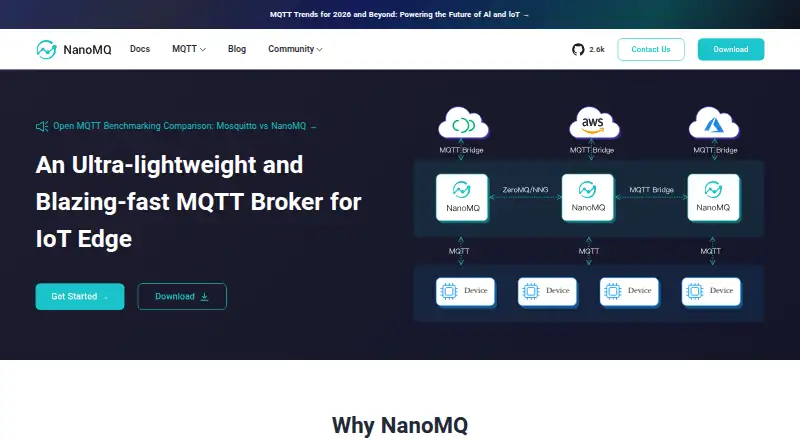
What NanoMQ is
NanoMQ is a free, open-source MQTT broker designed for IoT edge devices and MECs. It supports MQTT 5.0, 3.1.1, and 3.1, and bridges messages from edge devices to multiple clouds. Supported protocols also include ZeroMQ, nanomsg, NNG, WebSocket, SOME/IP, DDS, and MQTT over QUIC, with configurable delivery guarantees. A SQL-based rule engine integrates with eKuiper for edge stream processing. Built-in persistence can resume uploads after a restored connection. Integration options include bidirectional NNG pub/sub bridging, event-driven WebHooks, and HTTP APIs. Security includes TLS/SSL, authentication, ACL, and HTTP authorization; the HTTP API accepts Basic or JWT authentication. NanoMQ can run on Linux, Windows, or self-hosted deployments, installed through Docker, package managers, Windows zip packages, or source builds. Basic, SQLite, MsQuic, and Full editions are each priced at $0.
Who it suits
NanoMQ suits teams deploying self-hosted MQTT messaging at the edge, including environments needing cloud bridges, persistence, rules, or multiple protocols.
What it does well
- Supports MQTT 5.0, 3.1.1, and 3.1
- Bridges edge messages to multiple clouds
- Built-in persistence resumes uploads
- Includes SQL-based rule engine
- Free open-source editions
What to know first
- Windows documentation marks QUIC unsupported
- Linux table marks several gateways unavailable
- HTTP API lists default admin/public credentials
- Self-hosted deployment requires installation
Limits
The Linux deployment table marks AWS bridging, SOME/IP gateway, and DDS gateway unavailable across all four listed editions. Windows documentation marks QUIC unsupported.
Plans
| Plan | Billed and limits | Price |
|---|---|---|
| NanoMQ Basic Version | MQTT broker · TLS/SSL · MQTT over TCP/TLS bridging | Free |
| NanoMQ SQLite Edition | MQTT broker · TLS/SSL · SQLite · MQTT over TCP/TLS bridging | Free |
| NanoMQ MsQuic Edition | MQTT broker · TLS/SSL · rule engine · MQTT over TCP/TLS/QUIC bridging · benchmark tools | Free |
| NanoMQ Full Version | MQTT broker · TLS/SSL · SQLite · rule engine · MQTT over TCP/TLS/QUIC bridging · ZMQ gateway · benchmark tools | Free |
As nanomq.io lists them, read 11 Oct 2026. The maker's own page has the final word.
Getting started
- Open the NanoMQ website
- Choose Docker, a Linux package, a Windows zip package, or a source build
- Select a free edition: Basic, SQLite, MsQuic, or Full
- Install NanoMQ on a Linux or Windows environment
- Configure MQTT, bridges, rules, persistence, integrations, and security options
Verdict
NanoMQ provides a broad, self-hosted protocol and integration set for edge messaging without a listed charge. Platform-specific limitations, including Windows QUIC support and Linux gateway availability, should be checked against deployment needs.
Questions
Is NanoMQ free?
Yes. NanoMQ is open source, and the Basic, SQLite, MsQuic, and Full editions are each priced at $0.
Which operating systems does NanoMQ support?
NanoMQ supports Linux and Windows as self-hosted software.
Which MQTT versions are supported?
NanoMQ supports MQTT 5.0, MQTT 3.1.1, and MQTT 3.1.
How can NanoMQ be installed?
Installation options include Docker, Linux package managers, Windows zip packages, and building from source.
Does NanoMQ provide integrations?
It provides MQTT bridges, NNG pub/sub bridging, event-driven WebHooks, HTTP APIs, and documented eKuiper integration for edge stream processing.
Facts from NanoMQ's own pages
- Bridging
- NanoMQ supports MQTT bridges for messaging from edge devices to multiple clouds. · nanomq.io, 11 Oct 2026
- Founded
- 2021 · nanomq.io, 28 Sept 2026
- HTTP API authentication
- The HTTP API supports Basic or JWT authentication, and the documentation lists admin/public as the default credentials. · nanomq.io, 11 Oct 2026
- Installation
- NanoMQ can be installed with Docker, Linux package managers, Windows zip packages, or built from source. · nanomq.io, 11 Oct 2026
- Integrations
- NanoMQ documents event-driven WebHooks and HTTP APIs for integration with external systems. · nanomq.io, 11 Oct 2026
- Intended use
- NanoMQ describes its goal as serving edge devices and MECs with high-performance MQTT messaging. · nanomq.io, 11 Oct 2026
- Linux edition limits
- The Linux deployment table marks AWS bridging, SOME/IP gateway, and DDS gateway unavailable in all four listed editions. · nanomq.io, 11 Oct 2026
- MQTT support
- NanoMQ supports MQTT 5.0, 3.1.1, and 3.1. · nanomq.io, 11 Oct 2026
- NNG integration
- NanoMQ supports bidirectional data bridging with NNG pub/sub message flows. · nanomq.io, 11 Oct 2026
- Persistence
- NanoMQ provides built-in data persistence and can resume uploading when a connection is restored. · nanomq.io, 11 Oct 2026
- Product
- NanoMQ is a lightweight MQTT broker for the IoT Edge platform. · nanomq.io, 11 Oct 2026
- Rule engine
- NanoMQ includes a SQL-based rule engine and describes integration with eKuiper for edge stream processing. · nanomq.io, 11 Oct 2026
- Security
- NanoMQ supports TLS/SSL and provides authentication, ACL, and HTTP authorization options. · nanomq.io, 11 Oct 2026
- Windows support
- The Windows documentation lists MQTT 3.1, 3.1.1, and 5.0, TLS/SSL, WebSocket, MQTT-over-TCP bridging, HTTP APIs, rule engine, and Webhook as supported, while QUIC is unsupported. · nanomq.io, 11 Oct 2026
Where NanoMQ stands on Freedom251
- Message Broker Software#23 of 39