Freedom251 › Message Queue (MQ) Software
NATS
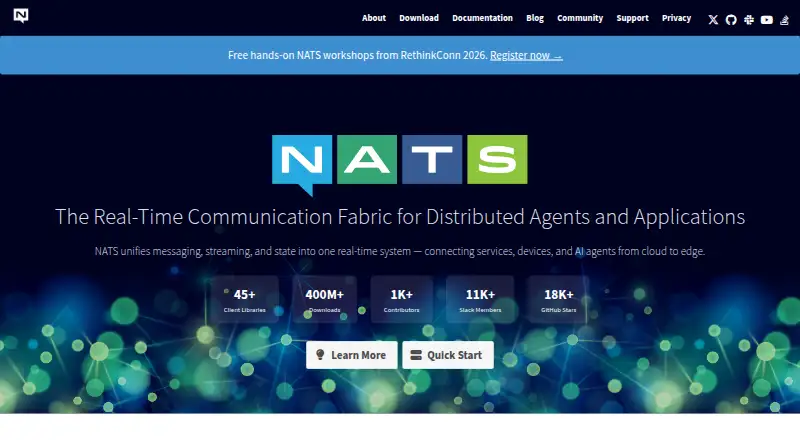
What NATS is
NATS is an open-source messaging system for distributed systems that span clouds and user-defined edge environments. It supports publish/subscribe and request/reply messaging, as well as persistent streaming through JetStream. Queueing, streaming, key-value functions, and object storage are available within the same system. The project describes delivery of millions of messages per second with sub-millisecond latencies across globally distributed systems.
The server is distributed as a single binary with no external dependencies and typically uses less than 20 MB of RAM. Official client libraries are listed for Go, Rust, JavaScript, TypeScript, Python, Java, C#, C, Ruby, and Elixir, alongside a command-line interface and more than 30 community-contributed clients. Listed connectors and utilities include Apache Flink, Apache Spark, AWS, Elasticsearch, Fluent Bit, MongoDB, and Prometheus.
NATS documents authentication, subject-level authorization, TLS encryption, and isolated accounts for multitenancy. Distributed deployments can grow through leaf nodes and superclusters, including deployments on low-resource edge devices. The NATS server and clients are open source under the Apache 2.0 license, and the project is a Cloud Native Computing Foundation incubating project. Questions can be directed to its Slack channel, GitHub discussions, or [email protected].
Who it suits
NATS suits teams building distributed systems with dynamic, loosely coupled services across clouds or edge environments. Its single-binary server and low typical memory use also fit teams deploying on low-resource edge devices.
What it does well
- Supports pub/sub, request/reply, and persistent streaming through JetStream.
- Combines queueing, key-value functions, streaming, and object storage.
- Single binary has no external dependencies.
- Typically uses less than 20 MB of RAM.
- Documents authentication, authorization, TLS, and isolated accounts.
- Server and clients use the Apache 2.0 license.
What to know first
- It is a messaging system for teams building distributed systems.
- The server is listed for Linux and self-hosted environments, alongside an API platform.
Plans
| Plan | Billed and limits | Price |
|---|---|---|
| NATS | Open-source messaging system · Apache 2.0 license | Free |
As nats.io lists them, read 4 Oct 2026. The maker's own page has the final word.
Getting started
- Visit https://nats.io/.
- Choose a client library for your language or use the CLI.
- Choose a deployment approach for your distributed or edge environment.
- Review the documented security options for authentication, authorization, encryption, and isolated accounts.
- Use Slack, GitHub discussions, or [email protected] for project questions.
Verdict
Choose NATS if you need open-source messaging for distributed services and want pub/sub, request/reply, and persistent streaming in one system. Its documented clients and connectors offer options across many languages and tools; teams seeking an app outside the listed API, Linux, and self-hosted platforms should look elsewhere.
Questions
Does NATS have a free plan?
Yes. The NATS plan is free, and the server and clients are open source under Apache 2.0.
Which messaging patterns does NATS support?
It supports pub/sub, request/reply, and persistent streaming through JetStream.
Which programming languages have official clients?
Official clients are listed for Go, Rust, JavaScript, TypeScript, Python, Java, C#, C, Ruby, and Elixir. A CLI and more than 30 community-contributed clients are also listed.
What deployment environments does NATS support?
NATS is designed for distributed systems across clouds and user-defined edge environments. It supports topology growth through leaf nodes and superclusters.
What security options does NATS document?
It documents authentication, subject-level authorization, TLS encryption, and isolated accounts for multitenancy.
Who maintains or supports the project?
NATS is a Cloud Native Computing Foundation incubating project. The project directs questions to its Slack channel, GitHub discussions, and [email protected].
Facts from NATS's own pages
- Client libraries
- Official clients are listed for Go, Rust, JavaScript, TypeScript, Python, Java, C#, C, Ruby, Elixir, and a CLI, with 30+ community-contributed clients. · nats.io, 4 Oct 2026
- Data features
- Pub/sub, request/reply, queueing, streaming, key-value, and object storage operate within the same system. · nats.io, 4 Oct 2026
- Deployment
- NATS is designed for distributed systems and edge deployments, and supports topology growth using leaf nodes and superclusters. · nats.io, 4 Oct 2026
- Integrations
- The download page lists connectors and utilities for Apache Flink, Apache Spark, AWS, Elasticsearch, Fluent Bit, MongoDB, Prometheus, and other tools. · nats.io, 4 Oct 2026
- Intended users
- NATS is aimed at teams building distributed systems with dynamic, loosely coupled services, including deployments on low-resource edge devices. · nats.io, 4 Oct 2026
- License
- The NATS server and clients are open source under the Apache 2.0 license. · nats.io, 4 Oct 2026
- Messaging patterns
- NATS supports pub/sub, request/reply, and persistent streaming through JetStream. · nats.io, 4 Oct 2026
- Performance
- The site says NATS can deliver millions of messages per second with sub-millisecond latencies across globally distributed systems. · nats.io, 4 Oct 2026
- Project affiliation
- NATS is a Cloud Native Computing Foundation incubating project. · nats.io, 4 Oct 2026
- Purpose
- NATS is an open-source messaging system for building distributed systems across clouds and user-defined edge environments. · nats.io, 4 Oct 2026
- Resource use
- The server is a single binary with no external dependencies and typically uses less than 20 MB of RAM. · nats.io, 4 Oct 2026
- Security
- NATS documents authentication, subject-level authorization, TLS encryption, and isolated accounts for multitenancy. · docs.nats.io, 4 Oct 2026
- Support and community
- The project directs users to its Slack channel, GitHub discussions, and [email protected] for questions, comments, or requests. · nats.io, 4 Oct 2026
Where NATS stands on Freedom251
- Message Queue (MQ) Software#17 of 29
- Message Broker Software#24 of 39
- Distributed Systems#20 of 30