Lightstreamer
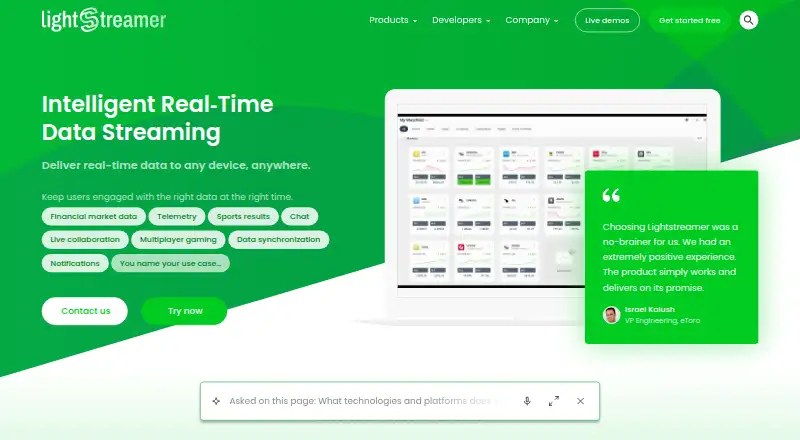
What Lightstreamer is
Lightstreamer is an event broker for delivering real-time data to web and mobile applications, including across proxies, firewalls, disconnections, and network congestion. Its Intelligent Streaming feature adapts data flow to network conditions and can resample or combine updates to keep clients synchronized. Messaging options include publish/subscribe, request/response, client-to-server messaging, and fine-grained item and field subscriptions. StreamSense selects WebSockets or HTTP for each client, including those behind restrictive firewalls or legacy proxies. Ready-made connectors integrate with Kafka, MQTT, and JMS, with named examples such as Confluent Cloud, Amazon MSK, Redpanda, AWS IoT Core, IBM MQ, and ActiveMQ. Custom adapters can be built with Java, Python, Node.js, .NET, or TCP sockets. Security capabilities include TLS, configurable cipher suites, certificates, mutual authentication, and custom authentication and authorization. It can run on-premises or in the cloud and supports Helm, Docker, and Kubernetes. Monitoring options include a web dashboard, configurable logs, JMX, Prometheus, and Grafana integrations. Its free Non-Production Limited License requires a Production License and a server restart after at most 210 minutes of uptime. The company was founded in 2003 and is based in Milan.
Who it suits
Lightstreamer suits teams building business-critical real-time applications in areas such as finance, gaming, aerospace, logistics, and media. Its deployment options and connectors also fit teams integrating event streams with existing systems.
What it does well
- Supports multiple messaging patterns and fine-grained subscriptions.
- StreamSense selects WebSockets or HTTP per client.
- Ready-made connectors include Kafka, MQTT, and JMS.
- Supports on-premises and cloud deployment.
- Monitoring includes Prometheus and Grafana integrations.
What to know first
- Free non-production license requires a Production License.
- Free license requires restart after at most 210 minutes.
- License pricing is available by contacting sales.
Limits
The free Demo License allows up to 20 concurrent client connections. The free Non-Production Limited License requires a Production License and a server restart after at most 210 minutes of uptime.
Plans
| Plan | Billed and limits | Price |
|---|---|---|
| Demo License | up to 20 concurrent client connections | Free |
| Annual subscription — Per Server License | upfront payment covering the entire year; contact sales for a tailored proposal · priced per Broker instance · no concurrent client limit · CPU and core count not factored in | On request |
| Annual subscription — Per Client License | upfront payment covering the entire year; contact sales for a tailored proposal · priced by peak concurrent client connections · excess usage reconciled every six months | On request |
| PAYG — Per Core-Hour License | monthly; contact sales for a tailored proposal · priced by total server core-hours operated · any number of servers and clients | On request |
| PAYG — Per Client-Hour License | monthly; contact sales for a tailored proposal · priced by total client connection hours · any number of servers and clients | On request |
As lightstreamer.com lists them, read 5 Oct 2026. The maker's own page has the final word.
Getting started
- Visit the Lightstreamer website.
- Use the free Demo License for up to 20 concurrent client connections.
- For production, contact sales for a tailored proposal.
- Select a license priced per server, peak concurrent clients, server core-hours or client connection hours.
- Deploy on-premises or in the cloud, using Helm, Docker or Kubernetes if appropriate.
Lightstreamer is a real-time event broker for teams delivering live data to web and mobile applications. It suits services that need to keep clients synchronized across difficult networks and operational setups. Its breadth is useful, but production licensing and capacity-based pricing call for planning.
Overview
Lightstreamer is built to deliver data despite proxies, firewalls, disconnections, and network congestion. Intelligent Streaming adjusts data flow to network conditions and can resample or conflate updates, helping clients stay synchronized when connections vary. That makes it a stronger fit for continuous live services than for projects that need only a basic message relay.
Messaging patterns, client options, integrations, deployment choices, and monitoring are brought together in one broker. The key trade-off is licensing: the free non-production license requires a Production License, and paid plans measure usage in different ways.
Key features
- Messaging: Publish/subscribe, request/response, client-to-server messaging, and fine-grained item and field subscriptions accommodate varied real-time interaction patterns.
- Transport selection: StreamSense chooses WebSockets or HTTP for each client, including through restrictive firewalls and legacy proxies. This is valuable when clients connect from mixed or tightly controlled network environments.
- Integration: Ready-made connectors cover Kafka, MQTT, and JMS, with examples including Confluent Cloud, Amazon MSK, Redpanda, AWS IoT Core, IBM MQ, and ActiveMQ. Java, Python, Node.js, .NET, and TCP socket options let teams build custom adapters when a ready-made connector is not the right fit.
- Client reach: SDKs cover web browsers, Android, Windows, Linux, Apple platforms, Flutter, and Unity. The range supports teams serving clients across several device and application types.
- Security: TLS supports configurable cipher suites, client and server certificates, and mutual authentication. Custom authentication and authorization can be implemented through a Metadata Adapter, offering control for organizations with specific access policies.
- Deployment and operations: On-premises and cloud deployment, with Helm, Docker, and Kubernetes support, gives teams options for fitting the broker into their infrastructure. The maker says it can scale to millions of concurrent clients; a web dashboard, configurable logs, JMX, Prometheus, and Grafana integrations provide operational visibility.
- Support: Every license includes unlimited technical support tickets and upgrades; 24×7 support is an additional option.
Pricing
Lightstreamer uses a freemium model, but its free options are bounded and production licensing matters. The Demo License costs free and permits up to 20 concurrent client connections, making it suitable for a small demonstration rather than a production workload.
The Non-Production Limited License allows unlimited connections, but it requires a Production License and the server must be restarted after no more than 210 minutes of uptime. That restriction makes it a poor fit for uninterrupted live service, even when connection volume is not the constraint.
Annual subscriptions are billed upfront for the year and require a tailored proposal from sales. The Per Server License is priced per Broker instance, has no concurrent-client limit, and does not factor CPU or core count, so it may suit deployments where server instances are the clearest unit to budget. The Per Client License is priced by peak concurrent client connections, with excess usage reconciled every six months; it is a more direct fit when peak audience size is the main capacity measure.
PAYG plans are billed monthly and also require a tailored proposal. Per Core-Hour charges by total server core-hours and allows any number of servers and clients, which suits workloads where computing time is the preferred basis. Per Client-Hour charges by total client connection hours, also allowing any number of servers and clients, and aligns better with usage that varies by connection time. These models avoid an annual upfront commitment, but the connection-hour or core-hour basis needs to match how the service actually operates.
Every paid model remains custom pricing, so Lightstreamer is less straightforward to budget than a product with a published production rate.
Platforms
Lightstreamer supports Android, iOS, Linux, macOS, Windows, web, API, and self-hosted use. The client SDK range extends to Flutter and Unity, while deployment can be on-premises or in the cloud. This makes it relevant to teams spanning mobile, browser, and managed infrastructure rather than a single client platform.
Who it's for
The maker positions Lightstreamer for business-critical real-time applications in finance, gaming, aerospace, logistics, and media. It is most compelling where live updates must keep flowing across varied networks and where the team can operate a broker and choose a suitable license basis. A small project seeking a permanently free production service, or a team with only basic messaging needs, is likely to find the licensing and operational breadth unnecessary.
Pros and cons
- Pro: Adaptive streaming and WebSocket-or-HTTP selection address congestion, firewalls, and legacy proxies, helping maintain synchronized clients across uneven connections.
- Pro: Messaging patterns, connectors, custom adapters, and broad client SDK coverage reduce the need to fit every application into one integration style.
- Pro: On-premises and cloud deployment plus established monitoring integrations give infrastructure teams meaningful operational choices.
- Con: Production requires a Production License, while the free non-production license has a 210-minute maximum uptime before restart; neither is a simple unrestricted free production route.
- Con: Paid prices are custom, and the subscription and PAYG models use different capacity measures, making cost planning dependent on deployment and usage patterns.
Alternatives
Choose Faye if a free, Apache 2.0-licensed option is the priority. TIBCO FTL is another option, with a free Community Edition download for Windows, Linux, and macOS alongside its Enterprise Edition.
Apache Artemis suits teams seeking a free, self-hosted broker under Apache License 2.0, with Java 17 or later required. Choose Eclipse Mosquitto for free, on-premises core MQTT features.
HiveMQ MQTT Broker is worth considering when its Lab tier's 100 connections and 100 messages per second fit the workload, or when a published monthly Launch price of $299 a month is useful for comparison. RabbitMQ offers a free self-managed broker under the Mozilla Public License 2.0 with community-based, best-effort support.
Pick ZeroMQ if a messaging library with no dedicated broker is preferable. Amazon SNS may fit teams looking for a managed API and web service with a free tier that includes monthly request and notification allowances.
For broader comparisons, browse Message Broker Software or Event Streaming Platforms.
Verdict
Lightstreamer is a strong choice for teams building business-critical live applications that need adaptable delivery, multiple integration paths, and deployment flexibility. Its central advantage is maintaining delivery across challenging network conditions; its main drawback is that production use depends on a paid license with custom pricing. Choose it when those delivery controls justify the licensing and operational commitment, and look elsewhere for a basic or permanently free production broker.
Verdict
Lightstreamer offers real-time delivery controls, a range of integration options, and both on-premises and cloud deployment. The free non-production license has a required production license and uptime limit; other pricing requires contacting sales.
Questions
Does Lightstreamer have a free plan?
Yes. Its free Demo License supports up to 20 concurrent client connections. A separate free Non-Production Limited License requires a Production License and a restart after at most 210 minutes of uptime.
How is Lightstreamer priced beyond the free license?
Pricing is available by request. Annual subscriptions can be priced per server or by peak concurrent client connections; pay-as-you-go licenses can be priced by server core-hours or client connection hours.
Where can Lightstreamer run?
It can be deployed on-premises or in the cloud, and supports Helm, Docker and Kubernetes.
Which platforms have client SDKs?
Client SDKs are listed for web browsers, Android, Windows, Linux, Apple platforms, Flutter and Unity.
Which systems have ready-made connectors?
Ready-made connectors integrate with Kafka, MQTT and JMS. Named examples include Confluent Cloud, Amazon MSK, Redpanda, AWS IoT Core, IBM MQ and ActiveMQ.
Where is Lightstreamer based?
Lightstreamer was founded in 2003 and is headquartered in Milan, Italy.
Facts from Lightstreamer's own pages
- Client platforms
- Client SDKs are listed for web browsers, Android, Windows, Linux, Apple platforms, Flutter, and Unity. · lightstreamer.com, 5 Oct 2026
- Custom adapters
- The maker lists Java, Python, Node.js, .NET, and TCP socket options for building custom adapters. · lightstreamer.com, 5 Oct 2026
- Deployment
- Lightstreamer can be deployed on-premises or in the cloud and supports Helm, Docker, and Kubernetes. · lightstreamer.com, 5 Oct 2026
- Founded
- 2003 · lightstreamer.com, 28 Sept 2026
- Headquarters
- Milan, Italy · lightstreamer.com, 28 Sept 2026
- Integrations
- Ready-made connectors integrate with Kafka, MQTT, and JMS; named examples include Confluent Cloud, Amazon MSK, Redpanda, AWS IoT Core, IBM MQ, and ActiveMQ. · lightstreamer.com, 5 Oct 2026
- Intelligent Streaming
- Its Intelligent Streaming feature adjusts data flow to network conditions and can resample and conflate updates to keep users synchronized. · lightstreamer.com, 5 Oct 2026
- Intended users
- The maker describes Lightstreamer for business-critical real-time applications across finance, gaming, aerospace, logistics, and media. · lightstreamer.com, 5 Oct 2026
- Messaging
- The broker supports publish/subscribe, request/response, client-to-server messaging, and fine-grained item and field subscriptions. · lightstreamer.com, 5 Oct 2026
- Non-production limit
- The free Non-Production Limited License requires a Production License and allows unlimited connections but requires a server restart after at most 210 minutes of uptime. · lightstreamer.com, 5 Oct 2026
- Product
- Lightstreamer is an event broker for reliable real-time data delivery to web and mobile applications, handling proxies, firewalls, disconnections, and network congestion. · lightstreamer.com, 5 Oct 2026
- Scale and monitoring
- The maker says the broker can scale to millions of concurrent clients and exposes monitoring through a web dashboard, configurable logs, JMX, Prometheus, and Grafana integrations. · lightstreamer.com, 5 Oct 2026
- Security
- The broker supports TLS with configurable cipher suites, client and server certificates, mutual authentication, and custom authentication and authorization through a Metadata Adapter. · lightstreamer.com, 5 Oct 2026
- Support
- Every license includes unlimited technical support tickets and unlimited upgrades; 24×7 support is available as an additional option. · lightstreamer.com, 5 Oct 2026
- Transports
- StreamSense selects WebSockets or HTTP connections for each client, including through restrictive firewalls and legacy proxies. · lightstreamer.com, 5 Oct 2026
Where Lightstreamer stands on Freedom251
- WebSocket Tools#5 of 55
- Event Streaming Platforms#7 of 27
- Message Broker Software#20 of 39