Freedom251 › Message Broker Software

Apache Artemis
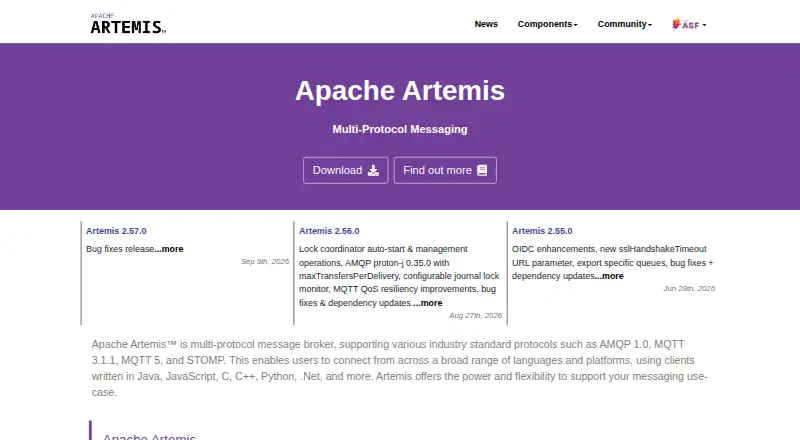
What Apache Artemis is
Apache Artemis is a free, self-hosted message broker for applications that exchange messages. It supports AMQP 1.0, MQTT 3.1, 3.1.1 and 5, STOMP 1.0, 1.1 and 1.2, OpenWire, and its own Core protocol. Client interfaces include Jakarta Messaging 3.1 and JMS 2.0 and 1.1, with client implementations and JNDI support. Clients are available in Java, JavaScript, C, C++, Python, .Net, and other languages. Clustering can distribute load, while high availability can use shared storage or network replication. Persistence options include Linux AIO, memory-mapped storage, Java NIO, and JDBC; asynchronous mirroring is available for disaster recovery. Security is enabled by default and includes role-based permissions, authentication managers, and SSL transport encryption. The project provides scripts to help create Docker images. Downloads include SHA-512 checksums and ASC signatures for verification. The free plan is billed under Apache License 2.0 and requires Java 17 or later.
Who it suits
It suits teams building messaging applications that want a self-hosted broker and need support for several protocols and client languages.
What it does well
- Supports AMQP, MQTT, STOMP, OpenWire, and Core.
- High availability can use shared storage or network replication.
- Offers multiple persistence options, including JDBC.
- Security is enabled by default.
- Free under Apache License 2.0.
What to know first
- Requires Java 17 or later.
- Self-hosted deployment requires users to manage the broker.
Limits
The free plan requires Java 17 or later and self-hosted deployment. No trial is offered.
Plans
| Plan | Billed and limits | Price |
|---|---|---|
| Apache Artemis | Apache License 2.0 · Java 17+ · self-hosted broker | Free |
As artemis.apache.org lists them, read 2 Oct 2026. The maker's own page has the final word.
Getting started
- Visit the Apache Artemis website.
- Choose a supported platform: Linux, macOS, or Windows.
- Install Java 17 or later.
- Use the project’s deployment scripts to help create a Docker image, if needed.
- Deploy the broker as a self-hosted service under the free Apache License 2.0 plan.
Apache Artemis is a self-hosted message broker for teams connecting applications over different messaging protocols. It is best suited to operators who want control over deployment and reliability choices; teams seeking a managed broker should look elsewhere.
Overview
Artemis combines broad protocol and client support with configurable delivery guarantees, per-queue ordering and dead-letter queues. That range can help a mixed application estate use one broker, while the self-hosted model puts deployment and operation on the team.
It supports AMQP 1.0, MQTT 3.1, 3.1.1 and 5, STOMP 1.0, 1.1 and 1.2, OpenWire and its Core protocol. Jakarta Messaging 3.1 and JMS 2.0 and 1.1 support, client implementations and JNDI support make it relevant to Java messaging applications as well. Clients are available in Java, JavaScript, C, C++, Python, .Net and other languages.
High availability can use shared storage or network replication; clustering can distribute load, and asynchronous mirroring is available for disaster recovery. Those choices give operators flexibility, but they also mean selecting and managing an architecture rather than relying on a hosted service.
For a broader shortlist, see Message Broker Software.
Key features
Protocols, APIs and clients
Artemis’s protocol breadth is its clearest fit for environments where clients use different messaging standards. Support for MQTT versions through 5 and multiple STOMP versions sits alongside AMQP, OpenWire and Core; the range reduces the need to standardize every application on one protocol. Its stated language options extend beyond Java, although teams still need to select and operate suitable clients.
Reliability and operations
Configurable delivery guarantees, dead-letter queues and per-queue ordering address distinct message-handling needs, but the guarantees are not a substitute for choosing appropriate configuration. Persistence options include Linux AIO, memory-mapped storage, Java NIO and JDBC. High availability and clustering provide ways to address continuity and load distribution, while asynchronous mirroring targets disaster recovery.
The project supplies scripts to help create Docker images, which can support container deployment without turning Artemis into a hosted product. Security is enabled by default and includes role-based permissions, authentication managers and SSL transport encryption. Download verification is supported through SHA-512 checksums and ASC signatures; the project advises users to verify downloaded files.
For questions, the project points users to community mailing lists; bugs and feature requests go through its issue system. This is a community-oriented support route, not a stated commercial support commitment.
Pricing
Apache Artemis costs nothing under Apache License 2.0. The plan is a self-hosted broker requiring Java 17 or later. There is no free trial because the software is already free; the practical cost is operating it in your own environment. There are no paid tiers or hosted service plan described here, so teams that do not want to run broker infrastructure should consider another model.
Platforms
Artemis is available for Linux, macOS and Windows, as well as through an API. Its deployment model is self-hosted, and the plan requires Java 17 or later. Docker image creation scripts offer deployment assistance, but teams remain responsible for their broker environment.
Who it's for
Artemis is a strong candidate for teams with messaging clients across several protocols or languages, especially those needing configurable delivery behavior, persistence choices and self-managed high availability. It is less suitable for organizations that want a managed broker, or that lack the capacity to configure and operate clustering, storage and security themselves.
Pros and cons
- Broad protocol coverage: AMQP, MQTT, STOMP, OpenWire and Core support can accommodate varied messaging clients.
- Multiple reliability options: Shared storage or network replication, clustering and asynchronous mirroring give operators distinct approaches to availability, load distribution and recovery.
- Flexible persistence: Linux AIO, memory-mapped, Java NIO and JDBC options support different operating choices.
- Self-hosted responsibility: Deployment, configuration and ongoing operation fall to the team rather than a managed provider.
- Community support route: Questions go to mailing lists, with bugs and feature requests handled through the project system; no commercial support commitment is stated.
Alternatives
Eclipse Mosquitto is a free, self-hosted option for readers focused on core MQTT features rather than Artemis’s wider protocol range.
HiveMQ MQTT Broker is worth considering for an MQTT-focused alternative with a free Lab plan capped at 100 connections and 100 messages per second, or a Launch plan at $299 a month.
RabbitMQ is another free, self-managed broker; its open-source server uses the Mozilla Public License 2.0 and community-based best-effort support.
Amazon SNS suits readers looking at a freemium API or web service, with a free tier covering 1 million requests, 100,000 HTTP notifications and 1,000 email notifications each month.
Amazon SQS is a freemium API or web alternative with a free tier of 1 million requests; its Standard queues offer at-least-once delivery and best-effort ordering, while FIFO queues are also available.
Apache ActiveMQ is a free, open-source alternative under Apache License 2.0 for teams comparing another self-hosted broker.
CloudAMQP offers a hosted freemium alternative: its free Loyal Lemming plan caps usage at 200 queues, 20,000 queued messages, 2 million messages per month and 40 connections, using a shared LavinMQ broker.
Google Cloud Pub/Sub is a freemium API or web alternative with a free usage allowance of 10 GiB throughput, suited to readers comparing a usage-based service rather than self-hosting.
Verdict
Choose Apache Artemis if you need one self-managed broker for varied protocols and want control over persistence, availability and clustering choices. Its breadth and free license are compelling for capable operators; look elsewhere if you want a hosted service or do not want responsibility for broker operations.
Verdict
Apache Artemis offers a broad protocol and client-language range alongside clustering, persistence, and security options. Its free, self-hosted model fits teams prepared to deploy and operate the broker themselves.
Questions
How much does Apache Artemis cost?
The listed plan is free, billed under Apache License 2.0.
Is there a free trial?
No. Apache Artemis has a free plan and no free trial.
Which platforms does it support?
The listed platforms are API, Linux, macOS, self-hosted, and Windows.
Which protocols does Apache Artemis support?
It supports AMQP, MQTT, STOMP, OpenWire, and Core. Listed versions include AMQP 1.0, MQTT 3.1/3.1.1/5, and STOMP 1.0/1.1/1.2.
What license applies to the free plan?
The plan is billed under Apache License 2.0 and requires Java 17 or later.
How can users get help?
The project directs users to community mailing lists and its bug and feature request system.
Facts from Apache Artemis's own pages
- Availability
- High availability can use shared storage or network replication. · artemis.apache.org, 2 Oct 2026
- Client APIs
- It supports Jakarta Messaging 3.1, JMS 2.0 and 1.1, and includes client implementations and JNDI support. · artemis.apache.org, 2 Oct 2026
- Client languages
- The project says clients are available in Java, JavaScript, C, C++, Python, .Net, and other languages. · artemis.apache.org, 2 Oct 2026
- Clustering
- The broker provides flexible clustering for distributing load. · artemis.apache.org, 2 Oct 2026
- Deployment
- The project provides scripts to help create Docker images for deployment. · artemis.apache.org, 2 Oct 2026
- Disaster recovery
- Asynchronous mirroring is available for disaster recovery. · artemis.apache.org, 2 Oct 2026
- Download verification
- The download page provides SHA-512 checksums and ASC signatures and says users should verify downloaded files. · artemis.apache.org, 2 Oct 2026
- Persistence
- Journal options include Linux AIO, memory-mapped, Java NIO, and JDBC persistence. · artemis.apache.org, 2 Oct 2026
- Product
- Apache Artemis is a multi-protocol message broker for messaging applications. · artemis.apache.org, 2 Oct 2026
- Protocols
- The broker supports AMQP 1.0, MQTT 3.1/3.1.1/5, STOMP 1.0/1.1/1.2, OpenWire, and its own Core protocol. · artemis.apache.org, 2 Oct 2026
- Security
- Security is enabled by default and supports role-based permissions, authentication managers, and SSL transport encryption. · artemis.apache.org, 2 Oct 2026
- Support
- The project directs users to community mailing lists for questions and to its bug and feature request system. · artemis.apache.org, 2 Oct 2026
Where Apache Artemis stands on Freedom251
- Message Broker Software#6 of 39