Freedom251 › Message Queue (MQ) Software

Eclipse Mosquitto
What Eclipse Mosquitto is
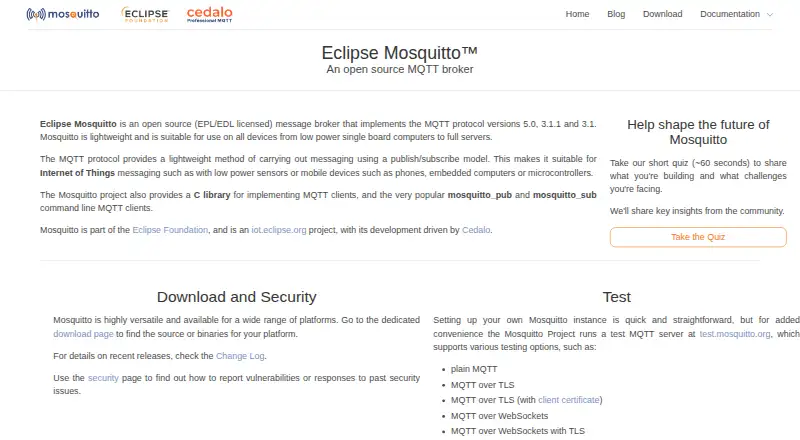
Eclipse Mosquitto is a free, open-source message broker that supports MQTT 5.0, 3.1.1, and 3.1. It uses publish/subscribe messaging, a model suited to connected devices such as sensors, phones, embedded computers, and microcontrollers. The project describes it as lightweight, with use ranging from low-power single-board computers to full servers. Mosquitto runs on Linux, macOS, Windows, and self-hosted environments; its free plan costs nothing and includes core MQTT features for on-premises use. Supported protocols are MQTT and MQTT over WebSockets, and delivery guarantees are configurable. The project also offers a C library for MQTT clients and the mosquitto_pub and mosquitto_sub command-line clients. A public test server offers plain MQTT, TLS, client-certificate TLS, and WebSocket options. Community support is best effort, while Cedalo offers commercial hosting, consulting, and custom development.
Who it suits
It suits people building MQTT-based messaging for connected devices, from low-power sensors to server environments, who can manage a self-hosted broker.
What it does well
- Free, open-source broker with core MQTT features
- Supports MQTT 5.0, 3.1.1, and 3.1
- Runs on Linux, macOS, and Windows
- Includes a C library and command-line clients
- Configurable delivery guarantees
What to know first
- Community support is best effort
- The listed plan is on-premises
Limits
The free plan is for core MQTT features and on-premises deployment. Community support is best effort.
Plans
| Plan | Billed and limits | Price |
|---|---|---|
| Open-source Mosquitto | Core MQTT features · On-premises | Free |
As mosquitto.org lists them, read 4 Oct 2026. The maker's own page has the final word.
Getting started
- Choose a platform: Linux, macOS, Windows, or self-hosted.
- On Windows, use a supported x64 or x86 installer.
- On macOS, install using Homebrew.
- On Linux, use Snap or a package or repository for Debian, Raspberry Pi, or Ubuntu.
- Use the public test MQTT server if you want to try plain MQTT, TLS, client-certificate TLS, or WebSockets.
Eclipse Mosquitto is an open-source MQTT broker with companion client tools for Linux, macOS, Windows and self-hosted deployments. It suits developers and operators building IoT messaging around sensors, embedded systems or servers who want direct control of the broker. The trade-off is that operating it and obtaining support largely remain your responsibility.
Overview
Mosquitto implements MQTT 5.0, 3.1.1 and 3.1, using MQTT’s publish/subscribe model to move messages between devices without requiring each device to communicate directly with every other device. That model fits low-power sensors, phones, embedded computers and microcontrollers, and the project names manufacturing, healthcare, automotive and smart-home systems as application areas.
Its lightweight design is a practical advantage when the broker must run on a low-power single-board computer, while remaining suitable for full servers. Deployment is self-hosted and on-premises, so you retain control of the environment but must provide and maintain that environment yourself.
Key features
Broker and client tooling
The core broker supports MQTT and MQTT over WebSockets. Delivery guarantees are configurable, allowing deployments to choose behavior appropriate to their messaging requirements rather than accepting one fixed policy. The project also supplies a C library for building MQTT clients, plus the mosquitto_pub and mosquitto_sub command-line clients. Those tools are useful for development, scripting and straightforward operational checks alongside the broker.
Security and testing
Mosquitto directs vulnerability reports through the Eclipse Security process and publishes past security issues and fixes. A public test MQTT server offers plain MQTT, TLS, client-certificate TLS and WebSocket options, giving teams a place to exercise connection methods before putting their own broker into service.
Related tooling and support
Streamsheets uses Mosquitto as a core component and can process incoming MQTT data. Community help is offered on a best-effort basis through GitHub, a mailing list, Matrix and Cedalo forums. Cedalo also provides hosted or on-premises instances, consulting and custom development when a project needs commercial assistance beyond community channels.
Pricing
The Open-source Mosquitto plan costs nothing. It includes core MQTT features and on-premises deployment, with no paid tier, seat count or usage quota stated. This is a strong fit for teams comfortable running their own infrastructure and selecting their own operational safeguards; it is less suitable if you want a managed service included in the software plan.
There is no trial or renewal term to manage because the plan is free. Commercial hosting, consulting and custom development from Cedalo are separate service options, with custom pricing.
Platforms
Mosquitto runs on Linux, macOS and Windows, as well as self-hosted environments. Windows downloads include supported x64 and x86 installers. On macOS, the project points to Homebrew installation. Linux users can use Snap, while packages or repositories are listed for Debian, Raspberry Pi and Ubuntu. This breadth makes it practical for mixed device estates and for moving from a small board to a server without changing broker software.
Who it's for
Choose Mosquitto for IoT and machine-to-machine systems that need standard MQTT versions, configurable delivery behavior and a broker that can fit constrained hardware. It is particularly appropriate when on-premises control matters or when developers need supplied C and command-line clients. It is a weaker choice for organizations seeking a fully managed broker, bundled service-level support or an administration experience that removes infrastructure work; those needs require Cedalo services or another product.
Pros and cons
Pros
- Free core software: the open-source plan costs 0.00 USD and includes core MQTT features on premises.
- Broad MQTT coverage: MQTT 5.0, 3.1.1 and 3.1 support covers current and established clients.
- Lightweight deployment: it can suit low-power single-board computers as well as servers.
- Useful companion tools: a C client library and command-line publisher/subscriber tools support development and operations.
- Flexible connection security: the public test server supports plain MQTT, TLS, client-certificate TLS and WebSockets.
Cons
- Self-managed operations: on-premises delivery leaves infrastructure, maintenance and availability work with your team.
- Best-effort community help: GitHub, mailing-list, Matrix and forum support does not promise commercial response times.
- No bundled managed tier: hosted operation and consulting come through separate Cedalo services with custom pricing.
Alternatives
EMQX is the better fit when you want a freemium serverless option with up to 1,000 connections and usage-based billing beyond its monthly free quota.
Aiven for Apache Kafka suits teams that prefer a managed Kafka service; its free plan specifies 250 KiB/s throughput, three days of retention, five topics and two partitions per topic.
Apache Pulsar, Apache Qpid Broker-J and Apache RocketMQ are free, open-source broker alternatives when their respective messaging ecosystems are a better match.
Confluent Cloud is preferable for a managed Kafka deployment with autoscaling resources and managed connectors on its free Basic tier.
HiveMQ MQTT Broker is worth considering when a defined connection and message-rate allowance or paid commercial tiers matter; its Lab plan states 100 connections and 100 messages per second.
RabbitMQ is another free, self-managed broker with community-based support under the Mozilla Public License 2.0.
For broader comparisons, see Message Queue (MQ) Software and Message Broker Software.
Verdict
Mosquitto is a strong recommendation for IoT developers and operators who want a no-cost, standards-based MQTT broker that can run from a small board to a server and remain under their control. Choose it for its lightweight footprint and practical client tooling; look elsewhere when managed hosting, guaranteed commercial support or a fully operated service is the priority.
Verdict
Mosquitto provides MQTT broker software and client tools across several platforms at no plan cost. Its self-hosted, on-premises model and best-effort community help are important considerations.
Questions
How much does Mosquitto cost?
The Open-source Mosquitto plan is free.
Which MQTT versions does it implement?
Mosquitto implements MQTT 5.0, 3.1.1, and 3.1.
Which platforms are supported?
The listed platforms are Linux, macOS, self-hosted, and Windows. Windows downloads include supported x64 and x86 installers; macOS installation is available through Homebrew, and Linux options include Snap and packages or repositories.
Is Mosquitto open source?
Yes. Mosquitto is described as an open-source message broker.
What protocols does it support?
Supported protocols are MQTT and MQTT over WebSockets. Delivery guarantees are configurable.
What support is available?
Community support is best effort through GitHub, a mailing list, Matrix, and Cedalo forums. Cedalo offers hosted or on-premises instances, consulting, and custom development.
Facts from Eclipse Mosquitto's own pages
- Client tools
- The project also provides a C library for MQTT clients and the mosquitto_pub and mosquitto_sub command-line clients. · mosquitto.org, 4 Oct 2026
- Commercial support
- Cedalo offers hosted or on-premises instances, consulting, and custom development for Mosquitto. · mosquitto.org, 4 Oct 2026
- Community support
- Community support is available on a best-effort basis through the project’s GitHub repository, mailing list, Matrix, and Cedalo forums. · mosquitto.org, 4 Oct 2026
- Lightweight
- The project describes Mosquitto as lightweight and suitable for devices ranging from low-power single-board computers to full servers. · mosquitto.org, 4 Oct 2026
- Linux support
- The download page lists Snap installation and packages or repositories for Debian, Raspberry Pi, and Ubuntu. · mosquitto.org, 4 Oct 2026
- macOS support
- The download page says Mosquitto can be installed on Mac using Homebrew. · mosquitto.org, 4 Oct 2026
- Messaging model
- MQTT uses a publish/subscribe model suited to IoT messaging, including low-power sensors, phones, embedded computers, and microcontrollers. · mosquitto.org, 4 Oct 2026
- Purpose
- Mosquitto is an open-source message broker that implements MQTT 5.0, 3.1.1, and 3.1. · mosquitto.org, 4 Oct 2026
- Related integration
- The project says Streamsheets uses Mosquitto as a core component and can process incoming MQTT data. · mosquitto.org, 4 Oct 2026
- Security
- The project directs people who find a vulnerability to report it through the Eclipse Security page and lists past security issues and fixes. · mosquitto.org, 4 Oct 2026
- Testing
- The project runs a public test MQTT server with plain MQTT, TLS, client-certificate TLS, and WebSocket options. · mosquitto.org, 4 Oct 2026
- Use cases
- The site names manufacturing, healthcare, automotive, and smart-home systems among MQTT broker application areas. · mosquitto.org, 4 Oct 2026
- Windows support
- The download page provides supported Windows x64 and x86 installers. · mosquitto.org, 4 Oct 2026
Where Eclipse Mosquitto stands on Freedom251
- Message Queue (MQ) Software#8 of 29
- Message Broker Software#13 of 39