Freedom251 › Message Broker Software
Apache Qpid Broker-J
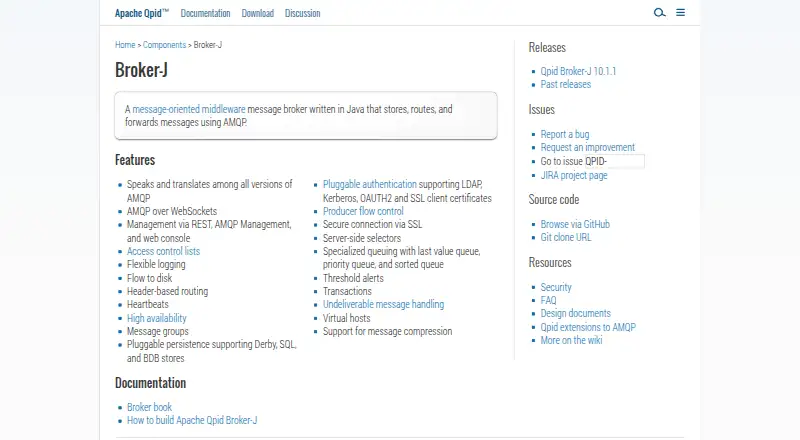
What Apache Qpid Broker-J is
Apache Qpid Broker-J is a Java message broker that stores, routes, and forwards messages using AMQP. It supports AMQP versions 0-8, 0-9, 0-9-1, 0-10, and 1.0, including AMQP over WebSockets. Administration is available through a web console, REST, and AMQP Management. Routing and queue features include header-based routing, message groups, server-side selectors, and last-value, priority, and sorted queues. Persistence can use Derby, SQL, or BDB stores. The feature list also includes high availability, producer flow control, and flow to disk. Authentication options include LDAP, Kerberos, OAuth2, and SSL client certificates, alongside access control lists and SSL connections. Broker-J is open source under Apache License 2.0 and is intended for self-hosted deployment. Installation documentation covers Windows and UNIX platforms. The listed current release is 10.1.1, with source archives and binary downloads in tar.gz and zip formats. The project directs users to Apache JIRA for issue reports and improvement requests.
Who it suits
Broker-J suits teams building Java-based messaging systems that need AMQP routing and queue controls in a self-hosted broker. Its documented installation platforms include Windows and UNIX.
What it does well
- Supports five AMQP versions and AMQP over WebSockets.
- Management is available through REST and a web console.
- Persistence options include Derby, SQL, and BDB.
- Authentication supports LDAP, Kerberos, OAuth2, and client certificates.
- Includes high availability and producer flow control.
What to know first
- The listed deployment model is self-hosted.
- The listed current release is version 10.1.1.
- The security page lists vulnerabilities fixed in 10.1.1 affecting earlier versions.
Limits
The plan is listed as free, with no paid plan or usage limits stated.
Plans
| Plan | Billed and limits | Price |
|---|---|---|
| Apache Qpid Broker-J | No paid plan or usage limits stated | Free |
As qpid.apache.org lists them, read 11 Oct 2026. The maker's own page has the final word.
Getting started
- Visit https://qpid.apache.org/components/broker-j/index.html.
- Download the 10.1.1 source archive or a binary in tar.gz or zip format.
- Install on Windows or a UNIX platform.
- Choose a persistence store from Derby, SQL, or BDB.
- Configure the desired AMQP protocol and management option.
Apache Qpid Broker-J is a Java broker for storing, routing, and forwarding messages over AMQP. It is a strong fit for teams that want a self-hosted broker with broad AMQP compatibility and control over persistence and authentication. Its flexibility is balanced by the work of operating and securing the broker yourself.
Overview
Broker-J supports AMQP 0-8, 0-9, 0-9-1, 0-10, and 1.0, translating among versions and carrying AMQP over WebSockets. That breadth is valuable when systems using different AMQP generations must share a broker; it is less compelling if your applications do not need AMQP or you want a managed service.
The current release is 10.1.1, distributed as source archives and binary downloads in tar.gz and zip formats. The Apache License, Version 2.0 makes it open source. Installation guidance covers Windows and UNIX platforms, while project feedback and issue reports go through Apache JIRA. The 10.1.1 security advisories include fixes for vulnerabilities affecting 10.1.0 and earlier, so deployments should stay current.
Key features
Routing and queue controls
Header-based routing, message groups, server-side selectors, and last value, priority, and sorted queues give operators several ways to direct and organize delivery. Dead-letter queues help handle messages that cannot be delivered as intended. Ordering is guaranteed per queue, a useful boundary to understand for applications that rely on sequence across multiple queues.
Persistence and operations
Pluggable persistence supports Derby, SQL, and BDB stores, giving teams a choice of backing store rather than a single fixed option. High availability, producer flow control, and flow to disk address resilience and pressure on the broker, but they also leave configuration and operational decisions with the team running it.
Management and security
Management is available through REST, AMQP Management, and a web console. Authentication plugins support LDAP, Kerberos, OAuth2, and SSL client certificates; access control lists and SSL secure connections add controls for authorization and transport. This range suits environments with established identity systems, though it means operators must select and configure the mechanisms their deployment needs.
Pricing
Apache Qpid Broker-J costs nothing. The project is open source, with no paid plan or usage limits stated. That makes it an option for teams seeking a self-managed broker without a software subscription; the trade-off is that they operate the deployment themselves.
Platforms
Broker-J is self-hosted and supports Linux, macOS, and Windows, with an API also supported. Its installation documentation covers Windows and UNIX platforms. This suits teams that need deployment control across common operating systems, rather than a hosted broker that removes infrastructure management.
Who it's for
Choose Broker-J when you need to connect applications across AMQP versions, want configurable queues and persistence, or need authentication options that fit existing identity infrastructure. It is less suitable for teams that prefer a managed service or do not want responsibility for upgrades, security configuration, and broker operations.
Pros and cons
- Broad AMQP coverage: support for five AMQP versions and translation between them can simplify interoperability across older and newer systems.
- Configurable delivery and storage: varied queue types, dead-letter queues, per-queue ordering, and three persistence backends provide useful control over broker behavior.
- Multiple management and identity options: REST, AMQP Management, a web console, and several authentication plugins support different operating practices.
- Self-hosting is an operational burden: teams must manage the broker and keep it patched; the advisories for earlier releases underscore the importance of upgrades.
Alternatives
RabbitMQ is another free, self-managed broker if you want an open-source alternative with community-based, best-effort support.
Apache Pulsar and Apache RocketMQ are free, open-source alternatives for teams comparing self-hosted messaging software; their listed platform support includes Linux, macOS, and Windows.
EMQX is worth considering if a freemium option with a free trial and web platform support better fits your requirements; its Serverless plan has a free monthly quota and charges by usage beyond it.
Aiven for Apache Kafka and Confluent Cloud are freemium alternatives with free plans and trials for teams evaluating Kafka-based services. Eclipse Mosquitto is a free, on-premises alternative centered on core MQTT features. HiveMQ MQTT Broker offers a Lab plan with 100 connections and 100 messages per second based on a normalized 5 KB message size.
Browse more options in Message Queue (MQ) Software and Message Broker Software.
Verdict
Apache Qpid Broker-J is a sound choice for teams that need a free, self-hosted AMQP broker with version translation, configurable persistence, and substantial routing and authentication controls. Choose it when those capabilities justify owning deployment and maintenance; look elsewhere if you need a managed service or want to avoid broker operations.
Verdict
Broker-J provides multiple AMQP versions, management interfaces, queue options, and configurable persistence for self-hosted use. Check the listed security advisories and release information when evaluating a deployment.
Questions
How much does Apache Qpid Broker-J cost?
The plan is listed as free.
Is Broker-J open source?
Yes. Apache Qpid licenses it under Apache License, Version 2.0.
Which AMQP versions does it support?
It supports AMQP 0-8, 0-9, 0-9-1, 0-10, and 1.0, as well as AMQP over WebSockets.
How can Broker-J be managed?
Management options include REST, AMQP Management, and a web console.
Can Broker-J be self-hosted?
Yes. Its deployment model is self-hosted, and installation documentation covers Windows and UNIX platforms.
What persistence stores can it use?
Its pluggable persistence supports Derby, SQL, and BDB stores.
Facts from Apache Qpid Broker-J's own pages
- AMQP support
- It speaks and translates among all AMQP versions and supports AMQP over WebSockets. · qpid.apache.org, 11 Oct 2026
- Authentication
- Pluggable authentication supports LDAP, Kerberos, OAuth2, and SSL client certificates. · qpid.apache.org, 11 Oct 2026
- Availability and flow control
- The broker lists high availability, producer flow control, and flow to disk among its features. · qpid.apache.org, 11 Oct 2026
- Current release
- The listed current release is Qpid Broker-J 10.1.1. · qpid.apache.org, 11 Oct 2026
- Distribution
- Apache Qpid identifies the project as open source and licenses it under the Apache License, Version 2.0. · qpid.apache.org, 11 Oct 2026
- Download formats
- The 10.1.1 release page provides source archives and binary downloads in tar.gz and zip formats. · qpid.apache.org, 11 Oct 2026
- Management
- It supports management through REST, AMQP Management, and a web console. · qpid.apache.org, 11 Oct 2026
- Persistence
- Pluggable persistence supports Derby, SQL, and BDB stores. · qpid.apache.org, 11 Oct 2026
- Purpose
- Broker-J is a Java message broker that stores, routes, and forwards messages using AMQP. · qpid.apache.org, 11 Oct 2026
- Routing and queues
- Features include header-based routing, message groups, server-side selectors, and last value, priority, and sorted queues. · qpid.apache.org, 11 Oct 2026
- Security
- The feature list includes access control lists and secure connections via SSL. · qpid.apache.org, 11 Oct 2026
- Security advisories
- The security page lists multiple vulnerabilities fixed in Broker-J 10.1.1, including issues affecting versions 10.1.0 and earlier. · qpid.apache.org, 11 Oct 2026
- Support and feedback
- The project page links users to issue reporting and improvement requests through Apache JIRA. · qpid.apache.org, 11 Oct 2026
- Supported systems
- The broker book documents installation on Windows and UNIX platforms. · qpid.apache.org, 11 Oct 2026
Where Apache Qpid Broker-J stands on Freedom251
- Message Broker Software#7 of 39
- Message Queue (MQ) Software#7 of 29