Freedom251 › Message Broker Software
Aedes
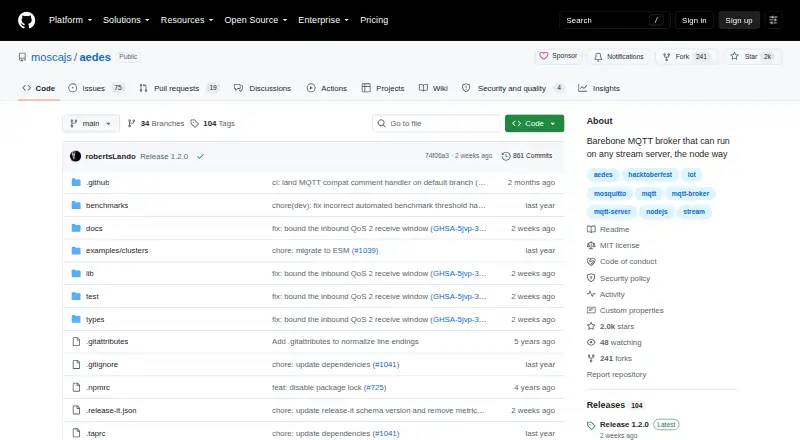
What Aedes is
Aedes is a free, MIT-licensed MQTT broker for self-hosted use or API integration. It runs on stream servers and supports MQTT 3.1 and 3.1.1, with TCP, SSL/TLS and WebSocket connections. Listed messaging features include persistence, automatic reconnect, offline buffering and a backpressure-support API. It also provides authentication and authorization, pluggable middleware and dynamic topics, and lists high availability and clustering. Persistence plugins cover in-memory storage, MongoDB, Redis, SQLite, LevelDB and NeDB. Clustering requires an on-disk database such as MongoDB or Redis; the README recommends MongoDB persistence with the Redis emitter based on tests and user reports. MQTT 5.0 is not supported yet. A message is considered valid once it passes the `authorizePublish` callback, even if the client's permissions are revoked afterward. The documented npm installation command is `npm install aedes`, and Docker documentation is linked. The project directs vulnerability reports to its GitHub security page; for production bugs or leaks, maintainers invite pull requests or contact for paid support.
Who it suits
Aedes may suit developers building self-hosted messaging systems that need MQTT 3.1 or 3.1.1 support and configurable persistence. Teams considering clustering should account for its database requirement.
What it does well
- Free under the MIT License
- Supports MQTT 3.1 and 3.1.1
- Offers TCP, SSL/TLS and WebSocket connections
- Persistence plugins cover several storage options
- Includes authentication and authorization support
What to know first
- MQTT 5.0 is not supported
- Clustering requires an on-disk database
- Revoked permissions do not invalidate already authorized messages
Plans
| Plan | Billed and limits | Price |
|---|---|---|
| Aedes | MIT-licensed open-source MQTT broker | Free |
As github.com lists them, read 4 Oct 2026. The maker's own page has the final word.
Verdict
Aedes offers core MQTT broker features, multiple connection types and a range of persistence options for self-hosted deployments. Its MQTT version limit and authorization behavior are important considerations for a project.
Facts from Aedes's own pages
- Authentication
- Aedes lists authentication and authorization support. · github.com, 4 Oct 2026
- Availability
- The project lists high availability and clustering among its features. · github.com, 4 Oct 2026
- Cluster requirements
- Clustering requires on-disk databases such as MongoDB and Redis; the README recommends MongoDB persistence with the Redis emitter based on its tests and user reports. · github.com, 4 Oct 2026
- Connections
- It supports standard TCP, SSL/TLS, and WebSocket connections. · github.com, 4 Oct 2026
- Installation
- The README gives npm install aedes as the installation command and links Docker documentation. · github.com, 4 Oct 2026
- License
- Aedes is licensed under the MIT License. · github.com, 4 Oct 2026
- Messaging features
- Listed features include message persistence, automatic reconnect, offline buffering, and a backpressure-support API. · github.com, 4 Oct 2026
- Middleware
- The broker supports pluggable middleware and dynamic topics. · github.com, 4 Oct 2026
- MQTT 5.0 limitation
- The README says MQTT 5.0 is not supported yet. · github.com, 4 Oct 2026
- Persistence integrations
- Listed persistence plugins include in-memory, MongoDB, Redis, SQLite, LevelDB, and NeDB options. · github.com, 4 Oct 2026
- Protocol support
- It is compatible with MQTT 3.1 and 3.1.1. · github.com, 4 Oct 2026
- Purpose
- Aedes is a barebone MQTT broker that can run on any stream server. · github.com, 4 Oct 2026
- Security notice
- A message is considered valid after it passes the authorizePublish callback, even if that client's permissions are revoked afterward. · github.com, 4 Oct 2026
- Support
- For production bugs or leaks, the maintainers invite pull requests or contact for paid support. · github.com, 4 Oct 2026
- Vulnerability reporting
- The security policy directs vulnerability reports to the repository's GitHub security page. · github.com, 4 Oct 2026
Where Aedes stands on Freedom251
- Message Broker Software#8 of 39