Freedom251 › Message Queue (MQ) Software
ZeroMQ
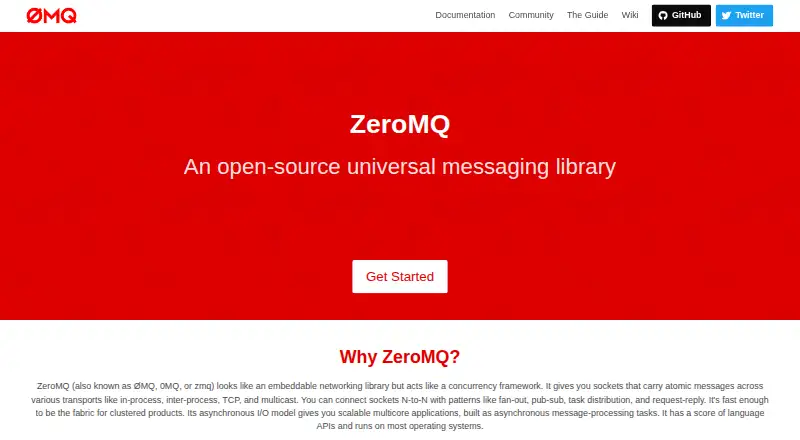
What ZeroMQ is
ZeroMQ is a messaging library for developers building distributed or concurrent applications. It can connect application components without a dedicated broker, using patterns such as publish-subscribe, request-reply, and client-server. Delivery guarantees are configurable, and messages can move over transports and protocols including TCP, UDP, in-process and inter-process communication, multicast, WebSocket, ZMTP, IPC, PGM, NORM, and TIPC. The project lists language bindings and libraries for C, C++, C#, Dart, Erlang, F#, Go, Haskell, Java, Node.js, Perl, Python, Ruby, Rust, and Zig. The libzmq library uses the MPL-2.0 license; the project says it can be used in closed-source commercial applications without a separate commercial license. libzmq and many bindings support PLAIN and CURVE security mechanisms. ZeroMQ is free and open source, with installation guidance for Linux, macOS, and Windows. Its guide includes examples and diagrams. One noted constraint: Go's zmq4 wrapper requires ZeroMQ and development files to be installed and cannot be cross-compiled.
Who it suits
ZeroMQ suits developers building distributed or concurrent applications who want messaging patterns and configurable delivery without a dedicated broker. It is available for Linux, macOS, Windows, and self-hosted deployment.
What it does well
- Can run without a dedicated message broker
- Supports publish-subscribe, request-reply, and client-server
- Offers bindings for many programming languages
- Free and open source
- Supports PLAIN and CURVE security mechanisms
What to know first
- Go's zmq4 wrapper cannot be cross-compiled
- Go's wrapper requires installed ZeroMQ development files
Limits
The listed plan is free. The Go zmq4 wrapper requires ZeroMQ and development files to be installed and cannot be cross-compiled.
Plans
| Plan | Billed and limits | Price |
|---|---|---|
| ZeroMQ | Open-source messaging library · no dedicated broker required | Free |
As zeromq.org lists them, read 4 Oct 2026. The maker's own page has the final word.
Getting started
- Open the ZeroMQ website and download page.
- Choose installation guidance for Linux, macOS, or Windows.
- Install ZeroMQ and select a listed language binding or library.
- For Windows CZMQ installation, follow the vcpkg guidance and choose shared or static libraries.
- Use the ZeroMQ Guide for examples and diagrams.
Verdict
ZeroMQ offers a broad set of messaging patterns, transports, and language bindings for application developers. Go users should account for the wrapper's installation and cross-compilation constraints.
Questions
How much does ZeroMQ cost?
The listed ZeroMQ plan costs nothing. The pricing model is free, and the pricing note identifies it as open source.
Is ZeroMQ open source?
Yes. The libzmq library is licensed under MPL-2.0. The project says commercial applications can be closed source without a separate commercial license.
Which platforms does ZeroMQ support?
The listed platforms are Linux, macOS, self-hosted, and Windows. The download page provides installation guidance for Linux distributions, macOS, and Windows.
Which programming languages have bindings?
The project lists bindings and libraries for C, C++, C#, Dart, Erlang, F#, Go, Haskell, Java, Node.js, Perl, Python, Ruby, Rust, and Zig.
Does ZeroMQ require a broker?
No dedicated message broker is required for a system using ZeroMQ.
What limitation applies to Go?
The Go zmq4 wrapper requires ZeroMQ and development files to be installed, and it cannot be cross-compiled.
Facts from ZeroMQ's own pages
- Brokerless
- A ZeroMQ system can run without a dedicated message broker. · zeromq.org, 4 Oct 2026
- Commercial use
- The site says ZeroMQ is safe to use in closed-source applications and that its share-alike terms do not apply to applications built on top of it. · zeromq.org, 4 Oct 2026
- Community
- The project describes itself as developed by a large community of contributors and provides a contribution process for core projects. · zeromq.org, 4 Oct 2026
- Documentation
- The ZeroMQ Guide covers use of ØMQ with more than 60 diagrams and 750 examples in 28 languages. · zeromq.org, 4 Oct 2026
- Downloads
- The download page provides installation guidance for macOS, Linux distributions, and Windows. · zeromq.org, 4 Oct 2026
- Intended users
- The site describes ZeroMQ as aimed at developers building distributed or concurrent applications. · zeromq.org, 4 Oct 2026
- Language bindings
- The project lists bindings and libraries for C, C++, C#, Dart, Erlang, F#, Go, Haskell, Java, Node.js, Perl, Python, Ruby, Rust, and Zig. · zeromq.org, 4 Oct 2026
- License
- The libzmq library is licensed under MPL-2.0, and the site says commercial applications do not need a separate commercial license. · zeromq.org, 4 Oct 2026
- Messaging patterns
- It supports patterns including publish-subscribe, request-reply, and client-server. · zeromq.org, 4 Oct 2026
- Notable limitation
- The site says Go's zmq4 wrapper requires ZeroMQ and development files to be installed and cannot be cross-compiled. · zeromq.org, 4 Oct 2026
- Product
- ZeroMQ is a high-performance asynchronous messaging library for distributed or concurrent applications. · zeromq.org, 4 Oct 2026
- Security
- The listed libzmq and many language bindings support PLAIN and CURVE mechanisms. · zeromq.org, 4 Oct 2026
- Transports
- It carries messages over transports including TCP, in-process, inter-process, multicast, and WebSocket. · zeromq.org, 4 Oct 2026
- Windows install
- The site documents installing CZMQ on Windows with vcpkg, including shared and static library options. · zeromq.org, 4 Oct 2026
Where ZeroMQ stands on Freedom251
- Message Queue (MQ) Software#21 of 29
- Message Broker Software#30 of 39