SocketCluster
What SocketCluster is
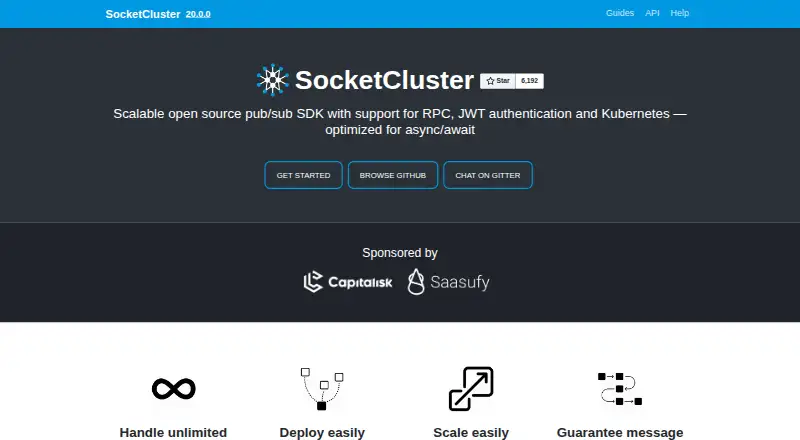
SocketCluster is a self-hosted HTTP and WebSocket server environment for building real-time systems, including pub/sub and RPC applications such as chat systems and multiplayer online games. It is designed to scale across processes on one machine and across multiple machines or instances. Its pub/sub channels are lightweight, removed automatically when no longer used, and can support millions of unique channels. Asynchronous operations in socket streams preserve message order, while server methods let operators monitor inbound and outbound backpressure. JWT is the default authentication method, with HTTP and WebSocket flows supported. Middleware streams can block connections or socket actions, and can delay or transform packets between clients and the server. After a disconnection, a client’s channels remain pending and resubscribe when it reconnects. The project is MIT-licensed and free to use, with JavaScript, Java/Android, Python, .NET, Go, Swift/iOS, Ruby and Unity clients listed by the maker. It can run with frameworks such as Express and be deployed on Kubernetes in Docker containers.
Who it suits
SocketCluster suits developers building real-time chat, multiplayer, pub/sub or RPC systems who want to host the server themselves. Its listed client libraries and deployment options may suit teams working across web and mobile clients or multiple machines.
What it does well
- Scales across processes and machines.
- Channels can support millions of unique channels.
- Socket streams preserve message order.
- Offers middleware controls for connections and packets.
- MIT-licensed and free to use.
What to know first
- Self-hosted deployment requires operating the server.
- Getting-started guide lists Node.js v10 as a requirement.
- Docker CLI and kubectl are optional deployment dependencies.
Plans
| Plan | Billed and limits | Price |
|---|---|---|
| SocketCluster | Open-source software; no paid plans are listed on the maker’s site. · MIT licensed · self-hosted deployment | Free |
As socketcluster.io lists them, read 8 Oct 2026. The maker's own page has the final word.
Getting started
- Open the SocketCluster website and documentation.
- Install Node.js v10 as required by the getting-started guide.
- Use the CLI and deployment YAML files for Kubernetes deployment if needed.
- Use Docker CLI and kubectl as optional dependencies for the Kubernetes route.
- Choose a listed client library for the application platform.
SocketCluster is a self-hosted server environment for developers building real-time applications over HTTP and WebSockets. It is a strong fit for chat, multiplayer games and other pub/sub or RPC systems that need to scale across processes or machines. Its appeal is control over messaging and connection behavior without a paid plan; its cost is owning deployment and operations.
Overview
SocketCluster combines HTTP and WebSocket support with pub/sub and RPC patterns. It is designed to scale vertically across processes and horizontally across machines or instances, so teams can choose how to distribute the server as their system grows. That flexibility is useful for engineering teams managing their own infrastructure, but less suitable for anyone looking for a hosted service that removes operational work.
Its pub/sub channels are lightweight, cleaned up automatically when unused and designed to support millions of unique channels. That makes the model a natural fit for applications with many transient topics or rooms, such as chat and multiplayer games.
Key features
Message flow and recovery
Asynchronous operations in socket streams preserve processing order per queue, helping applications that depend on sequential message handling. Methods for monitoring inbound and outbound backpressure also give operators a way to observe pressure in the message flow. When a client disconnects, its channels enter a pending state and resubscribe automatically after reconnection, reducing the need to rebuild subscriptions manually.
Authentication and access control
JWT is the default authentication mechanism, with both HTTP-based and WebSocket-based flows supported. Middleware streams can block connections or socket actions, and can delay or transform packets traveling between client and server. This gives teams control over both who connects and how socket traffic is handled.
Frameworks and deployment
SocketCluster can run with frameworks such as Express, and its deployment tooling includes Kubernetes shortcut commands and deployment YAML files for Kubernetes inside Docker containers. These are useful starting points for teams already operating that stack, but do not remove the need to manage the deployment. The getting-started guide names Node.js v10 as a requirement; Docker CLI and kubectl are optional dependencies.
The maker’s site lists clients for JavaScript, Java/Android, Python, .NET, Go, Swift/iOS, Ruby and Unity. That breadth can help teams support clients across a range of application stacks. Documentation, an API reference and community chat on Gitter provide routes to technical guidance. The project is distributed under the MIT License.
Pricing
SocketCluster is open-source software with a free plan at no cost, under the MIT License, for self-hosted deployment. There is no free trial and no paid plan. The absence of a subscription makes it an option for teams that can provide their own infrastructure and operational effort; it is not a way to avoid hosting costs or server management.
Platforms
SocketCluster supports Android, iOS, Linux, web, API and self-hosted use. The client libraries span several languages and platforms, while the deployment model remains self-hosted. HTTP and WebSocket are the supported protocols.
Who it's for
Choose SocketCluster if you are building a real-time system with pub/sub or RPC requirements and want control over scaling, authentication and socket-level access rules. It is particularly well matched to teams that can operate Node.js-based services and want Kubernetes deployment options. Look elsewhere if you need a managed hosting option or prefer not to own deployment and ongoing operations.
Pros and cons
- Pros: Scaling across processes and machines supports more than a single-process deployment model.
- Pros: Per-queue message ordering, backpressure monitoring and automatic channel resubscription address practical messaging and reconnection concerns.
- Pros: JWT authentication and middleware controls offer several points to govern connections, actions and packets.
- Pros: The MIT-licensed, self-hosted software has no paid plan, and its client libraries cover multiple languages.
- Cons: Self-hosting means the team must provide infrastructure and handle operations rather than purchasing a managed service.
- Cons: The getting-started guide names Node.js v10 as a requirement, which teams must account for when evaluating their runtime setup.
Alternatives
Compare message broker software if you want to assess SocketCluster alongside a broader category of tools.
- Lightstreamer is worth considering if a freemium option with a free trial and a demo capped at 20 concurrent client connections better suits your evaluation.
- Eclipse Amlen is another free option for readers comparing self-hosted messaging software across Android, iOS, Linux and web.
- EMQX may suit readers who want a freemium serverless plan with a free monthly quota and up to 1,000 connections, with usage-based billing beyond the quota.
- Faye is an alternative open-source option under the Apache 2.0 license.
- TIBCO FTL offers a free Community Edition download alongside its Enterprise Edition.
- Apache Artemis is a free, self-hosted broker under the Apache License 2.0 and requires Java 17 or later.
- Apache Qpid Broker-J is another free, self-hosted broker with no paid plan or usage limits stated.
- Apache RocketMQ is a free, open-source option under the Apache License 2.0.
Verdict
SocketCluster is a sound choice for developers building chat, games or other real-time pub/sub and RPC applications who want ordered per-queue processing, connection controls and room to scale on infrastructure they operate. Its main reason to choose it is the combination of messaging and access-control features in an MIT-licensed, self-hosted package with no paid plan. Look elsewhere if you need managed hosting or want to avoid taking responsibility for deployment and operations.
Verdict
SocketCluster combines real-time messaging, authentication, access controls and scaling in a self-hosted server environment. Its listed clients, deployment options and per-queue ordering guarantee are useful details to weigh against the operational requirements of hosting it.
Questions
How much does SocketCluster cost?
The listed SocketCluster plan is free. No paid plans are listed on the maker’s site.
Is SocketCluster open source?
Yes. The repository states that SocketCluster is distributed under the MIT License.
Which protocols does it support?
SocketCluster supports HTTP and WebSocket.
Can SocketCluster run on Kubernetes?
Yes. The maker provides Kubernetes deployment YAML files and CLI shortcut commands. Docker CLI and kubectl are optional dependencies in the getting-started guide.
What client libraries are available?
The maker lists JavaScript, Java/Android, Python, .NET, Go, Swift/iOS, Ruby, and Unity clients.
Facts from SocketCluster's own pages
- Access control
- Middleware streams can block connections and socket actions, and can delay or transform packets sent between client and server. · socketcluster.io, 8 Oct 2026
- Authentication
- JWT is the default authentication mechanism, with HTTP-based and WebSocket-based flows supported. · socketcluster.io, 8 Oct 2026
- Channels
- The maker says pub/sub channels are lightweight, automatically cleaned up when unused, and can support millions of unique channels. · socketcluster.io, 8 Oct 2026
- Client libraries
- The maker’s site lists JavaScript, Java/Android, Python, .NET, Go, Swift/iOS, Ruby, and Unity clients. · socketcluster.io, 8 Oct 2026
- Deployment
- The CLI provides Kubernetes shortcut commands, and the maker provides Kubernetes deployment YAML files. · socketcluster.io, 8 Oct 2026
- Integrations
- The documentation describes running SocketCluster with frameworks such as Express and deploying it on Kubernetes inside Docker containers. · socketcluster.io, 8 Oct 2026
- License
- The SocketCluster repository states that the project is distributed under the MIT License. · github.com, 8 Oct 2026
- Message handling
- Asynchronous operations in socket streams preserve message processing order, and the server exposes methods to monitor inbound and outbound backpressure. · socketcluster.io, 8 Oct 2026
- Purpose
- SocketCluster is an HTTP and WebSockets server environment for building scalable, multi-process real-time systems such as pub/sub and RPC applications. · socketcluster.io, 8 Oct 2026
- Reconnect behavior
- When a client loses its connection, its channels enter a pending state and automatically resubscribe after reconnection. · socketcluster.io, 8 Oct 2026
- Requirements
- The getting-started guide lists Node.js v10 as a requirement and Docker CLI and kubectl as optional dependencies. · socketcluster.io, 8 Oct 2026
- Scaling
- It is designed to scale vertically across processes and horizontally across machines or instances. · socketcluster.io, 8 Oct 2026
- Support
- The maker’s site links to community chat on Gitter and provides documentation and an API reference. · socketcluster.io, 8 Oct 2026
- Use cases
- The maker describes SocketCluster as suitable for chat systems and multiplayer online games. · socketcluster.io, 8 Oct 2026
Where SocketCluster stands on Freedom251
- WebSocket Tools#9 of 55
- Message Broker Software#25 of 39