Freedom251 › Unified Endpoint Management Software
myMDM
What myMDM is
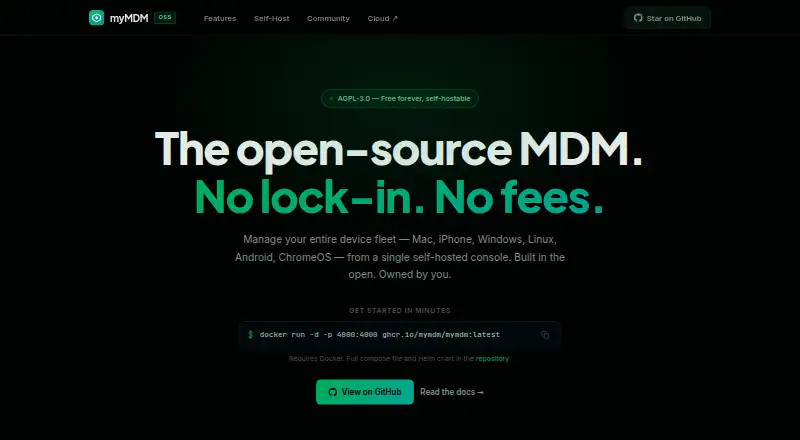
myMDM is an open-core unified endpoint management platform for managing device fleets from one console. Its listed device coverage includes Mac computers, iPhone, Windows, Linux, Android, ChromeOS and cloud VMs. The self-hosted core, released under AGPL-3.0, includes a policy engine, platform agents, enrollment, app management, identity federation and a web console. Device management capabilities include Apple Declarative Device Management and classic MDM, Android Management API, Windows OMA-DM, a Linux agent and ChromeOS enrollment. Policies cover passcodes, Wi-Fi, VPN, restrictions, OS updates, compliance, mobile threat defense integration, geofencing and workflow automation. App management includes Apple VPP/ABM managed apps, Google Play managed configurations, an enterprise app catalog, AppConfig.org and automated third-party patching for 100+ titles. Identity options include LDAP/AD sync, SAML 2.0, OIDC, SCIM 2.0 provisioning, just-in-time provisioning and role-based access control with IdP role mapping. The managed product is marked “Coming Soon,” with a waitlist for early access. The Free plan costs nothing and covers up to 25 devices; Pro costs $4 a month. Self-hosting supports Docker, Docker Compose and Helm.
Who it suits
The Free plan is described for individuals and small teams, while Pro is aimed at IT teams. Enterprise is intended for MSPs and large organizations. Teams choosing it can manage a mixed fleet across the listed operating systems, with self-hosting available for the open-source core.
What it does well
- Covers six operating system families, including ChromeOS and Linux.
- Self-hosted core is released under AGPL-3.0.
- Free plan supports up to 25 devices.
- Policies include compliance rules, geofencing and workflow automation.
- App management includes automated patching for 100+ titles.
- Identity options include SAML 2.0, OIDC and SCIM 2.0.
What to know first
- Managed product is marked “Coming Soon.”
- Free plan is limited to 25 devices.
- Self-hosting requires Docker 24+ or Kubernetes 1.28+, PostgreSQL 15+ and public HTTPS.
Limits
The Free plan covers up to 25 devices and includes core MDM policies, basic app management and community support. The Pro plan is $4 a month and includes unlimited devices, AI fleet automation, DEX analytics, third-party patching, MTD integration, identity federation, remote support and priority support.
Plans
| Plan | Billed and limits | Price |
|---|---|---|
| Free | $0/mo · up to 25 devices · all 6 platforms · core MDM policies · basic app management · community support | Free |
| Pro | $4/device/mo · unlimited devices · AI fleet automation · DEX analytics · third-party patching · MTD integration · SAML/OIDC identity federation · TeamViewer/Splashtop remote support · priority support | $4 a month |
| Enterprise | Custom · everything in Pro · MSP organization hierarchy · white-label and custom domain · ZTNA posture API · per-app VPN · SLA and dedicated support · on-premises deployment | On request |
As mymdm.org lists them, read 15 Oct 2026. The maker's own page has the final word.
Getting started
- Visit https://mymdm.org/ and join the waitlist for early access to the managed product.
- Choose the Free plan for up to 25 devices or Pro at $4 a month.
- For self-hosting, use Docker, Docker Compose or Helm.
- For self-hosting, provide Docker 24+ or Kubernetes 1.28+, PostgreSQL 15+ and a public HTTPS endpoint for Apple APNs and Android AMAPI callbacks.
Overview
myMDM is an open-core unified endpoint management platform that brings device fleets into one console. Its strongest case is the combination of broad device coverage, policy controls, app management and identity features, with a self-hosted edition for teams that want to run the core themselves.
The free tier’s 25-device cap makes it a practical starting point for individuals and small teams, while Pro removes the device limit and adds capabilities aimed at IT teams. The managed product is still marked “Coming Soon,” so buyers seeking a hosted service should weigh that against the current self-hosting option.
Key features
Device support spans Apple Declarative Device Management and classic MDM, Android Management API, Windows OMA-DM, a Linux agent and ChromeOS enrollment. The supported fleet types also include cloud VMs. That breadth is useful for organizations managing mixed estates, though the Free plan’s 25-device ceiling limits how far a growing fleet can go without a plan change.
Policies cover passcodes, Wi-Fi, VPN, restrictions, operating system updates and compliance rules, alongside mobile threat defense integration, geofencing and workflow automation. This makes myMDM relevant to teams that need more than enrollment and inventory, particularly when device rules and response workflows need to sit in the same management system.
App management combines Apple VPP and ABM managed apps, Google Play managed configurations, an enterprise app catalog, AppConfig.org and automated third-party patching for more than 100 titles. The patching capability is a meaningful Pro addition for teams maintaining a larger application estate; basic app management is included on Free.
Identity capabilities include LDAP and Active Directory synchronization, SAML 2.0, OIDC, SCIM 2.0 provisioning, just-in-time provisioning and role-based access control with identity-provider role mapping. The managed product also lists Entra ID, Okta Device Trust, Cloudflare Access, Zscaler, TeamViewer and Splashtop integrations. The web console provides SIEM-compatible audit logs, and remote-support sessions are recorded and audited.
The self-hosted core is licensed under AGPL-3.0 and includes the policy engine, platform agents, enrollment, app management, identity federation and web console. Deployment supports Docker, Docker Compose and Helm, with Docker 24+ or Kubernetes 1.28+, PostgreSQL 15+ and a public HTTPS endpoint required for Apple APNs and Android AMAPI callbacks. The recommended 2 vCPU and 4 GB RAM for up to 500 devices is useful capacity guidance, but teams still need to operate the deployment themselves.
Pricing
Free — free. This plan supports up to 25 devices across all six platforms and includes core MDM policies, basic app management and community support. It suits individuals and small teams evaluating or managing a modest fleet. The device cap and community-only support are the main trade-offs.
Pro — $4 a month. Pro includes unlimited devices, AI fleet automation, DEX analytics, third-party patching, mobile threat defense integration, SAML/OIDC identity federation, remote support through TeamViewer or Splashtop, and priority support. It is the more suitable tier for IT teams that need fleet growth, identity controls or the additional operational features. The price is monthly; no annual term or trial terms are stated.
Enterprise — custom pricing. Aimed at MSPs and large organizations, it includes everything in Pro plus MSP organization hierarchy, white-labeling and a custom domain, ZTNA posture API, per-app VPN, SLA and dedicated support, and on-premises deployment. This is the fit for organizations that need those service and deployment options, though its cost depends on custom pricing.
Platforms
myMDM supports macOS, iOS, Windows, Linux, Android and ChromeOS, with web access and a self-hosted deployment option. The platform list also includes an API. Application management, automated enrollment and policy management are supported, giving administrators coverage from device setup through ongoing controls.
Who it's for
myMDM is a good fit for small teams that can work within 25 devices and want core fleet management at no charge, or IT teams that need unlimited devices plus the Pro identity, patching, analytics and support features. Organizations with administrators comfortable running Docker or Kubernetes can also make use of the AGPL-3.0 self-hosted core.
It is less compelling for a buyer who needs a managed service immediately: that product is marked “Coming Soon,” with a waitlist for early access. Teams that do not want to operate infrastructure should consider that constraint before choosing the self-hosted route.
Pros and cons
- Pros: Free covers up to 25 devices and all six platforms, giving small fleets room to manage multiple operating systems without a paid plan.
- Pros: The self-hosted AGPL-3.0 core includes policy, enrollment, app management, identity federation and the web console, making it a substantial option for teams able to run their own deployment.
- Pros: Pro combines unlimited devices with identity federation, third-party patching, MTD integration and remote support, addressing several common fleet operations in one tier.
- Cons: Free stops at 25 devices, so teams with larger fleets need Pro or Enterprise.
- Cons: The managed product is not yet generally available; buyers seeking hosted management now face a waitlist.
- Cons: Self-hosting has infrastructure requirements, including PostgreSQL and a public HTTPS endpoint for platform callbacks, which adds operational responsibility.
Alternatives
For a broader comparison, see Unified Endpoint Management Software.
Consider FileWave if its free Community Edition’s published allowance of up to 15 computers, 15 tablets and 15 Chrome devices better matches your fleet.
Relution is an alternative if a free plan for up to five devices, with shared cloud or on-premises deployment and unlimited duration, is sufficient.
Choose Miradore if a free plan covering up to 50 devices after a 14-day trial is a better fit for your fleet size.
SureAsset is an alternative for teams focused on asset lifecycle management, hardware and software license tracking, and API access and automation.
Consider OpenUEM if you want a free, open-source endpoint management option.
ManageEngine Endpoint Central is another option, with a free edition for 25 endpoints.
UNO UEM is an alternative with per-device pricing scaled to fleet size and needs, and full platform access across six platforms.
BlackBerry AtHoc is another paid alternative.
Verdict
myMDM is a strong fit for small fleets that want a broad free MDM foundation, and for IT teams ready to pay for unlimited devices and deeper identity, patching and support capabilities. Its open-source self-hosted core adds a useful path for organizations that want control over deployment. Look elsewhere if you need a managed service today or want to avoid running the infrastructure yourself.
Verdict
myMDM is a fit for individuals and small teams seeking core fleet management at no charge, or IT teams that need the listed policy, app and identity capabilities. The self-hosted core gives teams an AGPL-3.0 option. Buyers seeking the managed product should consider that it is marked “Coming Soon” and currently offers a waitlist for early access.
Questions
Is myMDM free?
Yes. The Free plan is listed as free and supports up to 25 devices.
What platforms does myMDM support?
Listed platforms are Android, API, iOS, Linux, macOS, self-hosted, web and Windows. Supported operating systems also include ChromeOS.
Is myMDM open source?
Its self-hosted core is released under AGPL-3.0. The core includes the policy engine, platform agents, enrollment, app management, identity federation and web console.
When can I use the managed product?
The managed product is marked “Coming Soon.” Visitors can join a waitlist for early access.
What does Pro cost?
Pro costs $4 a month and includes unlimited devices, AI fleet automation, DEX analytics, third-party patching, MTD integration, identity federation, remote support and priority support.
Who makes myMDM?
The product website is https://mymdm.org/. The listed facts do not name a maker.
Facts from myMDM's own pages
- AI automation
- The planned cloud tier describes natural-language fleet queries, anomaly detection, predictive compliance and plain-English policy generation. · getmymdm.com, 15 Oct 2026
- Android management
- Android devices are managed through the Android Management API and Android Zero-Touch enrollment. · mymdm.org, 15 Oct 2026
- API and extensibility
- The project advertises an Open API, webhooks and a gRPC plugin SDK with a Go SDK for custom integrations, policy enforcers and data connectors. · mymdm.org, 15 Oct 2026
- Apple management
- Apple support combines Declarative Device Management with classic MDM and includes SCEP, APNs lifecycle handling and ABM/ASM zero-touch enrollment. · mymdm.org, 15 Oct 2026
- Application management
- App controls include Apple VPP/ABM apps, Google Play managed configurations, an enterprise catalog, AppConfig.org and automated patching for more than 100 titles. · mymdm.org, 15 Oct 2026
- App management
- App features include Apple VPP/ABM managed apps, Google Play managed configurations, an enterprise app catalog, AppConfig.org, and automated third-party patching for 100+ titles. · mymdm.org, 9 Oct 2026
- Availability
- The managed product is marked “Coming Soon” and invites visitors to join a waitlist for early access. · getmymdm.com, 9 Oct 2026
- Capacity guidance
- The site recommends 2 vCPU and 4 GB RAM for deployments of up to 500 devices. · mymdm.org, 9 Oct 2026
- Cloud availability
- The managed cloud site labels the service as coming soon and invites visitors to join an early-access waitlist. · getmymdm.com, 15 Oct 2026
- Device management
- Listed capabilities include Apple Declarative Device Management and classic MDM, Android Management API, Windows OMA-DM, Linux agent, and ChromeOS enrollment. · mymdm.org, 9 Oct 2026
- Documentation depth
- The project links self-hosting, API-reference and contributing documentation through its GitHub project and provides Docker, Compose and Helm examples. · mymdm.org, 15 Oct 2026
- Identity
- Identity features include LDAP/AD sync, SAML 2.0, OIDC, SCIM 2.0 provisioning, just-in-time provisioning, and role-based access control with IdP role mapping. · mymdm.org, 9 Oct 2026
- Identity federation
- Identity features include LDAP/AD synchronization, SAML 2.0, OIDC, SCIM 2.0, just-in-time provisioning and IdP-to-RBAC role mapping. · mymdm.org, 15 Oct 2026
- Independent company association
- The G2 seller page associates its myMDM listing with Quadient, whose profile states a 1924 founding year and headquarters in Bagneux, France. · g2.com, 15 Oct 2026
- Independent company size
- The G2 category page reports 3,976 LinkedIn employees for Quadient in the myMDM listing metadata. · g2.com, 15 Oct 2026
- Independent listing deployment
- That GoodFirms entry describes its listed myMDM as cloud-hosted and web-based, with iPhone/iPad, Android, Windows and Mac support. · goodfirms.co, 15 Oct 2026
- Independent listing features
- GoodFirms lists application management, asset management, deployment management, device enrollment, location tracking, remote maintenance, rewards and gamification, and security management for its entry. · goodfirms.co, 15 Oct 2026
- Independent listing identity
- GoodFirms lists a myMDM product whose website is datacapturesolutions.co.uk, indicating that its directory entry may refer to a different or older product than mymdm.org. · goodfirms.co, 15 Oct 2026
- Independent listing pricing
- GoodFirms marks the listed product's pricing as contact-vendor and quote-based, with no free version. · goodfirms.co, 15 Oct 2026
- Independent listing support
- GoodFirms says its listed product offers phone support and knowledge resources including help guides, video guides and blogs. · goodfirms.co, 15 Oct 2026
- Independent review volume
- GoodFirms reports that no reviews had been submitted for its myMDM listing. · goodfirms.co, 15 Oct 2026
- Integrations
- The managed product lists Entra ID, Okta Device Trust, Cloudflare Access, Zscaler, TeamViewer, and Splashtop integrations. · getmymdm.com, 9 Oct 2026
- Intended users
- The site describes the Free plan for individuals and small teams, Pro for IT teams, and Enterprise for MSPs and large organizations. · getmymdm.com, 9 Oct 2026
- Licence
- The self-hosted core is released under the GNU Affero General Public License version 3.0. · mymdm.org, 15 Oct 2026