Freedom251 › OS Deployment Software
Matchbox
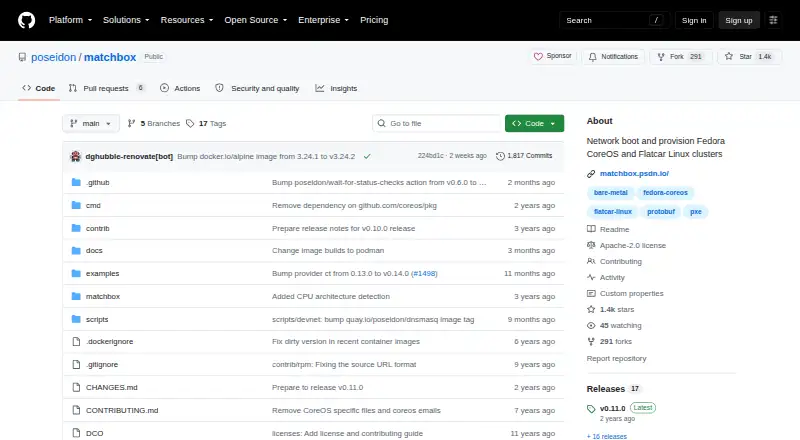
What Matchbox is
Matchbox matches bare-metal machines with profiles for network booting and cluster provisioning. It provisions Fedora CoreOS or Flatcar Linux with Ignition configuration, and can select a profile using hardware labels such as a machine’s MAC address or UUID. For booting, Matchbox supports iPXE chainloading and can render network boot configuration for iPXE and GRUB2 clients.
Clients can use HTTP endpoints or an authenticated gRPC API to create and update resources. The gRPC API uses TLS credentials for client authentication and secure communication. Terraform usage is documented, and a provider plugin is available. Matchbox can run as a Linux binary, a container image, or on a Kubernetes cluster. Poseidon also provides dnsmasq as a container for DHCP, TFTP, and DNS services.
The maker describes Matchbox for use with client machines in a lab or datacenter. It is free, open-source software and can be self-hosted on Linux. The installation guide instructs users to verify release signatures with the maker’s GPG signing key. Example Kubernetes manifests use ephemeral emptyDir storage; the guide recommends replacing that with persistent storage when available.
Who it suits
Matchbox suits administrators provisioning bare-metal client machines in a lab or datacenter, especially when they need network booting for Fedora CoreOS or Flatcar Linux. It also fits teams that want to manage resources through its APIs or Terraform provider and operate the service themselves.
What it does well
- Matches machines to profiles using MAC addresses or UUIDs.
- Supports iPXE chainloading and iPXE and GRUB2 configurations.
- Provides HTTP endpoints and an authenticated, TLS-secured gRPC API.
- Can run as a Linux binary, container, or Kubernetes service.
- Free open-source software with documented Terraform support.
What to know first
- Provisioning facts cover Fedora CoreOS and Flatcar Linux.
- Kubernetes example manifests use ephemeral storage by default.
Limits
The provisioning facts cover Fedora CoreOS and Flatcar Linux. The example Kubernetes manifests use ephemeral emptyDir storage, and the guide recommends persistent storage when available.
Plans
| Plan | Billed and limits | Price |
|---|---|---|
| Matchbox | Open-source software · self-hosted service | Free |
As github.com lists them, read 7 Oct 2026. The maker's own page has the final word.
Getting started
- Open the Matchbox project website.
- Choose a deployment route: Linux binary, container image, or Kubernetes cluster.
- Follow the installation guide and verify release signatures with the maker’s GPG signing key.
- Configure profiles and hardware labels such as MAC addresses or UUIDs.
- Set up network booting with iPXE or GRUB2 clients.
- For Kubernetes, replace ephemeral emptyDir storage with persistent storage when available.
Verdict
Choose Matchbox to match bare-metal machines to profiles and provision Fedora CoreOS or Flatcar Linux over the network. Its free self-hosted deployment and Terraform support suit lab and datacenter setups.
Questions
How much does Matchbox cost?
The listed Matchbox plan is free. It is open-source software and a self-hosted service.
Which operating systems does it provision?
Matchbox provisions Fedora CoreOS or Flatcar Linux using Ignition configuration.
How can Matchbox be deployed?
It can run as a Linux binary, a container image, or on a Kubernetes cluster.
Does Matchbox support Terraform?
Yes. Terraform usage is documented, and a provider plugin for Matchbox is available.
How does it match machines to profiles?
It can use hardware labels such as MAC addresses or UUIDs.
What storage do the Kubernetes examples use?
The example manifests use ephemeral emptyDir storage. The guide recommends replacing it with persistent storage when available.
Facts from Matchbox's own pages
- APIs
- Matchbox provides HTTP endpoints and an authenticated gRPC API for clients to create or update resources. · github.com, 7 Oct 2026
- Audience
- The maker describes Matchbox as serving client machines in a lab or datacenter. · github.com, 7 Oct 2026
- Boot support
- Matchbox can chainload via iPXE and render network boot configuration for iPXE and GRUB2 clients. · github.com, 7 Oct 2026
- Deployment
- The service can run as a Linux binary, a container image, or on a Kubernetes cluster. · github.com, 7 Oct 2026
- Hardware matching
- Machines can be matched to profiles by hardware labels such as MAC address or UUID. · matchbox.psdn.io, 7 Oct 2026
- Integration
- The maker documents Terraform usage and provides a Terraform provider plugin for Matchbox. · matchbox.psdn.io, 7 Oct 2026
- Operational limit
- The example Kubernetes manifests use ephemeral emptyDir storage, and the guide recommends replacing it with persistent storage when available. · github.com, 7 Oct 2026
- Provisioning
- It provisions Fedora CoreOS or Flatcar Linux using Ignition configuration. · matchbox.psdn.io, 7 Oct 2026
- Purpose
- Matchbox matches bare-metal machines to profiles for PXE booting and provisioning clusters. · matchbox.psdn.io, 7 Oct 2026
- Related tools
- Poseidon provides dnsmasq as a container for DHCP, TFTP, and DNS services. · github.com, 7 Oct 2026
- Release verification
- The installation guide instructs users to verify release signatures with the maker's GPG signing key. · github.com, 7 Oct 2026
- Security
- The gRPC API uses TLS credentials for client authentication and a secure communication channel. · github.com, 7 Oct 2026
Where Matchbox stands on Freedom251
- OS Deployment Software#10 of 29