Freedom251 › OS Deployment Software
FAI (Fully Automatic Installation)
Visit FAI (Fully Automatic Installation) Alternatives Pricing
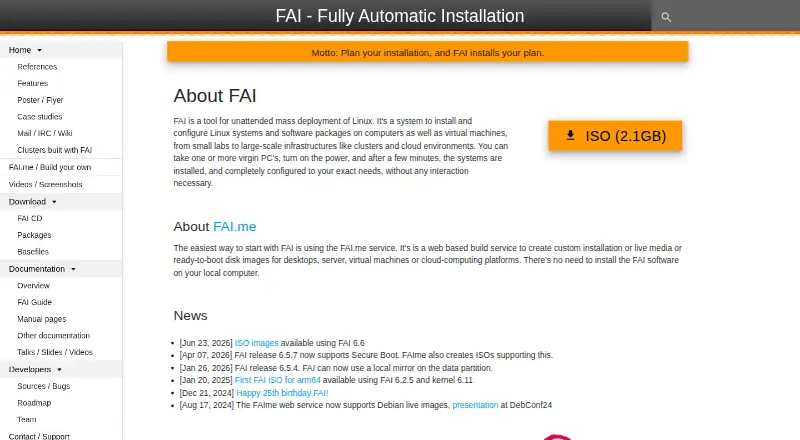
What FAI (Fully Automatic Installation) is
FAI (Fully Automatic Installation) automates unattended installation and configuration of Linux systems and software on computers and virtual machines. It is free software under GNU GPL version 2 or later, and the project dates to 1999. The maker describes use from a few computers to several thousand, for desktops, servers, notebooks, clusters, server farms and Linux labs or classrooms. Supported distributions include Debian, Ubuntu, Rocky Linux, AlmaLinux, Linux Mint, RHEL and SUSE. Machines can boot over PXE or from unattended CD media, with configuration retrieved through HTTP, NFS, SVN or Git. FAI groups similar machines into classes and uses hooks to customize installation stages. It can partition disks, create file systems and set up software RAID or LVM, as well as automate virtual machine installations and build customized cloud images for OpenStack, KVM, Azure, EC2 and GCE. FAI.me is a web service for creating custom installation or live media and bootable disk images without a local FAI installation. Its options include SSH keys, partitioning, repositories, packages, scripts and first-boot actions.
Who it suits
FAI suits administrators managing Linux desktops, servers, clusters or labs who need repeatable unattended installations. Its documented scale also makes it relevant to environments ranging from a few machines to several thousand.
What it does well
- Free software under GNU GPL version 2 or later.
- Supports multiple Linux distributions.
- Offers PXE and unattended CD installation methods.
- Can configure RAID, LVM and disk partitions.
- FAI.me builds custom media without local installation.
What to know first
- Some distributions fetch remaining packages over the network.
- Questions and bug reports use mailing list and Debian BTS.
Limits
The software is free under GNU GPL version 2 or later. The default large FAI CD includes Debian XFCE and GNOME packages; for several other listed distributions it includes base files, with remaining packages fetched over the network.
Plans
| Plan | Billed and limits | Price |
|---|---|---|
| FAI | Free software under GNU GPL version 2 or later | Free |
As fai-project.org lists them, read 7 Oct 2026. The maker's own page has the final word.
Getting started
- Visit the FAI project website.
- Choose whether to use FAI or build media with the FAI.me web service.
- For FAI installations, prepare PXE network boot or unattended CD media.
- Provide configuration data over HTTP, NFS, SVN or Git.
- Set classes and hooks for the machines and installation stages.
- Use FAI.me settings for items such as packages, SSH keys, partitioning and first-boot actions.
Verdict
FAI covers unattended Linux deployment across physical and virtual machines, with configuration hooks, storage setup and cloud-image support. Its free software model and FAI.me media builder are useful options for teams planning repeatable Linux installations.
Questions
How much does FAI cost?
The listed FAI plan costs nothing. FAI is free software under GNU GPL version 2 or later.
Which Linux distributions does it support?
The project lists Debian, Ubuntu, Rocky Linux, AlmaLinux, Linux Mint, RHEL and SUSE among supported distributions.
How can FAI install systems?
Installations can use PXE network boot or unattended CD media. Configuration data can come through HTTP, NFS, SVN or Git.
Can FAI create virtual machine or cloud images?
Yes. It supports automated virtual machine installation and customized images for OpenStack, KVM, Azure, EC2 and GCE.
Can I build installation media without installing FAI?
Yes. The FAI.me web service builds custom installation or live media and bootable disk images.
Where can users get support?
The project directs questions to its mailing list and bug reports to the Debian Bug Tracking System. Commercial support is available worldwide from the author.
Facts from FAI (Fully Automatic Installation)'s own pages
- Configuration
- FAI uses classes to group similar machines and hooks to customize installation stages. · fai-project.org, 7 Oct 2026
- Deployment scale
- FAI is described as scaling from a few computers to several thousand machines. · fai-project.org, 7 Oct 2026
- FAI.me
- FAI.me is a web service for building custom installation or live media and bootable disk images without installing FAI locally. · fai-project.org, 7 Oct 2026
- FAI.me options
- The image builder exposes settings for SSH keys, partitioning, repositories, desktop and packages, custom scripts, and first boot actions. · fai-project.org, 7 Oct 2026
- Founded
- 1999 · fai-project.org, 28 Sept 2026
- Installation media limit
- The default large FAI CD image includes packages for Debian XFCE and GNOME but only base files for several other listed distributions, whose remaining packages are fetched over the network. · fai-project.org, 7 Oct 2026
- Installation methods
- Installations can use PXE network boot or unattended CD media, with configuration data retrieved through HTTP, NFS, SVN or Git. · fai-project.org, 7 Oct 2026
- Integrations
- The maker documents receiving configuration over HTTP, NFS, SVN or Git, and adding SSH public keys from GitHub, GitLab, Debian Salsa or a custom URL in FAI.me. · fai-project.org, 7 Oct 2026
- Intended environments
- The maker lists desktops, servers, notebooks, clusters, server farms, and Linux labs or classrooms as installation targets. · fai-project.org, 7 Oct 2026
- Operating systems
- The project lists Debian, Ubuntu, Rocky Linux, AlmaLinux, Linux Mint, RHEL and SUSE among supported Linux distributions. · fai-project.org, 7 Oct 2026
- Purpose
- FAI automates unattended mass deployment and configuration of Linux systems and software on computers and virtual machines. · fai-project.org, 7 Oct 2026
- Security
- FAI packages are signed with Thomas Lange's GPG key, and the project lists Secure Boot support in FAI release 6.5.7. · fai-project.org, 7 Oct 2026
- Storage
- The project lists software RAID and LVM setup, disk partitioning, and file system creation as installation capabilities. · fai-project.org, 7 Oct 2026
- Support
- The project directs questions to its mailing list and bugs to the Debian Bug Tracking System, and says commercial support is available worldwide from the author. · fai-project.org, 7 Oct 2026
- Virtualization and cloud
- FAI supports automated virtual machine installation and customized cloud images for platforms including OpenStack, KVM, Azure, EC2 and GCE. · fai-project.org, 7 Oct 2026
Where FAI (Fully Automatic Installation) stands on Freedom251
- OS Deployment Software#7 of 29
- Bare Metal Provisioning Software#8 of 28
- OS Imaging & Deployment Software#7 of 24