Freedom251 › OS Deployment Software
OpenStack Ironic
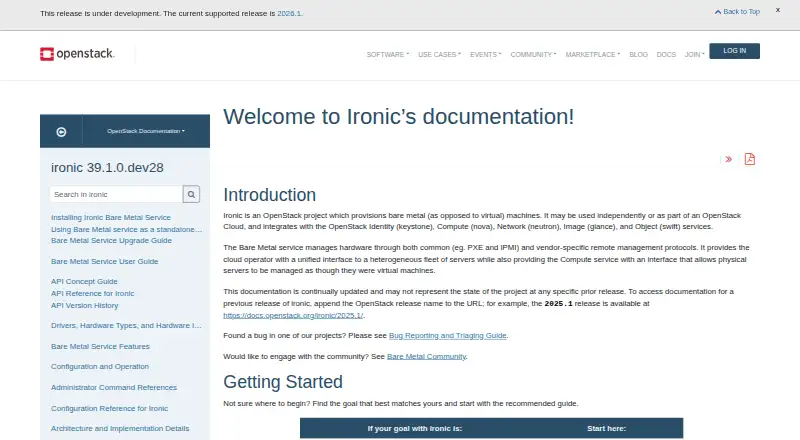
What OpenStack Ironic is
OpenStack Ironic provisions physical, bare-metal machines. It can run as a standalone service or as part of an OpenStack cloud, and manages hardware using common protocols such as PXE and IPMI alongside vendor-specific remote management protocols. Its documented hardware lifecycle covers inspection, deployment, cleaning, adoption, retirement, RAID and BIOS configuration, firmware updates and rescue.
Ironic supports several deployment arrangements: standalone, OpenStack without Nova, or a full OpenStack deployment with Nova and Placement. The standalone scenario is described for one to hundreds of nodes, but it does not provide multi-tenancy. Ironic integrates with OpenStack Identity (Keystone), Compute (Nova), Network (Neutron), Image (Glance) and Object (Swift). API authentication and authorization use Keystone and a Secure RBAC model.
Ironic is free and the OpenStack project is licensed under Apache 2.0. By default, provisioned nodes use a flat network, without safeguards against tenant interactions; integrating OpenStack services can provide tenant-network isolation. Default cleaning erases local drives after instance deletion, but does not reset BIOS, reflash firmware or erase peripheral devices. Operators are advised to assess and secure their own environments.
Who it suits
Ironic suits operators provisioning bare-metal hardware, whether in a standalone deployment or as part of OpenStack. Its lifecycle tools cover hardware preparation through retirement, while its documented integrations support deployments using other OpenStack services.
What it does well
- Provisions bare-metal machines standalone or within OpenStack
- Uses PXE, IPMI and vendor-specific remote management protocols
- Covers inspection, deployment, cleaning, adoption and retirement
- Supports RAID and BIOS configuration, firmware updates and rescue
- Integrates with Keystone, Nova, Neutron, Glance and Swift
- Free and licensed under Apache 2.0
What to know first
- The standalone scenario does not provide multi-tenancy
- Default flat networking does not isolate tenant interactions
- Default cleaning does not reset BIOS, reflash firmware or erase peripherals
Limits
The standalone deployment scenario is listed for one to hundreds of nodes but does not provide multi-tenancy. By default, nodes use a flat network, and disk cleaning does not reset BIOS, reflash firmware or erase peripheral devices.
Plans
| Plan | Billed and limits | Price |
|---|---|---|
| OpenStack Ironic | No price or plan limits stated on the official pages reviewed | Free |
As docs.openstack.org lists them, read 4 Oct 2026. The maker's own page has the final word.
Getting started
- Open the Ironic documentation website
- Choose a documented standalone, OpenStack without Nova, or full OpenStack deployment scenario
- Configure hardware access using supported common or vendor-specific remote management protocols
- Use Keystone for API authentication and authorization
- Integrate OpenStack services if tenant-network isolation is needed
Verdict
Choose Ironic if you need to provision physical machines and manage their hardware lifecycle, either independently or alongside OpenStack services. Look elsewhere if your deployment requires standalone multi-tenancy, or account for additional network isolation and cleanup needs in your environment.
Questions
How much does OpenStack Ironic cost?
Ironic is free.
Is Ironic open source?
Yes. The OpenStack project is provided under the Apache 2.0 license.
Can Ironic run without a full OpenStack cloud?
Yes. It can operate independently, and documented options include standalone deployments and OpenStack without Nova.
Which OpenStack services does Ironic integrate with?
The documentation lists Keystone, Nova, Neutron, Glance and Swift.
Does Ironic provide tenant isolation by default?
No. Nodes use a flat network by default; integration with OpenStack services can provide tenant-network isolation.
What does default disk cleaning do?
It erases local disk drives after instance deletion, but does not reset BIOS, reflash firmware or erase peripheral devices.
Facts from OpenStack Ironic's own pages
- Deployment options
- Documented scenarios include standalone deployments, OpenStack without Nova, and full OpenStack deployments with Nova and Placement. · docs.openstack.org, 4 Oct 2026
- Disk cleaning limit
- By default, cleaning erases local disk drives after instance deletion but does not reset BIOS, reflash firmware, or erase peripheral devices. · docs.openstack.org, 4 Oct 2026
- Hardware lifecycle
- Documented features include inspection, deployment, cleaning, adoption, retirement, RAID and BIOS configuration, firmware updates, and rescue. · docs.openstack.org, 4 Oct 2026
- Hardware management
- It manages hardware through common protocols such as PXE and IPMI as well as vendor-specific remote management protocols. · docs.openstack.org, 4 Oct 2026
- Integrations
- The documentation lists integrations with OpenStack Identity (Keystone), Compute (Nova), Network (Neutron), Image (Glance), and Object (Swift). · docs.openstack.org, 4 Oct 2026
- License
- The OpenStack project is provided under the Apache 2.0 license. · docs.openstack.org, 4 Oct 2026
- Purpose
- Ironic provisions bare-metal machines and can run independently or as part of an OpenStack cloud. · docs.openstack.org, 4 Oct 2026
- Security and access
- The security overview describes API authentication and authorization through Keystone and a Secure RBAC model, while advising operators to assess and secure their own environments. · docs.openstack.org, 4 Oct 2026
- Standalone scale
- The standalone scenario is listed for one to hundreds of nodes and does not provide multi-tenancy. · docs.openstack.org, 4 Oct 2026
- Support and community
- The documentation links to support resources, bug reporting and triaging, and the Bare Metal community for engagement. · docs.openstack.org, 4 Oct 2026
- Tenant isolation limit
- By default, nodes are provisioned on a flat network without precautions against interactions between tenants; the documentation says integration with OpenStack services can provide tenant-network isolation. · docs.openstack.org, 4 Oct 2026
Where OpenStack Ironic stands on Freedom251
- OS Deployment Software#11 of 29
- Bare Metal as a Service (BMaaS) Software#7 of 12