Freedom251 › OS Imaging & Deployment Software
xCAT
What xCAT is
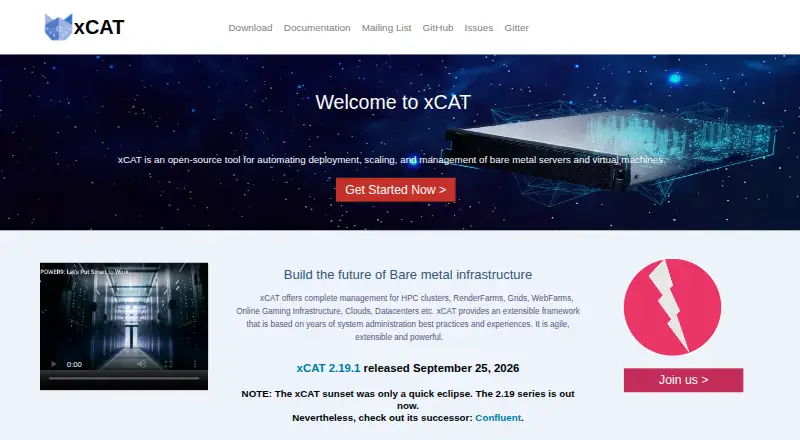
xCAT is an open-source toolkit for deploying, scaling, and managing bare metal servers and virtual machines. It supports use in HPC clusters, render farms, grids, web farms, online gaming infrastructure, clouds, and datacenters. Hardware discovery can rely on manual definitions, MTMS-based or switch-based methods, or sequential discovery. xCAT provisions operating systems on physical and virtual machines using diskful, stateless, or cloned installation methods. Administrators can control power, access consoles, query inventory and vitals, inspect event logs, and run parallel shell commands, copy files, or ping nodes. The project provides a REST API for third-party software integration, and documentation lists OpenStack and SoftLayer cloud integration plus configuration for HPC applications including GPFS, Parallel Environment, and LSF. Its distributed architecture is described as scaling to hundreds of thousands of nodes. Security documentation covers TLS, transmission channels, command access control, auditing, password management, secure zones, and IP-based access control. The download page identifies version 2.19.1 as the stable release and offers stable and development builds. The xCAT Consortium recommends Confluent as a long-term successor and migration path.
Who it suits
xCAT suits administrators managing fleets of physical or virtual machines, especially in cluster, grid, cloud, or datacenter environments. It is also relevant to teams that want to automate provisioning and parallel node operations using an open-source, self-hosted toolkit.
What it does well
- Open-source toolkit with a free plan at no cost.
- Provisions physical and virtual machines using three installation methods.
- Supports remote power control, console access, and node queries.
- Runs shell commands and file copies in parallel.
- REST API and listed cloud integrations.
- Distributed architecture can scale to hundreds of thousands of nodes.
What to know first
- The consortium recommends Confluent as a long-term successor and migration path.
- Security notices include vulnerability notices dated March 8, 2023, and earlier TLS notices.
- Support is directed to GitHub issues or an older user email list.
Plans
| Plan | Billed and limits | Price |
|---|---|---|
| xCAT | Open-source cluster management toolkit | Free |
As xcat.org lists them, read 10 Oct 2026. The maker's own page has the final word.
Getting started
- Visit https://xcat.org/ and obtain a stable or development build.
- Choose a self-hosted Linux deployment environment.
- Discover hardware using manual, MTMS-based, switch-based, or sequential methods.
- Provision operating systems using diskful, stateless, or cloned installation methods.
- Use the REST API or documented OpenStack and SoftLayer integrations as needed.
Verdict
Choose xCAT if you need open-source automation for provisioning and managing large server or VM environments. Consider the consortium's stated recommendation of Confluent if you are planning a long-term successor or migration path.
Questions
How much does xCAT cost?
The listed xCAT plan is free, and the project describes it as open source.
What platforms does xCAT support?
Listed supported platforms are RHEL, SLES, Ubuntu, CentOS, and Windows. Its deployment model is self-hosted.
What does xCAT manage?
It automates deployment, scaling, and management of bare metal servers and virtual machines.
Does xCAT have an API?
Yes. It provides a REST API for integration with third-party software.
What integrations are documented?
Documentation lists OpenStack and SoftLayer cloud integration, and configuration for GPFS, Parallel Environment, and LSF.
What release is identified as stable?
The download page identifies version 2.19.1 as the stable release and offers stable and development builds.
Facts from xCAT's own pages
- API
- xCAT provides a REST API for integration with third-party software. · xcat-docs.readthedocs.io, 10 Oct 2026
- Current release
- The download page identifies version 2.19.1 as the stable release and offers stable and development builds. · xcat.org, 10 Oct 2026
- Hardware discovery
- Discovery methods include manual definition, MTMS-based, switch-based, and sequential discovery. · xcat-docs.readthedocs.io, 10 Oct 2026
- Integrations
- The documentation lists OpenStack and SoftLayer cloud integration and mentions configuring HPC applications including GPFS, Parallel Environment, and LSF. · xcat-docs.readthedocs.io, 10 Oct 2026
- Notable guidance
- The documentation says the xCAT Consortium recommends Confluent as xCAT’s long-term successor and migration path. · xcat-docs.readthedocs.io, 10 Oct 2026
- Parallel operations
- Administrators can run parallel shell commands, copy files, and ping nodes. · xcat-docs.readthedocs.io, 10 Oct 2026
- Platforms
- The download page provides Linux RPM and Ubuntu Debian packages, with Ubuntu repositories serving amd64, ppc64el, and riscv64. · xcat.org, 10 Oct 2026
- Provisioning
- xCAT provisions operating systems on physical or virtual machines using diskful, stateless, or cloned installation methods. · xcat-docs.readthedocs.io, 10 Oct 2026
- Purpose
- xCAT automates deployment, scaling, and management of bare metal servers and virtual machines. · xcat.org, 10 Oct 2026
- Remote management
- Remote management features include power control, console access, inventory and vitals queries, and event log queries. · xcat-docs.readthedocs.io, 10 Oct 2026
- Scale
- The documentation says xCAT can scale to hundreds of thousands of nodes with a distributed architecture. · xcat-docs.readthedocs.io, 10 Oct 2026
- Security
- The security documentation covers TLS configuration, transmission channels, command access control, auditing, password management, secure zones, and IP-based access control. · xcat-docs.readthedocs.io, 10 Oct 2026
- Security notices
- The security notices page lists xCAT vulnerability notices dated March 8, 2023, and earlier OpenSSL and TLS notices. · xcat-docs.readthedocs.io, 10 Oct 2026
- Support
- The project encourages GitHub issues for support and also lists an older user email list. · xcat-docs.readthedocs.io, 10 Oct 2026
- Use cases
- The project describes use across HPC clusters, render farms, grids, web farms, online gaming infrastructure, clouds, and datacenters. · xcat.org, 10 Oct 2026
Where xCAT stands on Freedom251
- OS Imaging & Deployment Software#9 of 24
- IT Automation Software#30 of 77
- OS Deployment Software#12 of 29
- Data Center Automation#12 of 22
- Bare Metal Provisioning Software#16 of 28
- Bare Metal as a Service (BMaaS) Software#8 of 12