
Mackerel
What Mackerel is
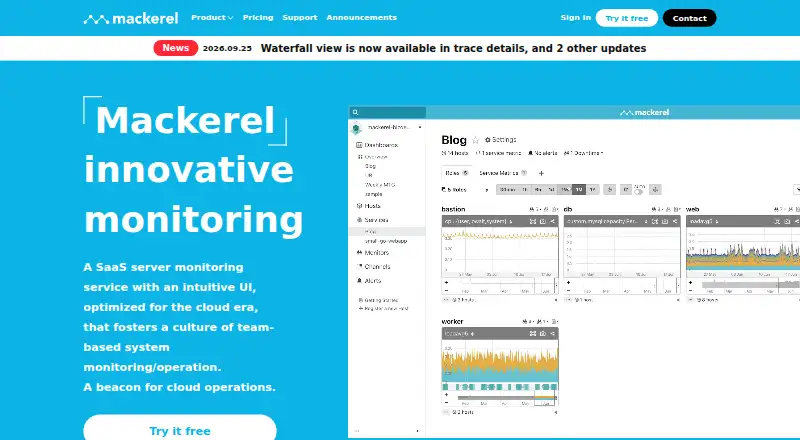
Mackerel is a cloud-based SaaS service for monitoring servers and infrastructure with teams. Installing its agent starts monitoring, after which hosts can be organized into services and roles. It visualizes host metrics and user-defined service metrics, including response time, sales, and page views. Monitoring options include combining metrics, tracking predicted values, and machine-learning anomaly detection. Cloud integrations cover Amazon Web Services, Microsoft Azure, and Google Cloud. A container agent monitors Amazon ECS tasks and Kubernetes pods by treating each as a host. Users can extend monitoring with open-source plugins, APIs, and the mkr command-line tool. Customer Reliability Engineers can provide implementation and use guidance; standard-plan support is email-only, with free contact during business-day hours from 10:00 to 19:00. Mackerel is provided by Hatena Co., Ltd., founded in 2001 and headquartered in Kyoto, Japan. Its free plan includes five standard and micro hosts total, 500 metrics, one-day data retention, 10 monitoring rules, one custom dashboard, and up to 5M trace spans. A 14-day trial offers Standard-plan functions with a 100M-span allowance. Paid usage is listed from 2,180 JPY/mo.
Who it suits
It suits teams monitoring cloud-era servers and infrastructure, including environments using the listed cloud services or container platforms. Teams wanting to extend monitoring through plugins, APIs, or the command-line tool may also find it relevant.
What it does well
- Organizes monitored hosts into services and roles.
- Tracks user-defined service metrics.
- Includes AWS, Azure, and Google Cloud integrations.
- Monitors ECS tasks and Kubernetes pods.
- Free plan supports five hosts total.
What to know first
- Free plan retains data for one day.
- Free plan allows only 10 monitoring rules.
- Standard-plan technical support is email-only.
- Free support contact is limited to business-day hours.
Limits
The Free plan includes five standard and micro hosts total, 500 metrics, one-day data retention, 10 monitoring rules, one custom dashboard, and up to 5M trace spans. The 14-day trial has a 100M-span allowance.
Plans
| Plan | Billed and limits | Price |
|---|---|---|
| Free | 5 standard and micro hosts total · 500 metrics · 1 day data retention · 10 monitoring rules · 1 custom dashboard · up to 5M trace spans | Free |
| Standard | 2,180 yen (tax included) per standard host month; 660 yen (tax included) per micro host month; 11 yen (tax included) per metric; 330 yen (tax included) per 1M spans · 460 days data retention · 100 monitoring rules · 100 custom dashboards · unlimited users · minimum usage fee of 2,180 JPY when billable features are used | On request |
| Standard (micro host) | 30 metrics per micro host | On request |
As mackerel.io lists them, read 5 Oct 2026. The maker's own page has the final word.
Getting started
- Visit the Mackerel website.
- Choose the Free plan or start the 14-day Standard-plan trial.
- Install the monitoring agent on a server to start monitoring.
- Group hosts into services and roles.
- Add cloud or container monitoring and extend it with plugins, APIs, or the mkr command-line tool.
Mackerel is a cloud monitoring service for teams running servers, applications and container workloads. It is best suited to operators who want infrastructure signals and business-level service metrics in one console. Its breadth is compelling, but Standard billing grows with hosts, metrics and trace volume, so larger estates need careful budgeting.
Overview
Installing the Mackerel agent on a server begins host monitoring, after which hosts can be arranged into services and roles. This structure maps technical data to the applications and responsibilities your team actually manages. User-defined service metrics can sit beside host measurements, covering signals such as response time, sales and page views.
Mackerel can combine metrics, monitor predicted values and apply machine-learning anomaly detection. Integrations include Amazon Web Services, Microsoft Azure and Google Cloud. Its container agent treats an Amazon ECS task or Kubernetes pod as a host, extending the same monitoring model to orchestrated workloads. Open-source plugins, APIs and the mkr command-line tool provide practical extension points. Customer Reliability Engineers can also advise on implementation and use.
Key features
Host, service and application context
Host and service metrics in one system help teams correlate infrastructure conditions with application or commercial impact. Services and roles give larger environments a clearer organizing layer than a flat host list.
Prediction and anomaly detection
Predicted-value monitoring is useful when a threshold should follow an expected trend rather than remain fixed. Machine-learning anomaly detection adds another way to surface unusual behavior, although teams should still define which signals matter operationally.
Cloud and container coverage
Native connections for AWS, Azure and Google Cloud suit multi-cloud estates. Treating ECS tasks and Kubernetes pods as hosts keeps container monitoring within the same model, rather than forcing a separate workflow.
Extensibility and support
Plugins, APIs and mkr allow teams to bring in data or automate administration beyond the built-in integrations. Reliability Engineers can guide implementation; Standard support contact is by email and is free during business days from 10:00 to 19:00.
Pricing
Mackerel uses a freemium model, with a 14-day trial and paid usage from 2,180 JPY/mo. The trial supplies Standard-plan functions and allows 100M trace spans, making it a meaningful way to evaluate the full service before committing.
Free
The Free plan costs nothing. It includes five standard and micro hosts in total, 500 metrics, one day of data retention, 10 monitoring rules, one custom dashboard and up to 5M trace spans. This is suitable for a small proof of concept or a tightly bounded service; the one-day retention and single dashboard quickly constrain historical analysis and team-wide views.
Standard
Standard has custom pricing based on usage: 2,180 yen (tax included) per standard host month, 660 yen (tax included) per micro host month, 11 yen (tax included) per metric and 330 yen (tax included) per 1M spans. A minimum usage fee applies. In return, retention extends to 460 days, with 100 monitoring rules, 100 custom dashboards and unlimited users. The separate Standard (micro host) option supports 30 metrics per micro host, which can reduce the footprint for lightly instrumented machines, while host, metric and trace charges still need to be forecast.
Platforms
Mackerel is delivered as a cloud service, with API, Linux, web and Windows access. It supports VM monitoring, service monitoring and agentless monitoring; operating-system coverage includes Linux and Windows.
Who it's for
Mackerel fits infrastructure and platform teams managing cloud, VM and container environments that also need application or business metrics. Standard is the practical choice for organizations requiring long retention, many dashboards, more rules and unlimited users. The Free plan is better for a small deployment, evaluation or low-volume monitoring footprint. Teams seeking predictable, host-unlimited costs or a self-hosted system should look elsewhere.
Pros and cons
- Pros: Host and custom service metrics share one organized view; AWS, Azure, Google Cloud, ECS and Kubernetes coverage supports modern mixed infrastructure; prediction, anomaly detection and extensibility broaden monitoring beyond fixed thresholds; unlimited users on Standard suit larger teams.
- Cons: Free retention is only one day, with five hosts, 10 rules and one dashboard; Standard charges separately for hosts, metrics and trace spans and includes a minimum usage fee; Standard technical support is email-only during stated business hours.
Alternatives
Choose Netdata instead if broad device access, including Android, iOS, macOS and self-hosted deployments, matters; its Community plan is free for up to five active connected nodes and one active custom dashboard per room.
Checkmk is a stronger fit for a free, integration-heavy community deployment, offering more than 2,000 pre-built integrations and roughly 100 hosts with community support.
Pick openITCOCKPIT for a self-hosted infrastructure and application monitoring option with a free Community Edition.
Sensu Go suits teams wanting a free tier for 100 nodes across one site, with a paid Pro option billed annually.
Checkmate is a free self-hosted choice with all features, no monitor limits and 12 alert channels.
Icinga is appropriate when an open-source, subscription-free edition with unlimited hosts and services is the priority.
MetricsHub is an alternative centered on an open-source project built around OpenTelemetry.
Prometheus is the straightforward free, open-source monitoring and alerting toolkit under the Apache 2.0 license.
Verdict
Choose Mackerel when your team needs one cloud service to connect host, application, cloud and container metrics, with anomaly detection and extensibility built in. Look elsewhere if usage-based Standard charges, short Free retention or a preference for self-hosting outweigh that unified operational view.
Verdict
Mackerel combines host and service metrics with cloud and container monitoring options. Its free plan has clear limits on hosts, retention, rules, and dashboards; paid usage is listed from 2,180 JPY/mo.
Questions
What is Mackerel?
It is a SaaS service for server monitoring and team-based infrastructure monitoring, provided by Hatena Co., Ltd.
Is there a free plan?
Yes. The Free plan costs nothing and includes five standard and micro hosts total, 500 metrics, one-day retention, 10 monitoring rules, one dashboard, and up to 5M trace spans.
What does the 14-day trial include?
It provides Standard-plan functions and a 100M-span trial allowance.
How is Standard usage billed?
Usage is billed at 2,180 yen (tax included) per standard host month, 660 yen (tax included) per micro host month, 11 yen (tax included) per metric, and 330 yen (tax included) per 1M spans. The plan has a minimum usage fee.
Which clouds and container platforms are supported?
Cloud integrations cover Amazon Web Services, Microsoft Azure, and Google Cloud. The container agent monitors Amazon ECS tasks and Kubernetes pods by treating each as a host.
What support is available?
Customer Reliability Engineers can guide implementation and use. Standard-plan technical support is email-only, with free contact during business-day operating hours from 10:00 to 19:00.
Facts from Mackerel's own pages
- Clouds
- Cloud integrations include Amazon Web Services, Microsoft Azure, and Google Cloud. · en.mackerel.io, 5 Oct 2026
- Company
- Mackerel is provided by Hatena Co., Ltd. · en.mackerel.io, 5 Oct 2026
- Containers
- The container agent monitors workloads on Amazon ECS and Kubernetes by treating a task or pod as a host. · en.mackerel.io, 5 Oct 2026
- Extensibility
- Users can extend monitoring with open-source plugins, APIs, and the mkr command-line tool. · en.mackerel.io, 5 Oct 2026
- Founded
- 2001 · mackerel.io, 28 Sept 2026
- Headquarters
- Kyoto, Japan · mackerel.io, 28 Sept 2026
- Metrics
- The service can visualize host metrics and user-defined service metrics, including response time, sales, and page views. · en.mackerel.io, 5 Oct 2026
- Monitoring
- Mackerel supports combining metrics, monitoring predicted values, and machine-learning anomaly detection. · en.mackerel.io, 5 Oct 2026
- Product
- Mackerel is a SaaS server monitoring service designed for cloud-era infrastructure and team-based monitoring. · en.mackerel.io, 5 Oct 2026
- Setup
- Installing the monitoring agent on a server starts monitoring, and Mackerel groups hosts into services and roles. · en.mackerel.io, 5 Oct 2026
- Support
- Customer Reliability Engineers provide technical support and can guide customers through implementation and use. · en.mackerel.io, 5 Oct 2026
- Support limits
- The pricing page describes standard-plan technical support as email-only and says support contact is free during business-day operating hours of 10:00–19:00. · en.mackerel.io, 5 Oct 2026
- Trial
- The two-week free trial provides Standard-plan functions, with a trial trace-span allowance of 100M spans. · en.mackerel.io, 5 Oct 2026
Where Mackerel stands on Freedom251
- Cloud Monitoring#7 of 31
- Infrastructure Monitoring#9 of 34