Freedom251 › Disk Wiping Software
Lethe
What Lethe is
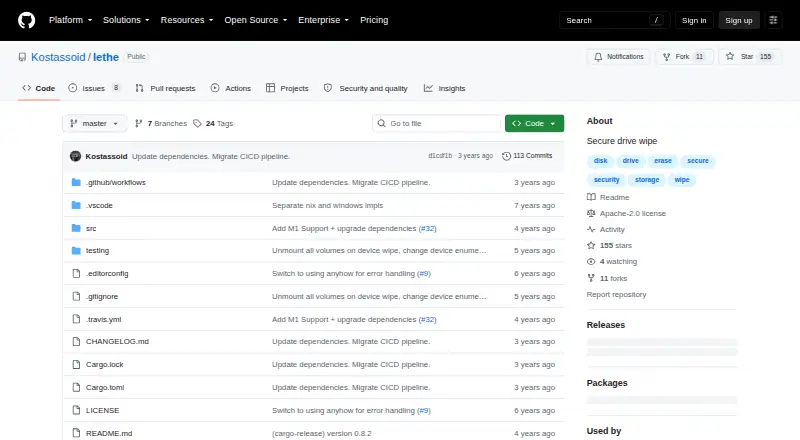
Lethe is a free, open-source utility for securely wiping drives on Linux, macOS, and Windows. It overwrites existing data with randomly generated data or a static pattern, and it can read data back to check whether write commands succeeded. The project says it should work with hard disk drives, flash drives, and solid-state drives, though SSD wiping has important limitations. Lethe is a command-line tool and requires root or administrator access to operate on real drives. Its performance features include a fast cryptographic random generator and an option to override the operating system’s recommended block size. It can also track and automatically skip bad blocks and other localized errors; this feature is marked experimental. The repository provides binaries for Windows x86-64, Intel macOS, experimental Apple macOS, and Linux x86-64, and documents installation from Rust sources. Lethe is licensed under Apache License, Version 2.0. The project says initial active development is complete, though changes may still happen occasionally; it has no exact roadmap, and users can report issues.
Who it suits
Lethe suits users who need a free, open-source command-line utility to overwrite drives on Linux, macOS, or Windows. It is intended for users comfortable with root or administrator access and with the limitations described for SSDs and RAID storage.
What it does well
- Free and open source under Apache License 2.0.
- Runs on Linux, macOS, and Windows.
- Can overwrite data with random data or a static pattern.
- Can read back data to verify write commands.
- Tracks and skips localized errors, though this feature is experimental.
- Repository includes binaries and Rust-source installation instructions.
What to know first
- Requires root or administrator access to operate on real drives.
- The current approach cannot reliably wipe all SSD data.
- The application has not been tested on RAID storage.
- Automatic skipping of bad blocks and localized errors is experimental.
Limits
Lethe is free. Its current approach cannot reliably wipe all SSD data because wear leveling and compression prevent reliable erasure; the application has not been tested on RAID storage. It also has a maximum of 4,294,967,296 blocks per device.
Plans
| Plan | Billed and limits | Price |
|---|---|---|
| Free | Free and open source · CLI utility · requires administrator/root access for real drives | Free |
As github.com lists them, read 14 Oct 2026. The maker's own page has the final word.
Getting started
- Visit https://github.com/Kostassoid/lethe.
- Choose a repository binary for Windows x86-64, Intel macOS, experimental Apple macOS, or Linux x86-64.
- Alternatively, follow the repository’s instructions for installation from Rust sources.
- Run the command-line tool with root or administrator access when operating on real drives.
Overview
Lethe is a free, open-source command-line utility for overwriting drives and checking that write commands succeeded. Its random or static-pattern writes, cross-platform support and block-level controls make it a practical fit for technically comfortable users wiping disks or removable media. Its biggest caveat is decisive: its current method cannot reliably erase all data on SSDs.
Key features
Lethe overwrites existing data with either randomly generated data or a static pattern, and can read data back to verify that writes succeeded. That verification gives users a way to check write results, though it is described as basic rather than a broader assurance of complete erasure.
A fast cryptographic random generator and an option to override the operating system’s recommended block size give experienced users some control over throughput. Lethe can also track and automatically skip bad blocks and other localized errors, but that behavior is experimental, so it is not a dependable basis for handling important erasure jobs.
The tool supports disk wiping and removable media. It requires root or administrator access to operate on real drives, and its command-line interface favors users comfortable selecting and managing disks without a graphical application.
Pricing
Lethe has one free plan: free. It includes the drive-wiping utility, with no paid tier or trial to weigh against it. Users give up a graphical interface and must work within the tool’s access requirements and storage limitations; the free price does not change its SSD or RAID caveats.
Platforms
Lethe supports Linux, macOS and Windows. The repository provides binaries for Windows x86-64, Intel macOS, Apple macOS marked experimental, and Linux x86-64; installation from Rust sources is also documented. Apple silicon users should treat that experimental binary accordingly.
Who it's for
Lethe suits users who want a no-cost, open-source command-line tool for overwriting HDDs or flash drives and checking whether writes succeeded. It is a poor fit when reliable erasure of all SSD data is essential, when a graphical workflow is needed, or when the target is RAID storage: the project warns of SSD wear-leveling and compression limits and has not been tested on RAID.
The maximum supported number of blocks per device is 4,294,967,296. The maker says active development is complete, with occasional changes possible and no exact roadmap; users can report issues. Apache License, Version 2.0 licensing may matter to users who need to review software terms.
Pros and cons
Pros
- Free and open-source: There is no purchase cost, and the Apache 2.0 license is stated.
- Write verification: Reading data back can show whether write commands succeeded.
- Broad platform and media support: It runs on Linux, macOS and Windows and supports removable media as well as disks.
- Configurable writing: Users can choose random data or a static pattern and override the recommended block size.
Cons
- Not reliable for complete SSD erasure: Wear leveling and compression prevent this approach from reliably wiping all SSD data.
- Command-line and elevated access: Real-drive operations require root or administrator privileges, which raises the bar for safe use.
- Experimental error handling: Automatic skipping of bad blocks and localized errors is not established behavior.
- RAID uncertainty and a device ceiling: RAID storage has not been tested, and devices are limited to 4,294,967,296 blocks.
- Limited ongoing development: Active development is complete, with no exact roadmap.
Alternatives
For a broader set of disk-wiping choices, browse Disk Wiping Software.
- Active@ KillDisk is worth comparing if you are open to paid personal licenses: its Personal Professional plan costs $64.95, paid once, and Personal Suite costs $79.95, paid once.
- DriveWipe is another free option for Linux, macOS and Windows, with a plan described as free for personal, hobby and commercial use.
- HDShredder may suit private users who want a free edition with a stated secure-erasing rate of up to 6 GB/min, or buyers seeking a paid edition.
- nwipe is a free Linux alternative with both command-line and ncurses GUI interfaces; choose it if Linux support is sufficient and an ncurses interface is useful.
- Overwrite is a macOS alternative with a free Preview plan that does not include secure wiping, and an Annual Pro plan at $12.99 a year.
- Strix Disk Cleaner is a free, MIT-licensed option for Windows and Linux.
- Blackwire Drive Eraser & Sanitizer has a free Windows plan for personal or noncommercial use, with up to two drives at once and approximately 50% software-overwrite speed.
- Disk Wipe is a free Windows option for personal or commercial use.
Verdict
Choose Lethe for free, open-source command-line overwriting of HDDs or flash drives when basic write verification and cross-platform availability matter. Its configurable writes and no-cost plan are useful, but its SSD limitation is central: users who need reliable erasure of all SSD data should choose another approach. Avoid relying on it for RAID storage or experimental bad-block handling.
Verdict
Choose Lethe if you want a free, open-source command-line tool for overwriting drives and checking whether writes succeeded. Look elsewhere if you need reliable wiping of all SSD data or an application tested on RAID storage.
Questions
Is Lethe free?
Yes. Lethe is listed as free, with a price of $0.
Is Lethe open source?
Yes. It is licensed under Apache License, Version 2.0.
Which platforms does it support?
The listed platforms are Linux, macOS, and Windows. Repository binaries are available for Windows x86-64, Intel macOS, experimental Apple macOS, and Linux x86-64.
What types of drives can it wipe?
The project says it should work with HDDs, SSDs subject to limitations, and flash drives.
Does Lethe verify a wipe?
It can read back data to verify that write commands succeeded.
What access does it require?
Lethe requires root or administrator access to operate on real drives.
Facts from Lethe's own pages
- Bad-block handling
- An experimental mode tracks and skips bad blocks and other localized errors automatically. · github.com, 14 Oct 2026
- Benchmark result
- On a 2015 MacBook Pro with macOS 10.14.4 and a 64 GB USB flash drive, the README records Lethe random fill at 2,758.11 seconds versus dd at 4,546.48 seconds in the shown test. · github.com, 14 Oct 2026
- Block-size control
- Users can override the operating system's recommended block size to potentially improve speed. · github.com, 14 Oct 2026
- Capacity limit
- A device is limited to 4,294,967,296 blocks; with 1 MB blocks the stated maximum is 4096 TB. · github.com, 14 Oct 2026
- Current release
- The repository identifies v0.8.2 as the current release. · github.com, 14 Oct 2026
- Development status
- The maker describes initial active development as complete, with occasional changes and no exact roadmap. · github.com, 14 Oct 2026
- Download options
- The repository provides binaries for Windows x86-64, Intel macOS, Apple macOS marked experimental, and Linux x86-64, and also documents installation from Rust sources. · github.com, 8 Oct 2026
- Downloads
- Release archives are offered for Windows x86-64, macOS Intel, experimental Apple Silicon, and Linux x86-64. · github.com, 14 Oct 2026
- Error handling
- It can track and automatically skip bad blocks and other localized errors, a feature marked experimental. · github.com, 8 Oct 2026
- Historical missing feature
- The Docs.rs documentation states that Secure Erase was not supported in Lethe 0.2.2 and recommends additional native Secure Erase where possible. · docs.rs, 14 Oct 2026
- Historical package documentation
- Docs.rs describes Lethe 0.2.2 as a free, cross-platform, open-source drive-wiping utility and exposes its Rust source documentation. · docs.rs, 14 Oct 2026
- Independent package platforms
- MyNixOS lists package targets across Darwin, Linux, BSD variants, Solaris, WASI, Redox, and Windows architectures. · mynixos.com, 14 Oct 2026
- Independent package version
- MyNixOS lists Lethe version 0.8.2, Apache-2.0 licensing, one executable, and marks it neither broken, insecure, unfree, nor unsupported. · mynixos.com, 14 Oct 2026
- Interface
- Lethe is a command-line interface with general and command-specific help commands. · github.com, 14 Oct 2026
- Interface and access
- Lethe is a command-line tool that requires root or administrator access to operate on real drives. · github.com, 8 Oct 2026
- Licence
- The repository states that Lethe is licensed under Apache License 2.0. · github.com, 14 Oct 2026
- License
- Lethe is licensed under the Apache License, Version 2.0. · github.com, 8 Oct 2026
- Limit: drive wear
- The guide warns that multi-pass VSITR and badblocks operations perform intense passes that increase drive wear. · qwertyarticles.com, 14 Oct 2026
- Limit: long operations
- The independent guide says wiping can take several hours depending on drive size and selected method. · qwertyarticles.com, 14 Oct 2026
- Limit: privilege UX
- An open issue says the application only notifies users when it lacks elevation instead of requesting elevation automatically through a manifest. · github.com, 14 Oct 2026
- Limit: verification failure
- A Windows 10 user reported that two random-fill passes on a 1.8 TB Seagate HDD completed writing but repeatedly failed verification. · github.com, 14 Oct 2026
- Linux support
- Linux x86-64 binaries are provided. · github.com, 14 Oct 2026
- macOS support
- macOS is supported, with Intel and experimental Apple Silicon binaries published. · github.com, 14 Oct 2026
- Maintenance and support
- The maker says initial active development is complete, changes may still be made occasionally, there is no exact roadmap, and users can report issues. · github.com, 8 Oct 2026
Where Lethe stands on Freedom251
- Disk Wiping Software#2 of 28