Freedom251 › Certificate Management Software
Let's Encrypt
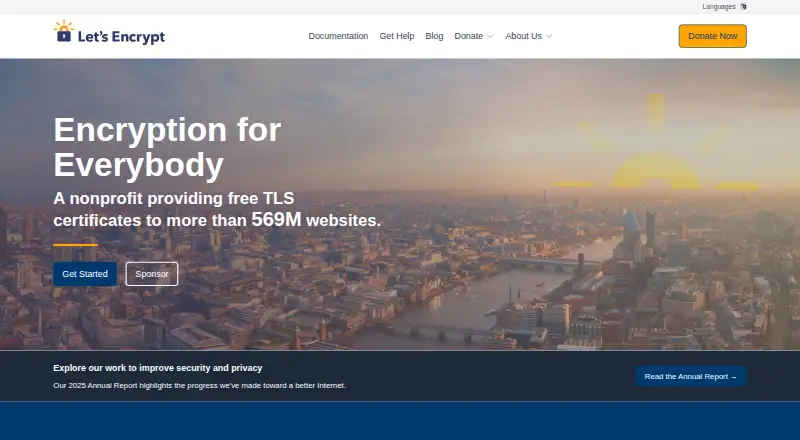
What Let's Encrypt is
Let’s Encrypt issues SSL/TLS certificates for secure HTTPS connections and serves people and organizations worldwide with domain-named servers, including web, mail, and FTP servers. The ACME protocol checks control of a domain, and compatible clients can automate certificate issuance, management, and renewal. The client directory covers Apache HTTP Server, Caddy, nginx, Kubernetes, Docker, Windows/IIS, and other environments. Certificates are Domain Validation (DV); wildcard certificates are available through the DNS-01 challenge. The default lifetime is 90 days, with an optional six-day term, and neither can be changed. Subscribers generate and manage private keys on their own servers. Certificates cost nothing plan. Each registered domain may receive up to 50 certificates every seven days, subject to published rate limits. Issued and revoked certificates are publicly inspectable. Let’s Encrypt says its certificates are trusted by most browsers and operating systems. It does not offer direct subscriber support, directing users to documentation and community forums.
Who it suits
It suits people and organizations needing certificates for domain-named servers and wanting automated issuance and renewal. Users should be comfortable relying on documentation and community forums rather than direct subscriber support.
What it does well
- Free certificates at no cost plan
- Clients can automate certificate management and renewal
- Wildcard certificates are available
- Private keys stay on subscribers’ servers
- Works with listed server and platform integrations
What to know first
- DV certificates only; no OV or EV plans
- Certificate lifetimes cannot be adjusted
- Wildcards require the DNS-01 challenge
- No direct subscriber support
Limits
Certificates are Domain Validation only. Default validity is 90 days, or subscribers can opt into six-day certificates; those lifetimes cannot be adjusted. A registered domain is limited to up to 50 certificates every seven days, subject to published rate limits.
Plans
| Plan | Billed and limits | Price |
|---|---|---|
| Short-lived certificates | Free · Six-day validity · renewal recommended every three days | Free |
| Let's Encrypt certificates | Free · Domain Validation certificates · default 90-day validity · automatic renewal through ACME clients | Free |
As letsencrypt.org lists them, read 15 Oct 2026. The maker's own page has the final word.
Getting started
- Visit the Let’s Encrypt website and review its documentation.
- Choose an ACME client from the client directory for your server environment.
- Use the ACME protocol to verify control of your domain and request a certificate.
- For a wildcard certificate, use the DNS-01 challenge.
- Configure the client to automate certificate management and renewal.
Let’s Encrypt is a global Certificate Authority that issues Domain Validation SSL/TLS certificates for HTTPS and other domain-named servers. It suits people and organizations worldwide who can manage certificates on their own infrastructure. Its free issuance and ACME automation make it a practical fit for routine domain validation, but fixed certificate lifetimes and no direct subscriber support demand reliable operations.
Overview
Let’s Encrypt verifies control of a domain through ACME, then issues certificates that clients can manage and renew automatically. That is a strong approach for operators who want HTTPS certificates without a certificate fee and can configure a compatible client. The service also covers mail and FTP servers, not just websites.
Certificates are Domain Validation only: Let’s Encrypt says it has no plans to issue Organization Validation or Extended Validation certificates. Its certificates are trusted by most browsers and operating systems, while issued and revoked certificates are publicly recorded for inspection. Private keys stay on subscribers’ servers rather than being stored by Let’s Encrypt, which keeps key custody with the operator but also makes server-side key management their responsibility.
Key features
- ACME automation: Clients can automate issuance, deployment, and renewal. This reduces manual certificate work, provided the operator configures and maintains the client environment.
- Broad client directory: Listed environments include Apache HTTP Server, Caddy, nginx, Kubernetes, Docker, and Windows/IIS. That range makes the service relevant across common server and container setups, though users still need a suitable client.
- Wildcard certificates: Wildcards are supported, but issuance must use the DNS-01 challenge. That requirement makes them less straightforward where DNS challenge handling is difficult to automate.
- Fixed lifetimes: Default certificates last 90 days; subscribers can opt in to six-day certificates. Neither lifetime can be adjusted, so dependable renewal automation matters, particularly for the shorter option.
- Rate limits: A registered domain can receive up to 50 certificates every seven days, subject to the published rate limits. High-volume issuance therefore needs to fit within those constraints.
- Support model: There is no direct subscriber support; users are directed to documentation and community forums. Operators who need a direct support channel should look elsewhere.
Pricing
Let’s Encrypt certificates cost nothing, billed Free; no fee is charged for certificates. The free plan includes DV certificates, 90-day default validity with an optional six-day lifetime, automatic renewal, deployment automation, and revocation workflows. There is no free trial because the plan is free.
This is a good fit for individuals and organizations that need DV certificates and can run their own certificate-management setup. The trade-off is not a cheaper paid tier but a defined scope: no OV or EV certificates, no adjustable validity period, and no direct subscriber support. The 50-certificates-per-registered-domain-in-seven-days limit also matters for larger issuance needs.
Platforms
Let’s Encrypt is categorized for API, Linux, self-hosted, web, and Windows environments. Its client directory names integrations including Apache HTTP Server, Caddy, nginx, Kubernetes, Docker, and Windows/IIS, giving administrators several routes to fit certificate automation into existing infrastructure.
Who it's for
Choose Let’s Encrypt if you need free DV certificates for domain-named web, mail, or FTP servers and can handle client configuration, key custody, and renewal operations. It is less suitable if your certificate requirements call for OV or EV validation, a custom certificate lifetime, direct subscriber support, or wildcard issuance without DNS-01.
Pros and cons
Pros
- No certificate fee: The plan is free, making it suitable where DV certificates meet the requirement.
- Automated lifecycle: ACME clients can automate issuance, deployment, and renewal, reducing recurring manual certificate tasks.
- Keys remain on subscriber servers: Let’s Encrypt does not store certificate private keys, leaving key custody with the operator.
- Wide environment coverage: The client directory spans established web servers, Windows/IIS, Kubernetes, and Docker.
Cons
- DV only: There are no OV or EV certificates, so organizations requiring those validation levels need another provider.
- Fixed certificate terms: The 90-day default and optional six-day validity cannot be changed, making reliable renewal especially important.
- Wildcard constraint: Wildcard issuance requires DNS-01, which may complicate setups without DNS challenge automation.
- No direct subscriber support: Help is through documentation and community forums, not a direct support channel.
- Issuance cap: The limit of 50 certificates per registered domain every seven days can constrain higher-volume issuance.
Alternatives
For a broader look at this category, browse Public Key Infrastructure Software or Certificate Management Software.
- OpenCA PKI is a free, open-source PKI management option for Linux, macOS, self-hosted, and web environments; consider it when PKI management software is the priority.
- step-ca is free and offers a configured intermediate CA, an offline root CA, and authority-wide issuance policies; choose it when those CA controls matter, noting that its plan has no Certificate Transparency integration.
- EJBCA has a free Community Edition for learning, testing, and prototyping, plus a free trial; it is a fit for non-production exploration of basic PKI functionality.
- OpenXPKI offers a free, fully functional Community Edition with Debian packages, example configuration, online documentation, and mailing-list support; consider it if that support and packaging model suits your deployment.
- XiPKI is a free Apache License 2.0 option for API, Linux, macOS, and self-hosted environments; consider it when those platform options fit your needs.
- Boulder is free and open source, but production deployment requires separate implementation and security work; choose it when you can take on that work.
- cert-manager is free X.509 certificate management for Kubernetes and OpenShift workloads; it is the more targeted choice for those environments.
- Dogtag Certificate System is free certificate authority software that requires access to 389 Directory Server; consider it if that dependency fits your setup.
Verdict
Let’s Encrypt is a strong choice for operators worldwide who need free DV certificates and can rely on ACME automation to keep them current. The combination of no certificate fee, broad client environments, and subscriber-held private keys is compelling for routine domain security. Look elsewhere when you need OV or EV certificates, a different validity term, DNS-independent wildcard issuance, or direct subscriber support.
Verdict
Let’s Encrypt offers free DV certificates with automation options and a broad directory of client environments. Its fixed certificate lifetimes, DNS-01 requirement for wildcards, and lack of direct subscriber support are important constraints.
Questions
How much do Let’s Encrypt certificates cost?
They are free; no fee is charged for certificates.
What certificate types are available?
Let’s Encrypt offers Domain Validation certificates and says it has no plans to issue Organization Validation or Extended Validation certificates.
How long are certificates valid?
The default validity is 90 days. Subscribers can opt into six-day certificates, and neither lifetime can be adjusted.
Can certificate issuance and renewal be automated?
Yes. ACME clients can automate certificate management and renewal, and deployment automation is supported.
Does Let’s Encrypt keep private keys?
No. Private keys are generated and managed on subscribers’ own servers.
Does Let’s Encrypt provide direct support?
No direct subscriber support is offered. Users are directed to documentation and community support forums.
Facts from Let's Encrypt's own pages
- ACME clients
- Users must operate an ACME client; the documentation recommends Certbot for most people and lists many alternatives. · letsencrypt.org, 15 Oct 2026
- API
- The production ACME directory endpoint is https://acme-v02.api.letsencrypt.org/directory and a separate staging endpoint is provided for testing. · letsencrypt.org, 15 Oct 2026
- Automation
- The ACME protocol verifies control of a domain and is used to issue certificates; clients can automate certificate management and renewal. · letsencrypt.org, 9 Oct 2026
- Certificate lifetime
- Default certificates are valid for 90 days; subscribers can opt in to certificates valid for six days, and these lifetimes cannot be adjusted. · letsencrypt.org, 9 Oct 2026
- Certificate transparency
- Issued certificates are submitted to public Certificate Transparency logs. · letsencrypt.org, 15 Oct 2026
- Certificate types
- The service issues standard Domain Validation certificates for domain-based servers, including web, mail and FTP servers. · letsencrypt.org, 15 Oct 2026
- Company founded
- LinkedIn lists Internet Security Research Group as founded in 2013. · linkedin.com, 15 Oct 2026
- Company size
- LinkedIn lists ISRG as having 11–50 employees. · linkedin.com, 15 Oct 2026
- Developer testing
- The Pebble project is a miniature ACME server intended for client testing, while Boulder is the production CA implementation. · letsencrypt.org, 15 Oct 2026
- Documentation
- The official documentation covers onboarding, ACME clients, rate limits, staging, certificate policy, challenge types, profiles, revocation, compatibility and integration guidance. · letsencrypt.org, 15 Oct 2026
- Domain validation
- Applicants prove domain control through challenges such as DNS records or HTTP resources. · letsencrypt.org, 15 Oct 2026
- Headquarters
- LinkedIn lists San Francisco, California as ISRG headquarters. · linkedin.com, 15 Oct 2026
- HTTPS automation
- The ACME protocol lets an ACME client obtain browser-trusted HTTPS certificates without manual intervention. · letsencrypt.org, 15 Oct 2026
- Integrations
- Hosting providers can obtain and manage certificates for customers through their own ACME clients. · letsencrypt.org, 15 Oct 2026
- Intended users
- The service is available to people and organizations worldwide that need certificates for domain-named servers, including web, mail, and FTP servers. · letsencrypt.org, 9 Oct 2026
- Legal structure
- ISRG describes itself as a California public benefit corporation recognized as a tax-exempt 501(c)(3) organization. · isrg.org, 15 Oct 2026
- License
- Boulder is open source under the Mozilla Public License 2.0. · github.com, 15 Oct 2026
- Limit: abuse complaints
- Trustpilot includes one-star complaints alleging that certificates were issued to phishing or scam domains. · trustpilot.com, 15 Oct 2026
- Limit: issuance limits complaint
- A Trustpilot reviewer reported repeated exact-domain certificate rate-limit errors despite claiming no recent changes to the domain. · trustpilot.com, 15 Oct 2026
- Limit: short validity
- G2 reviewers criticize the 90-day lifetime because missed automation can cause certificate expiry and service disruption. · g2.com, 15 Oct 2026
- Limit: technical setup
- G2 reviewers say configuring ACME clients, DNS, web servers, permissions and renewal jobs still requires technical expertise. · g2.com, 15 Oct 2026
- Maker
- The service is operated by the nonprofit Internet Security Research Group. · letsencrypt.org, 15 Oct 2026
- Multi-domain certificates
- A certificate can cover multiple names through the Subject Alternative Name mechanism. · letsencrypt.org, 15 Oct 2026
- Notable news: API incidents
- The official incident forum lists a complete API outage on July 21, 2025 and an ACME API outage on December 16, 2025. · community.letsencrypt.org, 15 Oct 2026