Freedom251 › Public Key Infrastructure Software
OpenXPKI
What OpenXPKI is
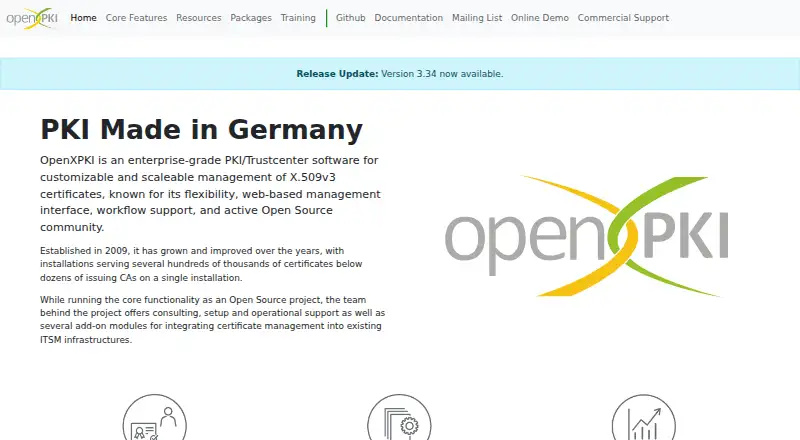
OpenXPKI is PKI and Trustcenter software for managing X.509v3 certificates in professional environments. Its customizable workflows cover certificate requests, renewals, and revocations, with enrollment interfaces for SCEP, EST, SimpleCMC, and ACME, plus a REST-like API with OpenAPI support. A single installation can host several PKI Realms with separate namespaces, profiles, workflows, and policies. The Ember.js web interface runs in major browsers and serves users, operators, and administrators. Connectors can access flat files, LDAP directories, SQL databases, and web services; Enterprise Edition adds extensions for DigiCert, Sectigo, and SwissSign. The software supports Hardware Security Modules through PKCS#11. Configuration uses YAML and can be kept under revision control, while custom reporting workflows can collect statistics and KPIs and generate downloadable CSV files. Community Edition is free and includes Debian 12 packages, example configuration, documentation, and mailing-list support. Enterprise and service options are also listed, with commercial SLAs available.
Who it suits
OpenXPKI is aimed at professional PKI environments. Its training audience includes system administrators, IT operations staff, PKI operators, developers, and integration engineers.
What it does well
- Supports certificate request, renewal, and revocation workflows.
- Enrollment interfaces include SCEP, EST, SimpleCMC, and ACME.
- A single instance can host multiple PKI Realms.
- Supports HSMs through PKCS#11.
- Community Edition is free and includes mailing-list support.
What to know first
- Community Edition packages are listed for Debian 12.
- Community Edition support is through a mailing list.
- Commercial support options and SLAs are separate offerings.
Limits
Community Edition is listed with Debian packages for Debian 12 and mailing-list support. Enterprise packages and extension modules are listed separately under Enterprise Edition.
Plans
| Plan | Billed and limits | Price |
|---|---|---|
| Community Edition | 100% free · fully functional code base · Debian packages · example configuration · online documentation · mailing-list support | Free |
| OpenXPKI as a Service | Health monitoring · logging and reporting · level-2 helpdesk · cloud or on-premise · flexible licensing · SLAs available | On request |
| Enterprise Edition | RHEL / SLES / Ubuntu packages · custom-built configuration · extension modules · individual support with SLAs | On request |
As openxpki.org lists them, read 7 Oct 2026. The maker's own page has the final word.
Getting started
- Visit the OpenXPKI website.
- Choose Community Edition for the free code base or review the commercial offerings.
- For Community Edition, use the Debian package available for Debian 12.
- Use the example configuration and online documentation to configure the system.
- Manage YAML configuration with revision control if you want an auditable system representation.
OpenXPKI is certificate authority and trust-center software for managing X.509v3 certificates. It suits professional PKI teams that need configurable policies and integrations; its fully functional free edition makes it possible to start without a software fee, but teams should expect to operate and configure their own infrastructure.
Overview
OpenXPKI handles certificate requests, renewals, and revocations through customizable workflows. That flexibility is valuable when an organization’s issuance and approval processes need to reflect its own policies, but it makes this a better fit for dedicated PKI operations than for teams seeking a simple certificate dashboard.
A single instance can host multiple PKI Realms with separate namespaces, profiles, workflows, and policies. This is a practical way to maintain distinct certificate environments within one deployment rather than applying one set of rules everywhere.
Key features
Enrollment and integrations
Enrollment interfaces include SCEP, EST, SimpleCMC, and ACME, with a REST-like API that supports OpenAPI. Connectors can reach flat files, LDAP directories, SQL databases, and web services. This breadth helps teams connect varied enrollment clients and existing systems; Enterprise Edition adds extensions for DigiCert, Sectigo, and SwissSign.
Operations and security
The Ember.js frontend runs in major browsers and serves users, operators, and administrators. PKCS#11 support enables integration with Hardware Security Modules. Configuration is managed in YAML and can be tracked with revision control, giving operations teams an auditable record of system state.
Custom reporting workflows can gather Realm statistics and KPIs and produce downloadable CSV files. This supports operational reporting, though teams must build workflows suited to the measures they need.
Deployment and support
Community Edition provides Debian packages for Debian 12; Enterprise Edition packages target RHEL, SLES, and Ubuntu Server LTS. Community users can seek support through a mailing list. White Rabbit Security GmbH offers commercial support with SLAs, which is a more suitable route for organizations that need a defined support arrangement.
Pricing
Community Edition costs nothing and includes a fully functional code base, Debian packages, example configuration, online documentation, and mailing-list support. It is the clearest choice for teams prepared to deploy and maintain the software themselves, with Debian 12 as the supported package target described for this edition.
OpenXPKI as a Service has custom pricing and includes health monitoring, logging and reporting, level-2 helpdesk, flexible licensing, and cloud or on-premise options; SLAs are available. It suits organizations seeking operational support rather than a software-only installation.
Enterprise Edition also has custom pricing. It includes RHEL, SLES, and Ubuntu Server packages, custom-built configuration, extension modules, and individual support with SLAs. Its listed extensions include multi-tenancy, external or public CA adapters, full ITSM integration, and GDPR-compliant data retention. These additions are relevant when those capabilities or commercial support justify moving beyond the free edition.
Platforms
OpenXPKI is available for Linux and self-hosted deployment, with a web interface and API. The edition-specific package targets matter: Community Edition packages are for Debian 12, while Enterprise Edition packages are for RHEL, SLES, and Ubuntu Server LTS.
Who it's for
OpenXPKI is aimed at professional PKI environments. Its training audiences include system administrators, IT operations staff, PKI operators, developers, and integration engineers, reflecting the operational and integration work involved. Organizations needing configurable certificate workflows across multiple Realms are its strongest fit. Teams without PKI expertise or the capacity to run certificate infrastructure should consider a service option or another approach.
Pros and cons
- Pro: A fully functional free code base lets teams adopt customizable certificate workflows without a software fee.
- Pro: Multiple Realms, broad enrollment interfaces, and connectors support varied certificate environments and integration needs.
- Pro: YAML configuration under revision control and CSV reporting workflows support auditable operations and tailored metrics.
- Con: The product is aimed at professional PKI environments, so it is not the natural choice for teams seeking a simple, low-operations tool.
- Con: Commercial support, service, and Enterprise extensions require custom pricing, making their costs difficult to compare in advance.
- Con: Community Edition packages target Debian 12, while organizations on other listed server distributions need Enterprise Edition packages.
Alternatives
OpenCA PKI is another free, self-hosted option, with Linux, macOS, and web platforms and a listed version 1.5.1. step-ca may suit teams that want a single configured intermediate CA, an offline root CA, and authority-wide issuance policies; its open-source plan notes no Certificate Transparency integration.
XiPKI is another free, self-hosted option with API, Linux, and macOS platforms. Boulder is worth considering for teams willing to handle separate production implementation and security work. cert-manager is a free option specifically for X.509 certificate management in Kubernetes and OpenShift workloads.
SecureW2 Cloud NAC is a paid alternative with pricing requested through a quote form. KeyTalk CKMS may suit teams seeking S/MIME on-premise service, with a listed plan at €5 a month per user for up to 250 participants. Cloudflare Serverless Registry has no separate registry price listed, with R2 charges based on storage and operations.
For broader comparisons, see Public Key Infrastructure Software and Certificate Management Software.
Verdict
Choose OpenXPKI if your organization has PKI expertise and needs configurable certificate workflows, multiple Realms, and integration flexibility, especially if a fully functional free edition is the priority. Look elsewhere if you need a simple managed experience or cannot take on PKI operations; the service option may help, but it carries custom pricing.
Verdict
OpenXPKI covers certificate lifecycle workflows, multiple PKI Realms, integrations, and reporting. Community Edition is free; Enterprise Edition and service options list additional modules and support arrangements.
Questions
Is OpenXPKI free?
Community Edition costs nothing and is described as a fully functional code base. Enterprise Edition and OpenXPKI as a Service are also listed, with SLAs available.
Which certificate enrollment methods does it support?
OpenXPKI supports SCEP, EST, SimpleCMC, and ACME enrollment interfaces. It also provides a REST-like API with OpenAPI support.
Can one installation manage multiple certificate authorities or realms?
A single instance can host multiple PKI Realms, each with its own certificate namespaces, profiles, workflows, and policies.
What platforms are listed for Community Edition?
The listed platforms include API, Linux, self-hosted, and web. Community Edition Debian packages are available for Debian 12.
What integrations are available?
Connectors can access flat files, LDAP directories, SQL databases, and web services. Enterprise Edition adds extensions for DigiCert, Sectigo, and SwissSign.
Who makes OpenXPKI?
The facts identify White Rabbit Security GmbH as the provider of commercial support options with SLAs. OpenXPKI was founded in 2009.
Facts from OpenXPKI's own pages
- Configuration
- System configuration uses YAML files and can be managed with revision control for an auditable representation of system state. · openxpki.org, 7 Oct 2026
- Deployment
- Community Edition Debian packages are available for Debian 12, while Enterprise Edition is packaged for RHEL, SLES, and Ubuntu Server LTS. · openxpki.org, 7 Oct 2026
- Enrollment
- The software supports SCEP, EST, SimpleCMC, and ACME enrollment interfaces, plus a REST-like API with OpenAPI support. · openxpki.org, 7 Oct 2026
- Enterprise additions
- Enterprise Edition lists multi-tenancy, external or public CA adapters, full ITSM integration, and GDPR-compliant data retention among its extension modules. · openxpki.org, 7 Oct 2026
- Founded
- 2009 · openxpki.org, 28 Sept 2026
- Integrations
- Connectors can access flat files, LDAP directories, SQL databases, and web services; Enterprise Edition offers DigiCert, Sectigo, and SwissSign extensions. · openxpki.org, 7 Oct 2026
- Intended users
- The product is aimed at professional PKI environments, and its training lists system administrators, IT operations staff, PKI operators, developers, and integration engineers as audiences. · openxpki.org, 7 Oct 2026
- Key security
- OpenXPKI supports Hardware Security Modules through the PKCS#11 interface. · openxpki.org, 7 Oct 2026
- Lifecycle
- Customizable workflows support certificate requests, renewals, and revocations. · openxpki.org, 7 Oct 2026
- Multiple CAs
- A single instance can host multiple PKI Realms with distinct certificate namespaces, profiles, workflows, and policies. · openxpki.org, 7 Oct 2026
- Purpose
- OpenXPKI is enterprise-grade PKI and Trustcenter software for customizable management of X.509v3 certificates. · openxpki.org, 7 Oct 2026
- Reporting
- Custom reporting workflows collect statistics and KPIs for PKI Realms and can generate downloadable CSV files. · openxpki.org, 7 Oct 2026
- Support
- Community Edition support is available through a mailing list; commercial support options with SLAs are offered by White Rabbit Security GmbH. · openxpki.org, 7 Oct 2026
- Web interface
- Its Ember.js web frontend runs in major browsers and serves users, operators, and administrators. · openxpki.org, 7 Oct 2026
Where OpenXPKI stands on Freedom251
- Public Key Infrastructure Software#8 of 26
- Certificate Management Software#11 of 31