Freedom251 › Container Development Environments
kind
What kind is
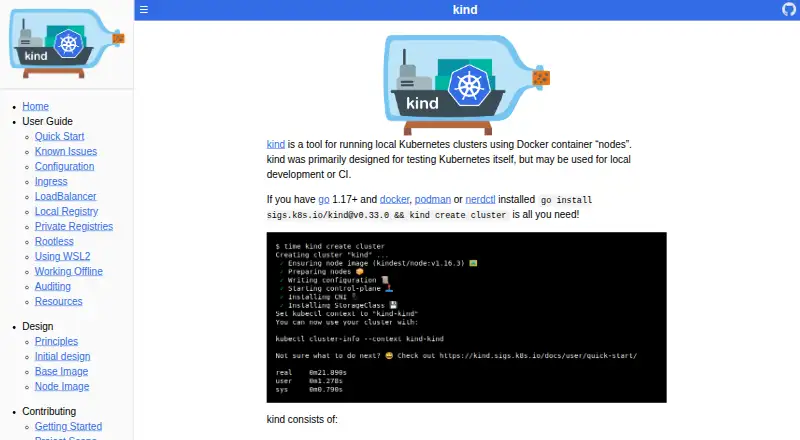
kind runs local Kubernetes clusters using Docker container nodes, primarily for Kubernetes testing, with local development and CI also listed as uses. It is a free, open-source project under the Apache-2.0 license and supports Linux, macOS, and Windows. Cluster nodes are bootstrapped with kubeadm, and configurations can define multiple control-plane and worker nodes, port mappings, and Kubernetes versions. Multi-node and high-availability clusters are supported. kind can build Kubernetes release builds from source or use pre-published builds, and it can detect Docker, Podman, or nerdctl as its container provider. Users can load Docker images or an image archive into a cluster. Documentation covers ingress and Gateway API configuration with cloud-provider-kind, private registry workflows, and Kubernetes API audit logging. Rootless Docker, Podman, and nerdctl are supported subject to provider and host requirements, though block storage and NFS cannot be mounted under documented rootless restrictions. Release binaries are listed for supported desktop systems. The project describes itself as a work in progress and says it is not intended as an alternative to Docker Compose.
Who it suits
kind suits developers and teams who need Kubernetes clusters for testing, local development, CI, or Cluster API work. It is not intended for users seeking a Docker Compose alternative.
What it does well
- Free and open source under Apache-2.0.
- Supports Linux, macOS, and Windows.
- Multi-node and high-availability clusters are supported.
- Can load Docker images into clusters.
What to know first
- Windows containers are unsupported or infeasible.
- Rootless restrictions prevent mounting block storage and NFS.
- Not intended as a Docker Compose alternative.
- Project describes itself as a work in progress.
Limits
kind is free, with no paid plans stated. Rootless providers have documented restrictions, including that block storage and NFS cannot be mounted; Windows containers are unsupported or infeasible.
Plans
| Plan | Billed and limits | Price |
|---|---|---|
| kind | Open-source tool; no paid plans or price stated | Free |
As kind.sigs.k8s.io lists them, read 9 Oct 2026. The maker's own page has the final word.
Getting started
- Visit the kind project website.
- Download a release binary for Linux, macOS, or Windows, or follow the source installation instructions.
- Use Docker, Podman, or nerdctl as the node provider.
- Create a configuration file if you need multiple nodes, port mappings, or a particular Kubernetes version.
- Start a cluster and load Docker images or an image archive as needed.
kind is a free, open-source tool for developers and testers who need configurable local Kubernetes clusters. It is strongest for Kubernetes-focused testing and CI, not for composing general container applications.
Overview
kind creates Kubernetes clusters whose nodes run as containers, then bootstraps them with kubeadm. Its configuration file can specify control-plane and worker nodes, port mappings, and Kubernetes versions, making it useful when a test needs more than a single default cluster. The project also supports multi-node and high-availability layouts, although it is intended for local testing and development rather than as a general-purpose cluster service.
Its Kubernetes focus is also a boundary: kind is not intended as an alternative to Docker Compose. The project describes itself as a work in progress and maintains a 1.0 roadmap, so teams making it central to a workflow should account for that status.
Key features
- Flexible cluster creation: Use Docker, Podman, or nerdctl as the container provider, subject to each provider's and host's requirements. Rootless providers are supported, but their constraints matter: block storage and NFS cannot be mounted.
- Kubernetes build and image workflows: Build Kubernetes release builds from source or use pre-published builds, then load one or more Docker images or an image archive into the cluster. This is useful for testing images locally without relying only on a registry.
- Networking and registries: Documentation covers ingress and Gateway API configuration with cloud-provider-kind, which supports both. Private images can be handled with imagePullSecrets, host-side image loading, or credentials mounted into nodes.
- Auditing: Kubernetes API audit logging can be enabled with an audit policy and log backend, giving teams a way to inspect API activity in a test cluster.
- Conformance: The project describes kind as a CNCF certified conformant Kubernetes installer, a useful signal for Kubernetes testing workflows.
Pricing
kind is free: its plan is free, and the project identifies its repository license as Apache-2.0. There are no paid plans or trial to weigh. The trade-off is not a feature tier but the tool's scope: it provides local Kubernetes clusters, not a Compose workflow or a managed production service.
Platforms
Release binaries and installation instructions cover Linux, macOS, and Windows; the project also lists community-maintained packages. Windows containers are unsupported or infeasible, so Windows users should distinguish running kind on Windows from using Windows container workloads. Rootless setups on supported providers also inherit provider and host requirements, including the inability to mount block storage and NFS.
Who it's for
kind is a good fit for Kubernetes developers, application testers, CI workflows, and Cluster API developers or users who need bootstrap clusters. It suits people who want to configure node counts and Kubernetes versions, build or load images, and test cluster behavior locally. It is a poor fit for teams seeking a Docker Compose replacement or relying on rootless mounts of block storage or NFS.
Installation is available through downloadable release binaries or source instructions, with community-maintained packages also listed. For help, the project points users to the Kubernetes Slack #kind channel, its GitHub issue tracker, and the SIG-Testing mailing list.
Pros and cons
- Pro: Multi-node and high-availability cluster configurations make kind more useful for realistic Kubernetes testing than a single-node-only setup.
- Pro: Multiple container providers, source-built Kubernetes releases, and local image loading give teams options for shaping a test environment.
- Pro: Free, open-source distribution avoids paid-plan and trial constraints.
- Con: It is deliberately not a Compose alternative, so it does not suit workflows centered on orchestrating general application containers.
- Con: Rootless operation cannot mount block storage or NFS, limiting some storage-dependent tests.
- Con: Windows-container workloads are outside its feasible support, despite Windows being a supported host platform.
- Con: The project's work-in-progress status is worth considering for teams that need a settled tool at the center of a workflow.
Alternatives
Choose Rancher Desktop if you want a free, open-source desktop application from SUSE's Rancher Engineering group instead. Colima is a free, MIT-licensed option for container runtimes on macOS and Linux. ctlptl is another free, Apache-2.0 option with no paid plans or usage limits stated.
For a Kubernetes client with a free desktop plan across macOS, Windows, and Linux, consider Kubeterm. Kubus is built in the open by its maker for network automation work. Kunobi has a free tier for up to three clusters at once with community support and no sign-up required.
srelens offers a free, open-source MIT-licensed download with no paid tier. vCluster Platform is worth considering when virtual clusters are the priority; its free tier allows unlimited virtual clusters up to 64 CPUs or 32 GPUs, with a maximum of one HA vCluster. Browse Local Kubernetes Tools or Container Development Environments for more options.
Verdict
Choose kind if you need free, configurable local Kubernetes clusters for testing, CI, or Cluster API bootstrap work. Its multi-node support and image workflows are the main reasons to choose it; look elsewhere if you need Docker Compose orchestration, Windows containers, or rootless block-storage and NFS mounts.
Verdict
kind focuses on local Kubernetes clusters and offers multi-node setups across three desktop operating systems. Its stated scope and rootless limitations matter if your workflow depends on Compose or those mounts.
Questions
Is kind free and open source?
Yes. kind is open source under the Apache-2.0 license and costs nothing.
Which systems does kind support?
It supports Linux, macOS, and Windows, with release binaries for those systems.
Which container providers can it use?
kind can detect Docker, Podman, or nerdctl as its container provider. Rootless providers are also possible subject to provider and host requirements.
Can kind create multi-node clusters?
Yes. It supports multi-node clusters, including high-availability configurations.
Can it be used for Docker Compose workflows?
No. The project says kind is not intended as an alternative to Docker Compose.
Where can users get support?
The project points users to its Kubernetes Slack #kind channel, GitHub issue tracker, and SIG-Testing mailing list.
Facts from kind's own pages
- Cluster configuration
- A configuration file can define multiple worker and control-plane nodes, port mappings, and Kubernetes versions. · kind.sigs.k8s.io, 9 Oct 2026
- Cluster features
- kind supports multi-node clusters, including high-availability clusters, and can build Kubernetes release builds from source. · kind.sigs.k8s.io, 9 Oct 2026
- Cluster setup
- kind bootstraps cluster nodes with kubeadm. · kind.sigs.k8s.io, 9 Oct 2026
- Conformance
- The project describes kind as a CNCF certified conformant Kubernetes installer. · kind.sigs.k8s.io, 9 Oct 2026
- Container providers
- kind can detect Docker, Podman, or nerdctl as its container provider. · kind.sigs.k8s.io, 9 Oct 2026
- Container runtimes
- kind can use Docker, Podman, or nerdctl as its node provider. · kind.sigs.k8s.io, 9 Oct 2026
- Image loading
- Users can load one or more Docker images or an image archive into a kind cluster. · kind.sigs.k8s.io, 9 Oct 2026
- Image workflow
- Users can load one or more Docker images or an image archive into a kind cluster. · kind.sigs.k8s.io, 9 Oct 2026
- Installation
- The project provides downloadable release binaries and source installation instructions; community-maintained packages are also listed. · kind.sigs.k8s.io, 9 Oct 2026
- Intended users
- Project priorities include supporting Kubernetes testing, Kubernetes application testing, and providing bootstrap clusters for Cluster API developers and users. · kind.sigs.k8s.io, 9 Oct 2026
- Kubernetes auditing
- The documentation explains how to enable Kubernetes API auditing on a kind cluster using an audit policy and log backend. · kind.sigs.k8s.io, 9 Oct 2026
- Kubernetes builds
- kind can build Kubernetes release builds from source and use pre-published builds. · kind.sigs.k8s.io, 9 Oct 2026
- License
- The kind GitHub repository identifies its license as Apache-2.0. · github.com, 9 Oct 2026
- Multi-node
- kind supports multi-node clusters, including high availability configurations. · kind.sigs.k8s.io, 9 Oct 2026
- Networking
- The documentation covers configuring ingress and Gateway API with cloud-provider-kind, which natively supports both. · kind.sigs.k8s.io, 9 Oct 2026
- Private registries
- kind supports private registry workflows using Kubernetes imagePullSecrets, host-side image loading, or credentials mounted into nodes. · kind.sigs.k8s.io, 9 Oct 2026
- Project status
- The project describes kind as a work in progress and links to a 1.0 roadmap. · kind.sigs.k8s.io, 9 Oct 2026
- Purpose
- kind runs local Kubernetes clusters using Docker container nodes and is designed primarily for Kubernetes testing, with local development and CI as other uses. · kind.sigs.k8s.io, 9 Oct 2026
- Rootless limitations
- The documentation notes rootless restrictions including that block storage and NFS cannot be mounted. · kind.sigs.k8s.io, 9 Oct 2026
- Rootless support
- Rootless Docker, Podman, and nerdctl can be used as node providers, subject to provider and host requirements. · kind.sigs.k8s.io, 9 Oct 2026
- Scope limitation
- The project scope says kind is not intended to be an alternative to Docker Compose. · kind.sigs.k8s.io, 9 Oct 2026
- Security auditing
- The docs explain how to enable Kubernetes API audit logging on a kind cluster using an audit policy and log backend. · kind.sigs.k8s.io, 9 Oct 2026
- Support
- The project directs users to its Kubernetes Slack #kind channel, GitHub issue tracker, and SIG-Testing mailing list for help and issues. · kind.sigs.k8s.io, 9 Oct 2026
- Supported platforms
- The project lists Linux, macOS, and Windows support, with release binaries for Linux, macOS, and Windows. · kind.sigs.k8s.io, 9 Oct 2026
Where kind stands on Freedom251
- Container Development Environments#14 of 40
- Local Kubernetes Tools#9 of 23