Freedom251 › Demand Planning Software
Kepion
by Kepion
What Kepion is
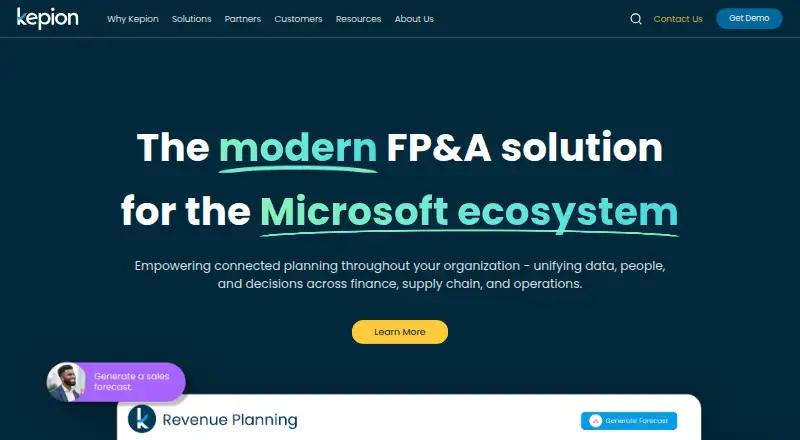
Kepion is an FP&A platform for planning across finance, supply chain, and operations. It covers budgeting, forecasting, revenue, workforce, capital, demand, and supply planning, along with variance analysis and financial consolidation. Teams can model possible outcomes in real time, comparing best, worst, and expected scenarios for revenue, costs, and operational plans. Shared data connects finance, sales, operations, and supply chain teams as they coordinate plans. Kepion says it works with Microsoft 365, Dynamics 365, Power BI, Azure Cloud, and SQL Server. Its integration guidance names SQL Server Management Studio, Azure Data Factory, and SQL Server Integration Services, while the documented application integration type currently supported is an Azure Data Factory pipeline. Deployment guidance covers cloud-hosted and on-premises setups. Single sign-on options include Windows Active Directory, Azure Active Directory, and custom identity providers. The product is available via web, Windows, API, and self-hosted deployment. Pricing is on request. Kepion was founded in 2009 and is headquartered in Seattle, Washington.
Who it suits
Kepion suits organizations planning across finance, supply chain, and operations, including companies of any size and across industries. It may fit teams that need shared planning data and scenario comparisons.
What it does well
- Supports budgeting, forecasting, and variance analysis
- Covers workforce and financial consolidation planning
- Compares best, worst, and expected outcomes in real time
- Supports cloud-hosted and on-premises deployments
What to know first
- Application integration currently supports Azure Data Factory pipelines
- Pricing is available on request
Plans
| Plan | Billed and limits | Price |
|---|---|---|
| Kepion | Contact sales for product information and a demo | On request |
As kepion.com lists them, read 8 Oct 2026. The maker's own page has the final word.
Getting started
- Visit https://www.kepion.com/.
- Contact sales for product information and a demo.
- Choose between cloud-hosted and on-premises deployment options.
- Select web, Windows, API, or self-hosted access.
Kepion is a financial and operational planning platform for organizations that need finance, sales, operations, and supply-chain teams working from common plans. It is best suited to connected planning across several functions and to Microsoft-oriented environments. The main trade-offs are custom pricing and a documented application-integration option limited to an Azure Data Factory pipeline.
Overview
Kepion combines budgeting, forecasting, revenue, workforce, capital, demand, and supply planning in one FP&A environment. It also handles variance analysis, financial consolidation, and forecast-versus-actuals work, giving finance teams a broader planning and performance cycle than a budgeting-only product.
Real-time what-if modeling compares best, worst, and expected outcomes for revenue, cost, and operational plans. That is useful when a demand shift, hiring decision, or supply constraint needs to be reflected across multiple plans rather than managed in separate spreadsheets. Shared data connects finance, sales, operations, and supply chain, so the product is a stronger fit for cross-functional planning than for a small finance group with no operational dependencies.
Key features
Connected planning
The use-case range spans financial and operational decisions, including revenue, workforce, capital, demand, and supply. Teams can align assumptions across those areas and then review variances and actual results against plans. The breadth can reduce handoffs between departmental planning processes, but organizations seeking only a narrow forecasting workflow may not need such a wide scope.
Scenario analysis
Real-time scenario modeling lets users compare alternative outcomes while assumptions change. Best-, worst-, and expected-case views are directly relevant to cost, revenue, and operational planning, making the feature valuable for decision cycles where uncertainty is material.
Microsoft alignment and data integration
Kepion is built to work with Microsoft 365, Dynamics 365, Power BI, Azure Cloud, and SQL Server. Its integration guidance points to SQL Server Management Studio, Azure Data Factory, and SQL Server Integration Services. However, the documented application integration type currently supported is an Azure Data Factory pipeline. Buyers with a broader application-integration estate should confirm that this approach covers their systems before committing.
Deployment, identity, and support
Guidance covers both cloud-hosted and on-premises deployments, giving organizations a choice between managed hosting and self-managed infrastructure. Single sign-on can use Windows Active Directory, Azure Active Directory, or a custom identity provider. Content Security Policy is enabled by default from version 6.1.24324. Kepion provides a support center for best practices and troubleshooting, plus support-ticket submission.
Pricing
Kepion uses paid, custom pricing. The Kepion plan has no published price; buyers contact sales for product information and a demo. There are no lower-cost or free tiers described, so the product is aimed at organizations prepared for a sales-led purchase and a fit discussion rather than self-serve adoption.
Custom pricing can make sense when deployment spans finance and operations, because scope, hosting, users, and implementation needs may vary. It also makes budgeting the purchase harder until a quote is obtained. Request a demonstration that covers your planning use cases and the Azure Data Factory integration boundary.
Platforms
Kepion supports web access, Windows, API connectivity, and self-hosted deployment. Its cloud-hosted and on-premises guidance gives IT teams flexibility over where the system runs, while the Microsoft ecosystem connections will be most practical for organizations already standardized on those services.
Who it's for
Kepion says its planning software serves companies of any size and across industries. In practice, its strongest case is an organization coordinating financial, commercial, operational, and supply-chain plans, especially one that needs scenario comparisons and consolidation in the same process. Microsoft-centric enterprises and teams requiring on-premises or cloud-hosted deployment have clear reasons to investigate it.
Look elsewhere if you need many prebuilt application connectors beyond the documented Azure Data Factory pipeline, or if you need transparent self-serve pricing and a free starting tier.
Pros and cons
- Pro: Budgeting, forecasting, workforce, revenue, capital, demand, and supply planning share one platform, supporting organizations with interdependent plans.
- Pro: Real-time best-, worst-, and expected-case modeling gives decision-makers a direct way to test changing assumptions.
- Pro: Variance analysis, consolidation, and forecast-versus-actuals extend the product into ongoing performance management.
- Pro: Microsoft 365, Dynamics 365, Power BI, Azure Cloud, and SQL Server alignment benefits Microsoft-based IT estates.
- Con: Application integration is documented as an Azure Data Factory pipeline, which may constrain environments needing broader connector coverage.
- Con: Custom pricing and a sales-contact requirement make initial cost comparison difficult.
Alternatives
OneStream is a paid platform available on web, Windows, mobile, API, and self-hosted deployments; choose it when that wider platform coverage matters.
CCH Tagetik is a paid, web and self-hosted option for buyers seeking an alternative enterprise planning platform.
Cube offers paid Bronze and Silver plans with full platform access, custom roles, unlimited dimensions and users, and unlimited dashboards; consider it when those plan inclusions match your requirements.
Finnivo is another paid option with web and API platforms.
Planful is paid and prices subscriptions according to company size, user count, and selected modules, making it worth comparing when those factors fit your buying process.
Syft Analytics has a freemium model and a web platform, suited to readers who want a free entry point.
Taxilla FP&A offers paid Essentials, Growth, and Enterprise plans organized around up to 3, 10, and 25+ entities.
Vena is a paid web and Windows platform with Professional and Complete plans; compare it when those deployment options and tier structure are preferable.
For category browsing, see Management Reporting Software, Revenue Operations Software, Revenue Planning Software, Corporate Performance Management Software, Demand Planning Software, and Financial Forecasting Software.
Verdict
Kepion is a strong candidate for organizations that need finance and operational teams to plan, model scenarios, consolidate results, and review variances on shared data. Choose it for broad cross-functional planning and Microsoft ecosystem alignment. Look elsewhere if your integration architecture needs more than the documented Azure Data Factory pipeline or if you require published, self-serve pricing.
Verdict
Kepion brings financial and operational planning together, with scenario modeling and collaboration on shared data. Buyers should note the stated limit on application integration and request pricing from the company.
Questions
How much does Kepion cost?
Pricing is on request. The listed Kepion plan directs buyers to contact sales for product information and a demo.
What platforms does Kepion support?
Kepion lists API, self-hosted, web, and Windows options.
What kinds of planning does Kepion support?
Its use cases include budgeting, forecasting, revenue, workforce, capital, demand, and supply planning. It also supports scenario modeling, variance analysis, and forecast-versus-actuals.
Which products does Kepion work with?
Kepion says it is built to work with Microsoft 365, Dynamics 365, Power BI, Azure Cloud, and SQL Server. Its documented application integration type currently supported is an Azure Data Factory pipeline.
Who makes Kepion?
Kepion is made by Kepion, founded in 2009 and headquartered in Seattle, Washington, United States.
Facts from Kepion's own pages
- Audience
- Kepion says its planning software is used across industries and companies of any size. · kepion.com, 8 Oct 2026
- Authentication
- Kepion documents Windows Active Directory, Azure Active Directory, and custom identity providers for single sign-on. · help.kepion.com, 8 Oct 2026
- Budgeting
- Yes · kepion.com, 22 Sept 2026
- Collaboration
- The platform connects finance, sales, operations, and supply chain planning on shared data so teams can collaborate and align plans. · kepion.com, 8 Oct 2026
- Data integration
- Kepion's support documentation recommends SQL Server Management Studio, Azure Data Factory, and SQL Server Integration Services for data integration. · help.kepion.com, 8 Oct 2026
- Deployment
- Kepion's data integration guidance describes cloud-hosted and on-premises deployments. · help.kepion.com, 8 Oct 2026
- Financial consolidation
- Yes · kepion.com, 22 Sept 2026
- Forecasting
- Kepion says rolling forecasts can integrate actuals from source systems and cover 12 to 24+ month horizons. · kepion.com, 8 Oct 2026
- Founded
- 2009 · kepion.com, 28 Sept 2026
- Headquarters
- Seattle, Washington, United States · kepion.com, 28 Sept 2026
- Integration limit
- The documented application integration type currently supported is an Azure Data Factory pipeline. · help.kepion.com, 8 Oct 2026
- Microsoft ecosystem
- Kepion says it is built to work with Microsoft 365, Dynamics 365, Power BI, Azure Cloud, and SQL Server. · kepion.com, 8 Oct 2026
- Product
- Kepion describes itself as an FP&A platform for planning across finance, supply chain, and operations. · kepion.com, 8 Oct 2026
- Scenario modeling
- Yes · kepion.com, 22 Sept 2026
- Scenarios
- Kepion supports real-time what-if modeling to compare best, worst, and expected outcomes for revenue, cost, and operational plans. · kepion.com, 8 Oct 2026
- Security
- Kepion's support documentation says Content Security Policy is enabled by default starting with version 6.1.24324. · help.kepion.com, 8 Oct 2026
- Support
- Kepion directs users to its support center for best practices and troubleshooting and lets them submit a support ticket. · help.kepion.com, 8 Oct 2026
- Use cases
- Its planning use cases include budgeting, forecasting, revenue, workforce, capital, demand, and supply planning. · kepion.com, 8 Oct 2026
- Variance analysis
- Yes · kepion.com, 22 Sept 2026
- Workforce planning
- Yes · kepion.com, 22 Sept 2026
Where Kepion stands on Freedom251
- Demand Planning Software#10 of 53
- Financial Planning & Analysis Software#18 of 90
- Scenario Planning Software#20 of 92
- Revenue Planning Software#8 of 26
- Financial Forecasting Software#23 of 74
- Business Performance Management#8 of 25
- Enterprise Performance Management#8 of 23
- Corporate Performance Management Software#11 of 31
- Project Portfolio Management Software#16 of 35
- Management Reporting Software#17 of 32
- Revenue Operations Software#14 of 26