Freedom251 › Container Engines
Incus
What Incus is
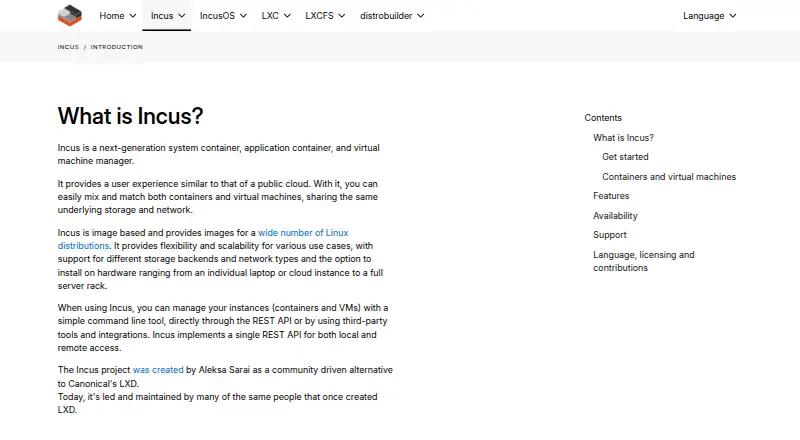
Incus is free software for managing system containers, application containers, and virtual machines. Instances can share underlying storage and networking, and users can manage them through a command-line tool, REST API, or third-party tools. Incus supports snapshots, backup and recovery, migration, configurable storage pools and networks, and resource controls. The project describes its API as scaling from a laptop to clusters of thousands of compute nodes. Documented integrations include Terraform, OpenTofu, Ansible, Packer, Distrobuilder, GARM, Kubernetes Cluster API, and Incant. The daemon runs on Linux, while client applications are available for Windows and macOS; client packages are also listed for FreeBSD. Upstream does not directly provide packages, so installation is through Linux distributions, third-party repositories, or source. The software is developed under the Apache 2 license and is described as suitable for development and production workloads. Local access to the Incus Unix socket grants full control, so the security guide recommends limiting access to trusted users. The 6.0 LTS release is supported until June 2029; feature releases are normally supported until the next release.
Who it suits
It suits teams managing containers and virtual machines on Linux, including development and production workloads. Windows and macOS clients are available for managing an Incus daemon.
What it does well
- Manages containers and virtual machines with shared storage and networking.
- Supports snapshots, backups, recovery, and migration.
- Offers REST API and command-line management.
- Free software under the Apache 2 license.
What to know first
- The daemon runs on Linux only.
- Upstream does not directly provide packages.
- Unix socket access grants full control.
Limits
The Incus daemon runs on Linux, and upstream does not directly provide packages. The 6.0 LTS release is supported until June 2029; feature releases are normally supported until the next release.
Plans
| Plan | Billed and limits | Price |
|---|---|---|
| Incus | Free software · Apache 2 license | Free |
As linuxcontainers.org lists them, read 3 Oct 2026. The maker's own page has the final word.
Getting started
- Open the Incus project website.
- Choose an installation route through a Linux distribution, a third-party repository, or source.
- Install the Incus daemon on a Linux host.
- Use the command-line tool, REST API, or a third-party tool to manage instances.
- Restrict Unix socket access to users trusted with full control.
Incus is free software for managing system and application containers alongside virtual machines. It is best suited to Linux operators who want one control plane for mixed workloads. Its range is a strength, but running the daemon and tightly controlling access are part of the deal.
Overview
Incus lets containers and virtual machines use the same underlying storage and network, bringing different workload types into a shared management model. That is useful for teams that operate both and want consistent administration; it is less compelling if the need is only for a narrowly focused container runtime.
Instances are managed through a command-line tool, REST API, or third-party tools and integrations. The project describes its API as scaling from a laptop to clusters of thousands of compute nodes, and positions Incus for development as well as production. Images for many Linux distributions are published daily, which gives operators a broad starting point for creating instances.
Key features
Snapshots, backup and recovery, migration, configurable storage pools and networks, and resource controls cover much of the day-to-day instance lifecycle. These capabilities make Incus more than a launch-and-run tool: operators can manage persistence, movement, and resource allocation without separating container and VM infrastructure.
Documented integrations include Terraform, OpenTofu, Ansible, Packer, Distrobuilder, GARM, Kubernetes Cluster API, and Incant. That breadth can fit teams already using infrastructure-as-code and automation tools, although the value depends on whether those integrations match an existing workflow.
Containers are unprivileged by default, a useful security baseline. But local access to the Incus Unix socket grants full control of Incus, so access should be restricted to trusted users. The daemon runs on Linux; Windows and macOS builds provide a client, not a non-Linux server.
Pricing
Incus is free software under the Apache 2 license. The Incus plan costs nothing and includes rootless mode and image building, with OCI as the image format and Linux as the supported host operating system. There are no paid tiers or seat charges in this plan. Commercial support is available from Zabbly for users of its Debian or Ubuntu packages; otherwise, community support is through the Linux Containers forum.
Platforms
The Incus daemon runs on Linux, making Linux the practical host requirement for operating workloads. The client is available for Windows and macOS, and FreeBSD client packages are also listed in the installation guide. Upstream does not provide packages directly: installation is through Linux distributions, third-party repositories, or source, so prospective operators should account for that setup choice.
The project offers LTS and feature releases. Incus 6.0 LTS is supported until June 2029, while feature releases arrive about monthly and are normally supported until the next release. The LTS track is the clearer fit for operators who prioritize a longer support window over following frequent feature releases.
Who it's for
Incus suits administrators and development teams that need to manage Linux containers and virtual machines together, especially where shared storage, networking, migration, and automation matter. Its free license lowers the cost barrier, and its API and integrations can support varied management approaches. It is not the right pick for someone seeking a non-Linux host daemon or an environment where local socket access cannot be limited to trusted users.
Pros and cons
- Pro: Containers and virtual machines share storage and networks, giving mixed-workload teams one infrastructure model.
- Pro: Snapshots, recovery, migration, and resource controls address important operational tasks within the same manager.
- Pro: Free Apache 2 licensing and a broad set of documented integrations make it adaptable without a license fee.
- Con: The daemon is Linux-only, so Windows and macOS clients do not make those systems host platforms.
- Con: Unix socket access grants full control, requiring careful access restrictions.
- Con: Upstream does not supply packages directly, leaving installation to distributions, third-party repositories, or source.
Alternatives
Choose Docker Desktop if a desktop-focused option across Linux, macOS, Windows, and web fits better; its Personal plan is free, with a Pro plan at $9 a month. Apptainer is another free container platform with commercial support through partners.
Rancher Desktop is a free alternative identified as part of SUSE's Rancher Engineering group. Colima is a free, MIT-licensed option for container runtimes on macOS and Linux. Finch is free and requires no licensing tiers or commercial agreements.
LXD offers self-hosted system containers and KVM-based virtual machines, with a free open-source plan. Podman provides free container, pod, and image management, while Podman Desktop adds a free desktop option for containers and Kubernetes across macOS, Windows, and Linux.
Verdict
Choose Incus if you want free, Linux-based management for both containers and virtual machines, with shared infrastructure and useful lifecycle controls. Its main advantage is that broad management scope; look elsewhere if you need a daemon on Windows or macOS, or cannot restrict socket access to trusted operators.
Verdict
Incus combines container and virtual-machine management with storage, networking, migration, and resource controls. Plan for a Linux daemon and trusted-only socket access, and choose an installation route through a distribution, third-party repository, or source.
Questions
How much does Incus cost?
The Incus plan costs nothing. It is free software under the Apache 2 license.
What can Incus manage?
It manages system containers, application containers, and virtual machines. Instances can share underlying storage and networking.
Which operating systems can run Incus?
The Incus daemon runs on Linux. Clients are available for Windows and macOS, and the installation guide also lists FreeBSD client packages.
How can users install Incus?
Upstream does not directly provide packages. Installation is available through Linux distributions or third-party repositories, and from source.
What integrations are documented?
Documented integrations include Terraform, OpenTofu, Ansible, Packer, Distrobuilder, GARM, Kubernetes Cluster API, and Incant.
How long are releases supported?
The 6.0 LTS release is supported until June 2029. Feature releases are published about monthly and normally supported until the next release.
Facts from Incus's own pages
- Access
- Instances can be managed through a command line tool, the REST API, or third-party tools and integrations. · linuxcontainers.org, 3 Oct 2026
- Client platforms
- The Incus client is available for Windows and macOS, and the installation guide also lists FreeBSD client packages. · linuxcontainers.org, 2 Oct 2026
- Cloud-like management
- Incus lets users manage containers and virtual machines that share underlying storage and networking. · linuxcontainers.org, 3 Oct 2026
- Commercial support
- The Incus project says commercial support is available from Zabbly. · linuxcontainers.org, 3 Oct 2026
- Features
- Features include backups and recovery, snapshots, instance migration, configurable profiles, storage backends, network management, resource controls, and device passthrough. · linuxcontainers.org, 3 Oct 2026
- Founded
- 2023 · linuxcontainers.org, 28 Sept 2026
- Images
- Incus provides images for a wide range of Linux distributions, published daily. · linuxcontainers.org, 3 Oct 2026
- Installation
- Incus upstream does not directly provide packages; packages are available through Linux distributions or third-party repositories, and it can also be installed from source. · linuxcontainers.org, 3 Oct 2026
- Integrations
- The documentation links to third-party tools and documents storage drivers including Btrfs, LVM, ZFS, Ceph, LINSTOR, and TrueNAS. · linuxcontainers.org, 3 Oct 2026
- License
- Incus is free software developed under the Apache 2 license. · linuxcontainers.org, 2 Oct 2026
- License and audience
- Incus is free software under the Apache 2 license, and the project describes it as suitable for development and production workloads. · linuxcontainers.org, 3 Oct 2026
- Linux server
- The Incus daemon runs on Linux; builds for other operating systems include only the client. · linuxcontainers.org, 2 Oct 2026
- Local access limit
- Access to the Incus Unix socket grants full control of Incus, so the documentation advises giving it only to users trusted with root access. · linuxcontainers.org, 3 Oct 2026
- Management
- Instances can be managed with a command line tool, the REST API, or third-party tools and integrations. · linuxcontainers.org, 2 Oct 2026
- Purpose
- Incus is a system container, application container, and virtual machine manager. · linuxcontainers.org, 2 Oct 2026
- Releases
- The Incus 6.0 LTS release is supported until June 2029, while feature releases are published about monthly and normally supported until the next release. · linuxcontainers.org, 2 Oct 2026
- Release support
- Incus offers LTS and feature releases; its page states that Incus 6.0 LTS is supported until June 2029, while feature releases are normally supported for about a month. · linuxcontainers.org, 3 Oct 2026
- Scale
- Incus is described as scaling from a single instance on one machine to a cluster in a full data center rack. · linuxcontainers.org, 3 Oct 2026
- Security
- The project highlights unprivileged containers, resource restrictions, and authentication as security measures. · linuxcontainers.org, 3 Oct 2026
- Security limitation
- Local access to the Incus Unix socket grants full control of Incus, so the guide recommends giving it only to trusted users. · linuxcontainers.org, 2 Oct 2026
- Shared infrastructure
- Containers and virtual machines can share the same underlying storage and network. · linuxcontainers.org, 2 Oct 2026
- Support
- Community support is available through the Linux Containers forum, and Zabbly provides commercial support for users of its Debian or Ubuntu packages. · linuxcontainers.org, 2 Oct 2026
- Supported hosts
- The Incus daemon works on Linux; the client is available on most platforms, and the project specifically identifies Windows and macOS clients. · linuxcontainers.org, 3 Oct 2026
- What it does
- Incus is a system container, application container, and virtual machine manager. · linuxcontainers.org, 3 Oct 2026
Where Incus stands on Freedom251
- Container Engines#6 of 31
- Container Runtime Software#8 of 28