Freedom251 › Container Runtime Software

Charliecloud
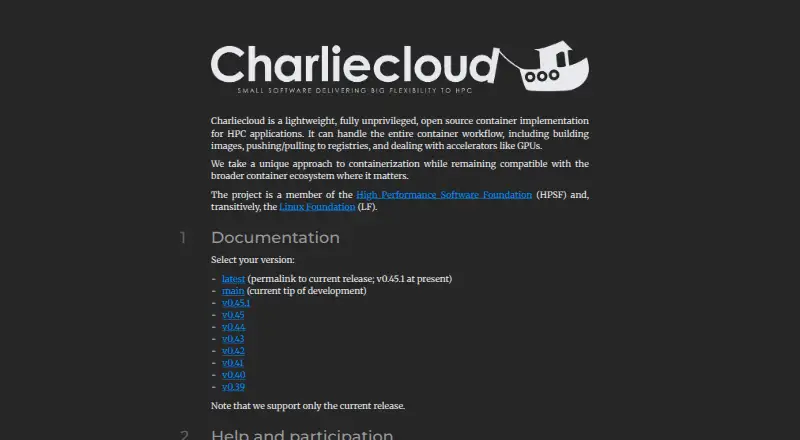
What Charliecloud is
Charliecloud is open-source container software for high-performance computing on Linux. It runs containers through Linux user namespaces, allowing an unprivileged workflow without privileged operations or daemons and with minimal configuration changes on computing-center resources. Users can build images, push and pull them to registries, and use accelerators such as GPUs. Its ch-image tool supports registry authentication, including with GitLab Container Registry. For image builds, Charliecloud uses a Git-based cache without layers, and it parses Dockerfiles using a formal grammar. At runtime, ch-run can inject host resources through the Container Device Interface, including NVIDIA GPUs and Cray networking. The software can be built from a release tarball or Git checkout, or installed through package managers such as Spack and Fedora/EPEL. It requires Linux user namespaces for its fully unprivileged workflow and is distributed under the Apache License, Version 2.0. The project supports only its current release. It does not provide its own security boundary, relying instead on the Linux kernel and userland.
Who it suits
Charliecloud suits high-performance computing users who need to build and run containers on Linux without privileged operations or daemons. Its registry support and host-resource injection may also fit workflows that use accelerators or computing-center resources.
What it does well
- Runs containers without privileged operations or daemons
- Builds and transfers images to registries
- Git-based build cache without layers
- Can inject GPUs and Cray networking
- Free and Apache License 2.0
What to know first
- Requires Linux user namespaces for unprivileged use
- Supports only the current release
- Does not provide its own security boundary
Limits
The fully unprivileged workflow requires Linux user namespaces. The project supports only the current release, and its software does not provide a security boundary of its own.
Plans
| Plan | Billed and limits | Price |
|---|---|---|
| Charliecloud | Open source container software; Apache License 2.0 | Free |
As charliecloud.io lists them, read 9 Oct 2026. The maker's own page has the final word.
Getting started
- Visit the Charliecloud website.
- Build from a release tarball or Git checkout, or install through Spack or Fedora/EPEL.
- Ensure Linux user namespaces are available for the fully unprivileged workflow.
- Build images and push or pull them through a supported registry.
- Use ch-run to run containers and inject host resources through the Container Device Interface.
Verdict
Charliecloud provides a Linux container workflow tailored to high-performance computing, with image-building, registry, and accelerator support. Users should account for its Linux user-namespace requirement and reliance on kernel and userland security enforcement.
Questions
Is Charliecloud free?
Yes. Its plan is listed as free, and it is open source under Apache License, Version 2.0.
Which operating system does it support?
Charliecloud supports Linux. Its fully unprivileged workflow requires Linux user namespaces.
Can it build and transfer container images?
Yes. It supports image building as well as pushing and pulling images to registries, with registry authentication.
Which registries can it use?
Its ch-image tool works with registries including GitLab Container Registry.
Can containers use GPUs?
Yes. At runtime, ch-run can inject host resources through the Container Device Interface, including NVIDIA GPUs and Cray networking.
How can I install it?
You can build it from a release tarball or Git checkout, or use package managers including Spack and Fedora/EPEL.
Facts from Charliecloud's own pages
- Build cache
- Its layer-free build cache is based on Git rather than union mount filesystems and tarballs. · charliecloud.io, 9 Oct 2026
- Dockerfile support
- Charliecloud parses Dockerfiles using a formal grammar. · charliecloud.io, 9 Oct 2026
- Hardware integration
- At runtime, ch-run can inject host resources into containers using the Container Device Interface, including resources such as NVIDIA GPUs and Cray networking. · charliecloud.io, 9 Oct 2026
- Installation
- Charliecloud can be built from a release tarball or Git checkout and is also available through package managers including Spack and Fedora/EPEL. · charliecloud.io, 9 Oct 2026
- License
- Charliecloud is open source software distributed under the Apache License, Version 2.0. · charliecloud.io, 9 Oct 2026
- Notable limit
- The project states that it supports only the current release. · charliecloud.io, 9 Oct 2026
- Platform requirements
- Charliecloud requires Linux user namespaces for its fully unprivileged workflow; it has been run on x86-64, ARM, and Power, and is currently tested on x86_64 and ARM. · charliecloud.io, 9 Oct 2026
- Project membership
- Charliecloud is a member of the High Performance Software Foundation and, through it, the Linux Foundation. · charliecloud.io, 9 Oct 2026
- Purpose
- Charliecloud is a lightweight, fully unprivileged, open source container implementation for high performance computing applications. · charliecloud.io, 9 Oct 2026
- Registry compatibility
- The ch-image tool can push and pull images to registries, including GitLab Container Registry, and supports registry authentication. · charliecloud.io, 9 Oct 2026
- Runtime model
- It uses Linux user namespaces to run containers without privileged operations or daemons, with minimal configuration changes on computing center resources. · charliecloud.io, 9 Oct 2026
- Security approach
- Charliecloud does not provide a security boundary within the software and relies on the Linux kernel and userland to enforce security. · charliecloud.io, 9 Oct 2026
- Support
- Users can report bugs or request features through the GitLab project and can get usage help through mailing lists and chat channels. · charliecloud.io, 9 Oct 2026
- Workflow
- It supports building images, pushing and pulling images to registries, and using accelerators such as GPUs. · charliecloud.io, 9 Oct 2026
Where Charliecloud stands on Freedom251
- Container Runtime Software#5 of 28
- Container Engines#7 of 31