Freedom251 › Usability Testing Software

Hubble
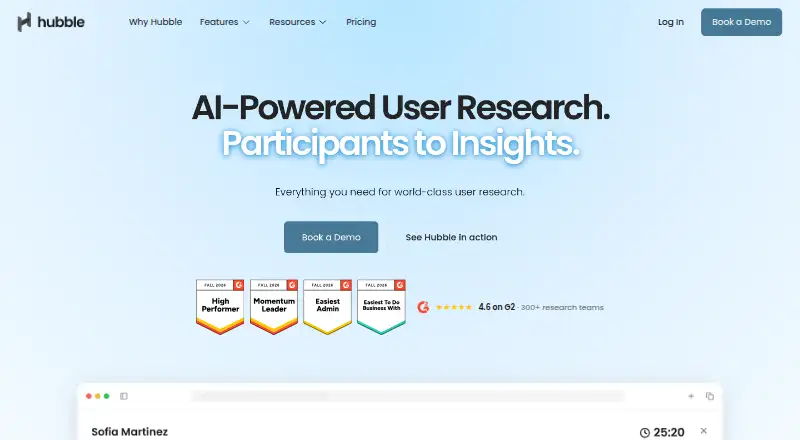
What Hubble is
Hubble is an AI-powered user research platform for exploring customer needs, testing designs, and collecting feedback. It brings research planning, recruitment, study launch, analysis, and sharing into a workspace aimed at UX teams. Methods include moderated and unmoderated studies, AI-moderated research, surveys, in-product surveys, diary studies, and concept studies. In unmoderated tests, participants work on their own time with prototypes or live websites, and researchers can review recordings and feedback. Hubble says its AI can tag transcripts, surface recurring themes, and synthesize interview findings. Its research assistant can help create studies, conduct interviews, and analyze feedback, with users approving suggestions or changes during planning. Named recruitment panels include Respondent, User Interviews, and Cint; Prolific is described as coming soon. Participant tools include screening, scheduling, incentives, and consent-document sharing. The Free plan costs nothing and includes one seat and 10 responses per month. Pro is $120 a month, billed per seat monthly.
Who it suits
Hubble suits UX teams that need to plan and run research, gather participant feedback, and analyze findings. The Free plan may fit a single-seat workflow with up to 10 responses per month.
What it does well
- Supports moderated and unmoderated research.
- AI can tag transcripts and synthesize findings.
- Includes Figma integration on the Free plan.
- Web and mobile SDKs can embed surveys.
- Free plan includes one seat and 10 monthly responses.
What to know first
- Free plan is limited to 10 responses monthly.
- Pro allows up to three seats at $120 each.
- Enterprise pricing is available by custom quote.
- Pro includes one AI report per month.
Limits
Free includes one seat, 10 responses per month, and one prototype per study. Pro includes 100 responses per month, up to three seats at 120.00 USD each per month, one prototype per study, and one AI report per month.
Plans
| Plan | Billed and limits | Price |
|---|---|---|
| Free | 1 seat · 10 responses per month · 1 prototype per study · AI study generation and rephrasing · Figma integration · Research templates | Free |
| Pro | Per seat per month billed monthly · 100 responses per month · Up to 3 seats at $120 each · 1 prototype per study · Video and audio recording · Custom question bank · 1 AI report per month | $120 a month |
| Enterprise | Contact for custom price · Custom seats and responses · Moderated studies · Custom templates · Unlimited AI reports · Participant panel access · SSO · Role based access control · Enterprise security docs | On request |
As usehubble.io lists them, read 3 Oct 2026. The maker's own page has the final word.
Getting started
- Visit https://www.usehubble.io/.
- Start with the Free plan, which includes one seat and 10 responses per month.
- Use the web, Android, or iOS platform, or connect through the API.
- Choose a research method and use Figma integration or a web or mobile SDK where relevant.
- For Pro or Enterprise access, select the plan that fits your seat and response needs.
Hubble is a research workspace for UX teams running studies across prototypes, live products and interviews. It best suits teams that want recruitment, participant management and AI-assisted synthesis together; very small projects may find its response allowances restrictive.
Overview
Hubble brings unmoderated and AI-moderated research, moderated sessions, surveys, in-product surveys, diary studies and concept studies into one platform. Participants can complete tasks asynchronously on prototypes or live websites, while researchers review recordings and feedback. The combination is useful when a team needs both scheduled conversations and larger task-based studies without splitting work across separate tools.
The platform also covers recruitment and study operations. Screening questions, scheduling, consent-document sharing, and incentives through Tremendous or participant credits support the path from recruiting to completion. Respondent, User Interviews and Cint are named panel providers, with Prolific planned for a future release.
Key features
Hubble's unmoderated testing is suited to evaluating flows at participants' convenience. Prototype and live-website support lets researchers investigate realistic tasks, while moderated studies remain available when probing and follow-up are essential.
AI automatically tags transcripts, surfaces recurring themes and synthesizes findings across interviews. Hubble MCP can help build studies, conduct interviews and analyze feedback, while requiring user approval for each planning change or suggestion. That approval step keeps researchers in control, but the depth of automated reporting depends on the subscription.
Figma integration connects design work to study setup. For product feedback after launch, the JavaScript Web SDK can embed surveys, target users by attributes and trigger them from tracked events. Web and mobile SDKs support survey modals inside products, making Hubble relevant to teams collecting continuous in-product responses rather than only one-off studies.
Security credentials include SOC 2 Type II, HIPAA and GDPR compliance. Enterprise adds Okta or Microsoft Enterprise SAML SSO, role-based access control and enterprise security documentation. Developer support is directed through Hubble's community Slack group.
Pricing
Free
The Free plan costs nothing and includes one seat, 10 responses per month, one prototype per study, AI study generation and rephrasing, Figma integration and research templates. It is practical for learning the workflow or running occasional, small studies, but 10 monthly responses and a single seat limit ongoing research.
Pro
Pro costs $120 a month per seat, billed monthly. It includes 100 responses per month, up to three seats at $120 each, one prototype per study, video and audio recording, a custom question bank and one AI report per month. This is the sensible tier for a small UX team running regular studies; the response quota is ten times Free's, but teams needing more than three seats or more frequent AI reports will outgrow it.
Enterprise
Enterprise uses custom pricing and custom seats and responses. It adds moderated studies, custom templates, unlimited AI reports, participant panel access, SSO, role-based access control and enterprise security documentation. Larger organizations with governance requirements or panel-based recruitment should choose it; teams without those needs may not justify a bespoke contract.
Platforms
Hubble supports Android, iOS, web and an API. Its web and mobile SDKs enable embedded survey experiences, while the API provides an integration path for product and research workflows.
Who it's for
Hubble is aimed at UX teams that want recruiting, planning, launching, analysis and sharing in one workspace. It fits organizations combining prototype tests, interviews and in-product surveys, especially where compliance controls and embedded feedback matter. Solo researchers with low monthly volume can start free, but the one-seat and 10-response caps make it a limited long-term home.
Pros and cons
Pros
- Broad research coverage: moderated, unmoderated, AI-moderated, survey, diary and concept formats support varied questions.
- Integrated operations: screening, scheduling, incentives and consent documents reduce handoffs between study stages.
- Product feedback channels: web and mobile SDKs support targeted, event-triggered in-product surveys.
- Governance options: SOC 2 Type II, HIPAA and GDPR compliance, with SSO and role controls on Enterprise.
Cons
- Free is tightly capped: one seat and 10 responses per month suit experimentation rather than continuous programs.
- Pro remains quota-based: 100 responses, three seats and one AI report monthly may constrain active teams.
- Advanced access is gated: moderated studies and participant panel access are Enterprise features.
Alternatives
For a wider comparison, see Usability Testing Software.
- PlaybookUX is a better fit when 50 annual self-serve sessions and pay-per-use panel credits suit a project-based budget.
- Userfeel suits teams wanting three monthly credits, one admin and their own testers on the Free plan.
- Lyssna is preferable for unlimited quick studies, three seats and 15 self-recruited responses on Free.
- Trymata fits buyers who want pay-as-you-go studies with no subscription and results stored up to six months.
- UXArmy offers a Free tier with one full seat and 15 monthly credits, but no recordings or participant panel.
- Maze is an alternative for teams already using its freemium research workflow.
- QuestionPunk is suited to 20 monthly responses with AI interviews and follow-ups on its free tier.
- UserTest Pro is worth considering when unlimited tests, seats and user-panel access are the priority.
Verdict
Choose Hubble if your UX team needs one workspace for mixed research methods, participant operations, embedded product surveys and AI-supported synthesis. Its main advantage is breadth with enterprise governance; look elsewhere if your work exceeds Pro's response, seat or AI-report limits or if you only need occasional low-volume testing.
Verdict
Hubble combines research methods, participant tools, and AI-assisted analysis in a workspace for UX teams. Its Free plan has a small response allowance, while Pro is $120 a month per seat, billed monthly.
Questions
Is Hubble free?
Yes. The Free plan costs nothing and includes one seat and 10 responses per month.
What does Hubble Pro cost?
Pro costs $120 a month per seat, billed monthly. It supports up to three seats at that price.
Which platforms does Hubble support?
Hubble lists Android, iOS, web, and API.
Can Hubble recruit research participants?
Yes. It names Respondent, User Interviews, and Cint as panel providers; Prolific is coming soon.
Does Hubble support moderated research?
Yes. Moderated studies are listed under Enterprise, and Hubble also offers unmoderated research.
What does Enterprise include?
Enterprise has custom seats and responses, moderated studies, unlimited AI reports, participant panel access, SSO, and role based access control. Its price is custom.
Facts from Hubble's own pages
- AI analysis
- Hubble says it can automatically tag transcripts, surface recurring themes, and synthesize findings across interviews with AI. · usehubble.io, 3 Oct 2026
- Design integration
- Hubble lists Figma integration on its pricing page. · usehubble.io, 3 Oct 2026
- Enterprise access controls
- The Enterprise plan lists Okta or Microsoft Enterprise SAML SSO and role based access control. · usehubble.io, 3 Oct 2026
- In-product SDK
- Hubble's documentation provides a JavaScript Web SDK for embedding surveys, targeting users by attributes, and triggering surveys from tracked events. · usehubble.io, 3 Oct 2026
- Intended users
- Hubble's Why Hubble page describes the platform as built for UX teams and says it combines recruiting, planning, launching, analysis, and sharing in one workspace. · usehubble.io, 3 Oct 2026
- Mobile SDK
- Hubble's documentation says its web and mobile SDKs can embed survey modals in products and collect responses from users. · usehubble.io, 3 Oct 2026
- Participant tools
- Hubble describes screening questions, participant scheduling, incentives through Tremendous or participant credits, and consent document sharing. · usehubble.io, 3 Oct 2026
- Product
- Hubble describes itself as an AI-powered user research platform for exploring customer needs, testing designs, and collecting feedback. · usehubble.io, 3 Oct 2026
- Recruitment
- The site names Respondent, User Interviews, and Cint as panel providers and says Prolific is coming soon. · usehubble.io, 3 Oct 2026
- Research assistant
- Hubble MCP can help build studies, conduct interviews, and analyze feedback, with users approving each change or suggestion made during research planning. · usehubble.io, 3 Oct 2026
- Research methods
- The platform lists unmoderated and AI-moderated research, moderated studies, surveys, in-product surveys, and diary and concept studies. · usehubble.io, 3 Oct 2026
- Security
- The site footer states that Hubble is SOC 2 Type II, HIPAA, and GDPR compliant. · usehubble.io, 3 Oct 2026
- Support
- Hubble's documentation directs users to its community Slack group for additional developer support. · usehubble.io, 3 Oct 2026
- Unmoderated testing
- Participants can complete tasks on their own time while researchers test prototypes or live websites and review recordings and feedback. · usehubble.io, 3 Oct 2026
Where Hubble stands on Freedom251
- Usability Testing Software#2 of 52
- User Testing#2 of 25