Freedom251 › Legal Time Tracking Software
Hourglass
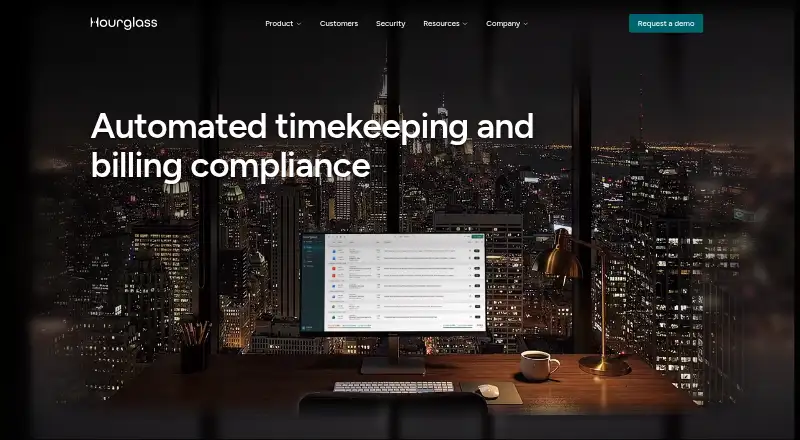
What Hourglass is
Hourglass captures attorneys’ work across email, documents, calls, and research, then drafts time entries with matter details, billing codes, and AI-written narratives. Before an entry reaches a bill, it checks the entry against the client’s outside counsel guidelines. Firms can provide guidelines as PDF, Word, or email files; Hourglass turns requirements into rules linked to their source paragraphs. If a deduction occurs, it links the deduction to a time entry, attaches work evidence, and prepares an appeal for review and editing. A timekeeper must approve every entry, and Hourglass says it does not submit entries on anyone’s behalf. Listed capture sources include Outlook, Word, Teams, Zoom, browsers, and legal research tools; billing destinations include Elite 3E, Aderant, ProLaw, Litify, and Clio. Each firm has a separate application deployment and database. The security information describes TLS protection, AES-256 encryption at rest, and a readable firm audit record. Deployments and customer data are hosted and processed in the United States. Hourglass is a web product for litigation and insurance-defense firms. Implementation typically takes about a month, beginning with a small pilot group. Pricing is on request.
Who it suits
Hourglass is aimed at litigation and insurance-defense firms that want to capture attorney work and check time entries against client billing rules. Its approval requirement suits firms that keep timekeepers in control of entries before billing.
What it does well
- Checks entries against client outside counsel guidelines.
- Links deductions to entries and prepares appeals for review.
- Requires timekeeper approval before entries reach a bill.
- Each firm has a separate deployment and database.
What to know first
- Pricing is available on request.
- Customer data is hosted and processed in the United States.
- Implementation typically takes about a month.
Hourglass is a web-based legal time-capture and billing-compliance system for firms whose clients enforce detailed outside-counsel rules. It is most suitable for litigation and insurance-defense practices that need evidence-backed deduction appeals as well as accurate entries. Its strongest case is a controlled workflow that combines capture, compliance checks and human sign-off.
Overview
Hourglass records attorneys’ activity across email, documents, calls and research, then drafts time entries with matter details, billing codes and AI-written narratives. Before prebill, it compares entries with each client’s outside-counsel guidelines to help catch deductions before submission. When time is deducted, it connects the deduction to the relevant entry, attaches evidence of the work and prepares an appeal draft for review and editing.
This goes beyond a basic timer or diary, making the product a better fit for firms where guideline compliance and recovery of challenged time are significant operational concerns. It is less suited to practices seeking a simple, self-serve logger without a broader review process.
Key features
Capture and drafted entries
Capture sources include Outlook, Word, Teams, Zoom, browsers and legal research tools. Drafts carry matter and billing-code context, which can reduce the reconstruction attorneys often do at the end of a day. Hourglass still requires the timekeeper to approve every entry before it reaches a bill, so it supports accuracy without removing professional responsibility.
Guideline controls
Firms can upload client guidelines as PDF, Word or email files. Hourglass extracts requirements into rules linked to their source paragraphs, giving billing staff a way to trace a warning to the underlying language. That is useful for clients with changing or highly specific policies, although the firm must establish and maintain those guideline inputs.
Deduction appeals
Linking a deduction to its time entry and work evidence creates a more organized appeal record than a separate email trail. Draft appeals can be edited before sending, preserving human judgment while reducing preparation work.
Integrations and deployment
Billing destinations include Elite 3E, Aderant, ProLaw, Litify, Clio and others. If a firm’s system is absent, Hourglass says it can build a custom integration in two weeks. Each customer receives a separate application deployment and database rather than sharing a firm database. Requests use TLS, stored data uses AES-256, and each firm has a readable audit record. The security page cites SOC 2 Type I and says a Type II commitment letter is available on request, alongside CCPA, GDPR and HIPAA topics.
Pricing
Hourglass uses paid, custom pricing; firms must request a price or book a demo. There are no published plan tiers, seat allowances, quotas or free-plan terms to compare, so budget approval depends on a sales discussion. That suits organizations needing a configured legal workflow but gives smaller practices no transparent self-serve entry point.
Platforms
Hourglass runs on the web. Firm deployments and customer data are hosted and processed in the United States. Core records follow the firm’s configured retention and enterprise agreement, while processing data and operational logs generally have rolling retention of no more than 30 days. Affected firms are notified within 72 hours of a security incident.
Who it's for
Hourglass is aimed at litigation and insurance-defense firms with substantial outside-counsel guideline exposure, multiple capture sources and recurring deduction work. Implementation typically takes about a month and begins with a small pilot group, so it fits firms prepared to manage a deliberate rollout. A solo lawyer or small practice wanting inexpensive manual time tracking is likely to find the deployment and approval model disproportionate.
Pros and cons
Pros
- Compliance before billing: guideline checks can identify problems before they become client deductions.
- Evidence-backed appeals: entries, work evidence and editable appeal drafts stay connected.
- Human control: every entry requires timekeeper approval, and Hourglass does not submit on anyone’s behalf.
- Separate customer environments: dedicated deployments and databases limit pooling of application data between firms.
- Broad workflow connectivity: listed capture and billing integrations cover common legal tools, with a stated two-week custom-integration option.
Cons
- Custom pricing: published costs and plan limits are unavailable, making comparison difficult.
- Web only: firms needing native mobile or desktop applications are not covered by the stated platform.
- US data processing: organizations requiring another hosting region may face a fit issue.
- Month-long typical rollout: it is not an immediate plug-and-play deployment.
- No expense tracking or billable-rate management: those tasks remain outside the product’s stated scope.
Alternatives
Choose TIMENTRY when iOS and web access, a 14-day free evaluation and no-cost trial entry matter more than Hourglass’s guideline and appeal workflow.
Bill4Time is the better choice for a freemium product with web, desktop and mobile platforms, including a Time & Billing plan at $49 a month billed monthly.
Pick PointOne for a paid service spanning iOS, macOS, web and Windows.
Billables AI suits firms seeking a paid extension, macOS, web and Windows option.
Choose iTimekeep if a free trial and Android, iOS, web and extension support are priorities; its price is provided by demo or trial request.
Laurel is an alternative paid platform covering Android, iOS, web, Windows and API access.
OneAdvanced Scribe is another paid, web-based option.
RTG Bills fits buyers wanting a free trial and a starting price of $15.95 a month for one user, with cost varying by user count.
See the broader Legal Time Tracking Software list for more options.
Verdict
Hourglass is a strong choice for litigation and insurance-defense firms that need guideline-aware entries and organized deduction appeals while keeping approval with each timekeeper. Its main reasons to look elsewhere are custom pricing, web-only access, United States data hosting and a typical month-long implementation. Firms comfortable with that controlled rollout should consider it; those seeking transparent, lightweight time tracking should compare alternatives first.
Verdict
Hourglass combines work capture, guideline checks, and deduction appeals, while leaving approval with the timekeeper. Firms should consider its United States data location and month-long typical rollout when evaluating fit.
Facts from Hourglass's own pages
- Appeals
- Hourglass ties deductions to entries, attaches evidence of the work, and drafts appeals for the billing team to review and edit. · onhourglass.com, 9 Oct 2026
- Assurance
- Hourglass states that it has a SOC 2 Type I report and that its report and commitment letter outlining its path to Type II are available on request. · onhourglass.com, 9 Oct 2026
- Audience and onboarding
- Hourglass describes its customers as litigation and insurance-defense firms and says implementation typically takes about a month, beginning with a small pilot group. · onhourglass.com, 8 Oct 2026
- Billing compliance
- It checks time entries against client outside counsel guidelines before prebill to help prevent deductions. · onhourglass.com, 8 Oct 2026
- Billing rules
- It checks time entries against each client’s outside counsel guidelines before submission to help prevent deductions. · onhourglass.com, 9 Oct 2026
- Custom integrations
- Hourglass says it can build a custom integration in two weeks when a firm’s system is not listed. · onhourglass.com, 9 Oct 2026
- Data location
- Firm deployments and customer data are hosted and processed in the United States. · onhourglass.com, 9 Oct 2026
- Data location and retention
- The security page says firm deployments and customer data are hosted and processed in the United States; core records follow firm-configured retention and the enterprise agreement, while processing data and operational logs generally have a rolling retention period of no more than 30 days. · onhourglass.com, 8 Oct 2026
- Data retention
- Core customer records follow the firm’s configured retention and enterprise agreement; processing data and operational logs generally have rolling retention of no more than thirty days. · onhourglass.com, 9 Oct 2026
- Dedicated deployments
- Each firm runs in its own application deployment and database, with customer application data not pooled into a shared database. · onhourglass.com, 9 Oct 2026
- Deployment
- Each firm gets a separate application deployment and database, with customer application data not pooled into a shared firm database. · onhourglass.com, 8 Oct 2026
- Encryption and audit
- Hourglass says requests are protected with TLS, data is encrypted at rest with AES-256, and each firm has an audit record it can read. · onhourglass.com, 8 Oct 2026
- Guideline setup
- Firms can upload client guidelines as PDF, Word, or email files, and Hourglass extracts requirements into rules linked to their source paragraphs. · onhourglass.com, 8 Oct 2026
- Human approval
- Every entry requires timekeeper approval before it reaches a bill, and Hourglass says it never submits on anyone’s behalf. · onhourglass.com, 8 Oct 2026
- Human review
- Every entry requires timekeeper approval before it reaches a bill, and Hourglass says it never submits entries on anyone’s behalf. · onhourglass.com, 9 Oct 2026
- Incident notice
- The security page says affected firms are notified within 72 hours of a security incident. · onhourglass.com, 9 Oct 2026
- Incident notification
- The security page says affected firms are notified within 72 hours of a security incident. · onhourglass.com, 8 Oct 2026
- Integrations
- The integrations page lists tools including Outlook, Word, Teams, Zoom, Chrome, Claude, Harvey AI, and billing systems such as Elite 3E, Aderant, Clio, and Filevine. · onhourglass.com, 9 Oct 2026
- Pricing
- The maker’s pages opened during this research did not state plan prices; the homepage invites firms to book a demo or estimate return. · onhourglass.com, 9 Oct 2026
- Privacy frameworks
- The site lists CCPA, GDPR, and HIPAA among its compliance and assurance topics. · onhourglass.com, 8 Oct 2026
- Product
- Hourglass automates legal timekeeping and billing compliance for law firms. · onhourglass.com, 9 Oct 2026
- Security
- The security page says data is encrypted in transit with TLS and at rest with AES-256, and each firm has an audit record it can read. · onhourglass.com, 9 Oct 2026
- Setup
- Hourglass says firm rollout usually takes about a month, beginning with a small pilot group. · onhourglass.com, 9 Oct 2026
- Time capture
- It records attorneys’ work across email, documents, calls, and research and drafts time entries with matter details, billing codes, and AI-written narratives. · onhourglass.com, 9 Oct 2026
Where Hourglass stands on Freedom251
- Legal Time Tracking Software#21 of 24