Freedom251 › GPU Cluster Management Software

HAMi
What HAMi is
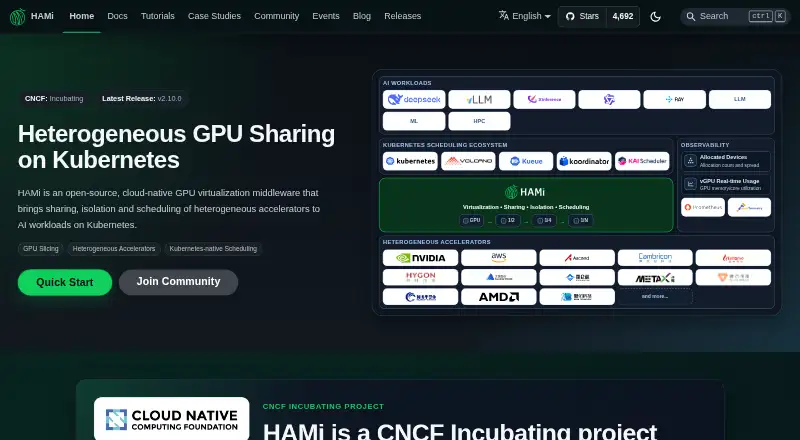
HAMi is open-source GPU virtualization middleware for sharing and scheduling accelerators across AI workloads on Kubernetes. Workloads can request GPU memory and core limits through Kubernetes resource limits, while scheduling policies include binpack, spread, and numa-first. The project lists support for accelerators from NVIDIA, AMD, AWS Neuron, Huawei Ascend, and other vendors; available isolation and partitioning capabilities vary by device. HAMi works with Kubernetes APIs, DRA, and CDI, and documents scheduling integrations with Volcano, Kueue, Koordinator, and NVIDIA KAI Scheduler. A node metrics endpoint exposes device memory and core utilization for Prometheus scraping. Classic HAMi requires Kubernetes v1.23 or later. HAMi-DRA requires Kubernetes v1.34 or later, the DRA Consumable Capacity feature gate, CDI, and NVIDIA driver 440 or later. For NVIDIA devices, enforcement relies on user-space library interception, so applications bypassing CUDA are not covered. The project characterizes memory and compute enforcement as soft and best-effort, and points to MIG for hardware-enforced isolation where compliance or SLAs require it.
Who it suits
HAMi suits teams running AI, machine-learning, LLM, or HPC workloads on Kubernetes that want to share accelerators and set GPU quotas. It is aimed at operators able to manage a self-hosted Kubernetes deployment.
What it does well
- GPU memory and core quotas for workloads
- Scheduling includes binpack, spread, and numa-first
- Metrics endpoint can be scraped by Prometheus
- Integrates with Kubernetes APIs, DRA, and CDI
What to know first
- Classic deployment requires Kubernetes v1.23 or later
- HAMi-DRA has Kubernetes v1.34 and additional requirements
- NVIDIA enforcement does not cover applications bypassing CUDA
- Memory and compute enforcement is soft and best-effort
Limits
The free HAMi plan has no listed quota. Isolation and partitioning capabilities vary by device, and memory and compute enforcement is described as soft and best-effort. HAMi’s built-in priority field supports two levels.
Plans
| Plan | Billed and limits | Price |
|---|---|---|
| HAMi | Open-source GPU virtualization middleware for AI workloads on Kubernetes | Free |
As project-hami.io lists them, read 4 Oct 2026. The maker's own page has the final word.
Getting started
- Open the HAMi project website and review its documentation or tutorials.
- Prepare a Kubernetes cluster; classic HAMi requires Kubernetes v1.23 or later.
- Install Helm and kubectl, and obtain installation permissions.
- Install HAMi with Helm.
- For HAMi-DRA, use Kubernetes v1.34 or later and enable DRA Consumable Capacity; provide CDI and NVIDIA driver 440 or later.
HAMi is open-source middleware for sharing accelerator capacity across Kubernetes workloads. It suits teams operating self-hosted AI, machine-learning or HPC clusters with mixed devices. Its quota controls and scheduling make shared GPUs more practical, but its best-effort isolation rules it out when hardware-enforced guarantees are essential.
Overview
HAMi lets Kubernetes workloads request GPU memory and core limits through resource controls such as nvidia.com/gpumem and nvidia.com/gpucores. For operators, that can make accelerator capacity available to more jobs than assigning whole devices individually. Its scheduling policies—binpack, spread and numa-first—offer different ways to place workloads; binpack and spread can be applied at node or GPU scope.
The project supports a wide range of accelerators, including NVIDIA, AMD, AWS Neuron, Huawei Ascend, Cambricon, Enflame, Hygon, Iluvatar, Kunlunxin, MetaX, Moore Threads, Vastai and Biren. That breadth is useful in heterogeneous clusters, but support is not uniform: some devices lack memory isolation, core isolation or multi-card partitioning.
Key features
Scheduling and monitoring
HAMi exposes real-time device memory and core utilization through a node metrics endpoint that Prometheus can scrape. Its scheduling ecosystem includes Kubernetes, Volcano, Kueue, Koordinator and NVIDIA KAI Scheduler. The built-in priority field has only two levels, so teams needing multi-level queue priorities should integrate Volcano rather than rely on HAMi alone.
Isolation and deployment
For NVIDIA devices, HAMi enforces limits by intercepting user-space library calls. Applications that bypass the CUDA library are outside that mechanism, and the FAQ describes memory and compute enforcement as soft and best-effort. That may suit shared development or batch capacity, but teams with compliance or SLA requirements for hardware-enforced isolation should use MIG instead.
Classic HAMi supports Kubernetes v1.23 or later. HAMi-DRA has a newer baseline: Kubernetes v1.34 or later, the DRA Consumable Capacity feature gate, CDI and NVIDIA driver 440 or later. Installation uses Helm and requires Kubernetes, Helm, kubectl and installation permissions. This is an infrastructure tool for cluster operators, not a managed service for users without Kubernetes administration.
Pricing
HAMi is free and open source. The HAMi plan costs free and provides open-source GPU virtualization middleware for AI workloads on Kubernetes. There is no paid tier or free trial in the stated plan; teams should account for operating their own deployment and matching device capabilities to their isolation needs.
Platforms
HAMi runs on Linux in a self-hosted deployment and supports Kubernetes. The project documents Kubernetes APIs, DRA and CDI integration. That makes it a fit for teams managing their own cluster, not organizations looking for a hosted accelerator-sharing service.
Who it's for
HAMi is best suited to platform teams sharing accelerator capacity among LLM, machine-learning and HPC workloads on Kubernetes, particularly where clusters mix GPU and other accelerator vendors. It is less suitable when workloads need strong hardware-level isolation, or when the target devices do not support the required memory, core or multi-card features.
Pros and cons
- Pro: Memory and core quotas let operators allocate accelerator capacity at workload level instead of reserving whole devices.
- Pro: Support across many accelerator families can help teams manage heterogeneous Kubernetes clusters with one middleware project.
- Pro: Prometheus-scrapable utilization metrics provide node-level visibility into device memory and core use.
- Con: NVIDIA enforcement relies on user-space library interception, and applications bypassing CUDA are not covered.
- Con: Best-effort isolation is not a substitute for hardware-enforced guarantees; some devices also lack specific isolation or partitioning capabilities.
- Con: Built-in priorities have two levels, limiting teams that need richer queue hierarchies without Volcano integration.
- Con: HAMi-DRA's Kubernetes v1.34 requirement is a significant constraint for clusters on older releases.
Alternatives
dstack is another free option, with a self-hosted open-source orchestration stack and a separate GPU marketplace plan billed by GPU usage; consider it when orchestration or marketplace access is a better match than HAMi's accelerator-sharing focus. ClearML offers a free Community plan and says its self-hosted version is open source; it may suit teams seeking a broader self-hosted platform. GPUStack is a free open-source GPU cluster manager, a reasonable alternative when cluster management is the priority.
Backend.AI has a free open-source plan for home users running their own hardware, plus a free try-out plan; it may suit users looking for those options. NVIDIA ShadowPlay is a free Windows app for supported GeForce hardware, rather than a Kubernetes cluster tool. OpenPBS, TORQUE Resource Manager and Apache YuniKorn are free scheduling or resource-management alternatives; choose among them when their respective project is the desired fit.
Browse GPU Cluster Management Software for more options.
Verdict
Choose HAMi if you operate a self-hosted Kubernetes cluster and want free, quota-based sharing and scheduling across a range of accelerators. Its clearest advantage is bringing those controls and utilization metrics into a Kubernetes workflow; its key reason to look elsewhere is that best-effort isolation cannot meet every device's security or SLA requirements.
Verdict
HAMi offers accelerator sharing, quotas, scheduling policies, and utilization metrics for Kubernetes workloads. Check device-specific capabilities and isolation limits, especially where hardware-enforced isolation is required.
Questions
How much does HAMi cost?
The listed HAMi plan is free.
Is HAMi open source?
Yes. HAMi is described as open-source GPU virtualization middleware.
What platforms does it support?
HAMi is for Linux and self-hosted deployment, and it supports Kubernetes.
Which accelerators does HAMi support?
The project lists NVIDIA, AWS Neuron, Huawei Ascend, Cambricon, Enflame, Hygon, Iluvatar, Kunlunxin, MetaX, Moore Threads, Vastai, AMD, and Biren devices. Available isolation and partitioning capabilities vary by device.
What integrations are documented?
HAMi works with Kubernetes APIs, DRA, and CDI. Its scheduling ecosystem includes Volcano, Kueue, Koordinator, and NVIDIA KAI Scheduler.
What Kubernetes versions are required?
Classic HAMi supports Kubernetes v1.23 or later. HAMi-DRA requires v1.34 or later, the DRA Consumable Capacity feature gate, CDI, and NVIDIA driver 440 or later.
Facts from HAMi's own pages
- Accelerators
- The project lists support for NVIDIA, AWS Neuron, Huawei Ascend, Cambricon, Enflame, Hygon, Iluvatar, Kunlunxin, MetaX, Moore Threads, Vastai, AMD and Biren accelerators. · project-hami.io, 3 Oct 2026
- Community support
- The project links to community support through Discord and Slack (#hami-dev). · project-hami.io, 4 Oct 2026
- Deployment
- The quick start installs HAMi with Helm and requires Kubernetes, Helm, kubectl, and installation permissions. · project-hami.io, 4 Oct 2026
- Deployment requirements
- Classic HAMi supports Kubernetes v1.23 or later; HAMi-DRA requires Kubernetes v1.34 or later with the DRA Consumable Capacity feature gate enabled, CDI and NVIDIA driver 440 or later. · project-hami.io, 3 Oct 2026
- Device coverage
- The v2.10.0 supported-device matrix lists NVIDIA, Cambricon, Hygon, Huawei Ascend, Iluvatar, Mthreads, MetaX, Enflame, Kunlunxin, Vastai, AMD, AWS Neuron, and Biren devices as stable. · project-hami.io, 4 Oct 2026
- Ecosystem integrations
- The project documents integrations with Volcano, Kueue, Koordinator, and NVIDIA KAI Scheduler. · project-hami.io, 4 Oct 2026
- Integrations
- The site lists Kubernetes, Volcano, Kueue, Koordinator and KAI Scheduler in its Kubernetes scheduling ecosystem. · project-hami.io, 3 Oct 2026
- Isolation limits
- The FAQ characterizes HAMi vGPU memory and compute enforcement as soft and best-effort, and recommends MIG when hardware-enforced isolation is required for compliance or SLAs. · project-hami.io, 3 Oct 2026
- Isolation mechanism
- For NVIDIA devices, HAMi enforces limits through user-space library interception; the FAQ says applications that bypass the CUDA library are not covered. · project-hami.io, 3 Oct 2026
- Kubernetes integration
- HAMi works with Kubernetes APIs, DRA, and CDI. · project-hami.io, 4 Oct 2026
- Limitations
- The supported-device matrix marks memory isolation, core isolation, and multi-card partitioning as unavailable for some listed devices. · project-hami.io, 4 Oct 2026
- Monitoring
- HAMi provides allocation counts and spread plus real-time GPU memory and core utilization visibility. · project-hami.io, 4 Oct 2026
- Product
- HAMi is open-source GPU virtualization middleware that enables sharing, isolation and scheduling of heterogeneous accelerators for AI workloads on Kubernetes. · project-hami.io, 3 Oct 2026
- Project status
- HAMi is a CNCF Incubating project. · project-hami.io, 4 Oct 2026
- Purpose
- HAMi is open-source, cloud-native GPU virtualization middleware for sharing, isolating, and scheduling heterogeneous accelerators on Kubernetes. · project-hami.io, 4 Oct 2026
- Resource controls
- HAMi supports GPU memory and compute quotas, with hard runtime isolation for supported devices. · project-hami.io, 4 Oct 2026
- Resource slicing
- HAMi lets workloads request GPU memory and core limits using Kubernetes resource limits such as `nvidia.com/gpumem` and `nvidia.com/gpucores`. · project-hami.io, 3 Oct 2026
- Scheduling
- HAMi offers binpack, spread, and topology-aware scheduling policies. · project-hami.io, 4 Oct 2026
- Scheduling limit
- HAMi's built-in priority field supports two levels; the FAQ recommends integrating Volcano for multi-level queue priorities. · project-hami.io, 3 Oct 2026
- Support
- The site links to documentation, tutorials, Discord and the `#hami-dev` Slack channel for community resources. · project-hami.io, 3 Oct 2026
- Workloads
- The site identifies LLM, machine-learning, and HPC workloads as use cases. · project-hami.io, 4 Oct 2026
Where HAMi stands on Freedom251
- GPU Cluster Management Software#6 of 21