Freedom251 › GPU Cluster Management Software
TORQUE Resource Manager
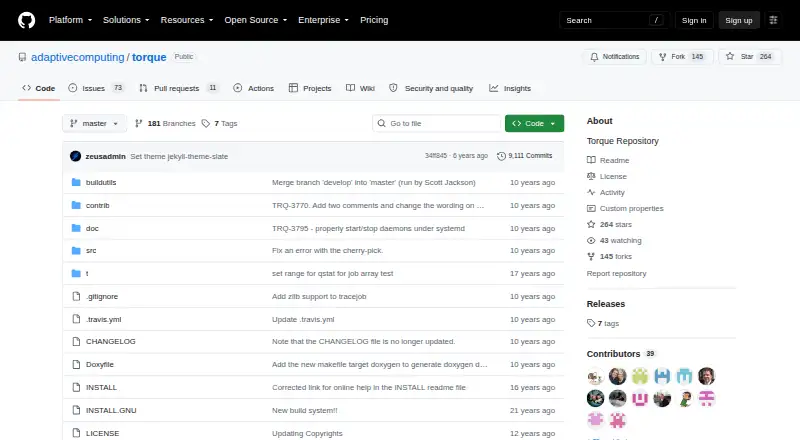
What TORQUE Resource Manager is
TORQUE Resource Manager is a free, open-source resource and queue manager for compute clusters, based on the original PBS resource manager. It is available for Linux and macOS, through an API, and for self-hosted deployment. TORQUE 4.0 release notes state support for clusters with more than 15,000 compute nodes. That release also introduced a multithreaded pbs_server intended to improve command response and job throughput. An optional MOM hierarchy can reduce update traffic from compute nodes to pbs_server and let administrators manage network communications. In TORQUE 4.0, component communication moved to TCP/IP, removing UDP and RPP. The trqauthd daemon authorizes client connections to pbs_server and must run as root on client hosts. Linux builds can optionally use control groups and cpusets, and documentation describes integration with the Moab Workload Manager. TORQUE is built from source with configure and make; installation instructions also cover RPM and self-extracting package creation. Use, modification, and distribution are subject to the repository's PBS_License.txt terms.
Who it suits
TORQUE suits administrators managing compute clusters who can build and deploy self-hosted software. Its documented options include Linux control groups and cpusets and integration with Moab Workload Manager.
What it does well
- Free, open-source resource and queue manager.
- TORQUE 4.0 notes support for clusters above 15,000 nodes.
- Optional MOM hierarchy can reduce node update traffic.
- Linux builds can optionally use control groups and cpusets.
What to know first
- Client hosts must run trqauthd as root.
- TORQUE 4.0 cannot communicate with earlier versions.
- Rolling upgrades are not supported for the 4.0 transition.
- Installation requires building from source.
Limits
The TORQUE 4.0 components cannot communicate with earlier TORQUE versions, and rolling upgrades will not work.
Plans
| Plan | Billed and limits | Price |
|---|---|---|
| TORQUE Resource Manager | Open-source project · use, modification, and distribution subject to PBS license | Free |
As github.com lists them, read 8 Oct 2026. The maker's own page has the final word.
Getting started
- Open the project's GitHub repository.
- Review the PBS_License.txt terms for use, modification and distribution.
- Build TORQUE from source with configure and make.
- Follow the installation instructions to create an RPM or self-extracting package, if needed.
- Run trqauthd as root on client hosts to authorize client connections to pbs_server.
Verdict
TORQUE provides cluster resource and queue management with options for large deployments and network administration. Note the version compatibility limit: TORQUE 4.0 components cannot communicate with earlier versions, so rolling upgrades will not work.
Questions
Is TORQUE Resource Manager free?
Yes. The project is listed as free and is open source, subject to the PBS_License.txt terms.
Which platforms does it support?
The listed platforms are Linux, macOS, API and self-hosted deployment. Linux builds can optionally use control groups and cpusets.
Is TORQUE open source?
Yes. Use, modification and distribution are subject to the terms in the repository's PBS_License.txt file.
How is TORQUE installed?
It can be built from source with configure and make. The installation instructions also describe creating RPM and self-extracting packages.
Can TORQUE 4.0 be upgraded alongside earlier versions?
No. TORQUE 4.0 components cannot communicate with earlier TORQUE versions, so the release notes say rolling upgrades will not work.
What does trqauthd do?
The daemon authorizes TORQUE client connections to pbs_server. It must run as root on client hosts.
Facts from TORQUE Resource Manager's own pages
- Authentication
- The trqauthd daemon authorizes TORQUE client connections to pbs_server and must run as root on client hosts. · github.com, 8 Oct 2026
- Communication
- TORQUE 4.0 release notes say component communication moved to TCP/IP and removed UDP and RPP. · github.com, 8 Oct 2026
- Compatibility limitation
- TORQUE 4.0 components cannot communicate with earlier TORQUE versions, so the release notes say rolling upgrades will not work. · github.com, 8 Oct 2026
- Installation
- TORQUE is built from source with configure and make, and the install instructions describe RPM and self-extracting package creation. · github.com, 8 Oct 2026
- Integrations
- The maker's documentation describes integration between TORQUE and the Moab Workload Manager. · docs.adaptivecomputing.com, 8 Oct 2026
- Large clusters
- TORQUE 4.0 release notes state it can support more than 15,000 compute nodes in a cluster. · github.com, 8 Oct 2026
- License
- Use, modification, and distribution are subject to the terms in the repository's PBS_License.txt file. · github.com, 8 Oct 2026
- Linux options
- The build configuration supports optional Linux control groups and cpusets. · github.com, 8 Oct 2026
- Node hierarchy
- An optional MOM hierarchy reduces compute node update traffic to pbs_server and lets administrators manage network communications. · github.com, 8 Oct 2026
- Purpose
- TORQUE is an open-source resource manager and queue manager based on the original PBS resource manager. · github.com, 8 Oct 2026
- Scalability
- The project highlights scalability, fault tolerance, usability, functionality, and security development as areas of improvement. · github.com, 8 Oct 2026
- Server throughput
- TORQUE 4.0 introduced a multithreaded pbs_server intended to improve command response and job throughput. · github.com, 8 Oct 2026
- Support
- The project README directs questions and contributions to the [email protected] mailing list. · github.com, 8 Oct 2026
- Use case
- The project describes itself as a resource manager for compute clusters. · github.com, 8 Oct 2026
Where TORQUE Resource Manager stands on Freedom251
- GPU Cluster Management Software#10 of 21