Freedom251 › Job Scheduler Software
Slurm Workload Manager
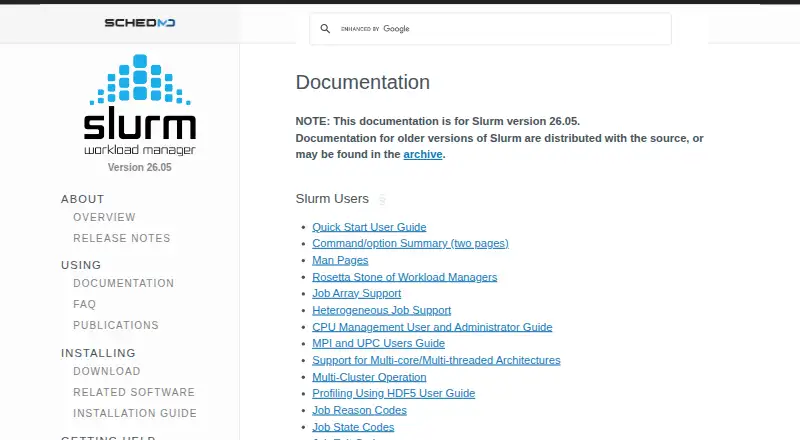
What Slurm Workload Manager is
Slurm Workload Manager is free, open-source software for managing clusters and scheduling work on Linux. It allocates compute resources, starts and monitors jobs on assigned nodes, and handles queues of pending work. Optional plugins add accounting, advanced reservations, gang and backfill scheduling, topology-aware resource selection, resource limits, and multifactor job prioritization. Its architecture centers on a slurmctld manager and slurmd daemons on compute nodes, with optional slurmdbd accounting and slurmrestd REST access. GPU plugins support NVIDIA, AMD, Intel, AWS Trainium, and AWS Inferentia accelerators, plus NVIDIA MPS and GPU sharing. Accounting can use MySQL or MariaDB, and data can be recorded in a text file, directly in a database, or through slurmdbd for multiple clusters. Slurmrestd provides a REST API, but it is not designed for direct internet exposure and supports only unencrypted HTTP. Linux is thoroughly tested on arm64, ppc64, and x86_64; FreeBSD and NetBSD have limited support, and macOS is unsupported. Deployment is self-hosted.
Who it suits
Slurm suits organizations running high-performance computing or AI workloads on Linux clusters, from smaller clusters to large-scale systems. It is intended for teams able to deploy and manage self-hosted cluster software.
What it does well
- Allocates resources, monitors work, and manages job queues.
- Optional plugins add reservations and scheduling controls.
- GPU plugins cover several accelerator types.
- Free, open-source, and self-hosted.
What to know first
- macOS is not currently supported.
- FreeBSD and NetBSD support is limited.
- REST access supports only unencrypted HTTP.
- REST API is not designed for direct internet exposure.
Limits
The plan is free and self-hosted. FreeBSD and NetBSD have limited support, macOS is not supported, and Slurmrestd supports only unencrypted HTTP and is not designed for direct internet exposure.
Plans
| Plan | Billed and limits | Price |
|---|---|---|
| Slurm | No monetary cost · GNU GPL v2 · self-hosted cluster software | Free |
As slurm.schedmd.com lists them, read 1 Oct 2026. The maker's own page has the final word.
Getting started
- Visit the Slurm website.
- Prepare a Linux cluster for self-hosted deployment.
- Use the centralized slurmctld manager and run slurmd daemons on compute nodes.
- Configure a component authentication plugin; MUNGE is the default and recommended option.
- Add optional accounting, REST, GPU, or scheduling plugins as needed.
Verdict
Slurm provides cluster resource allocation and job scheduling, with optional accounting, scheduling, and GPU capabilities. Its self-hosted model and REST API limitations are important considerations for deployment.
Questions
How much does Slurm cost?
The Slurm plan is free, with no monetary cost. It is offered under GNU GPL v2 as self-hosted cluster software.
Which operating systems does Slurm support?
Linux is thoroughly tested on arm64, ppc64, and x86_64. FreeBSD and NetBSD have limited support, and macOS is not currently supported.
Does Slurm have a REST API?
Yes. Slurmrestd provides REST API access, but it supports only unencrypted HTTP and is not designed for direct internet exposure.
Which GPUs and accelerators can Slurm support?
Optional GRES plugins support NVIDIA, AMD, Intel, AWS Trainium, and AWS Inferentia accelerators. NVIDIA MPS and GPU sharing are also supported.
What support services are available?
SchedMD offers standard support, deployment services, on-site training, and technical account manager services for Slurm and Slinky.
Can Slurm integrate with cloud services or Kubernetes?
SchedMD documents integrations for Google Cloud, AWS Parallel Computing Service, Microsoft Azure, and CycleCloud. Slinky provides interoperability between Slurm and Kubernetes.
Facts from Slurm Workload Manager's own pages
- Architecture
- Slurm uses a centralized slurmctld manager, slurmd daemons on compute nodes, optional slurmdbd accounting, and optional slurmrestd REST access. · slurm.schedmd.com, 1 Oct 2026
- Authentication
- Slurm authenticates communications between components through a configurable authentication plugin, with MUNGE as the default and recommended option and an internal auth/slurm plugin also available. · slurm.schedmd.com, 1 Oct 2026
- Cloud and Kubernetes
- SchedMD documents Slurm integrations for Google Cloud, AWS Parallel Computing Service, Microsoft Azure and CycleCloud, while Slinky provides interoperability between Slurm and Kubernetes. · slurm.schedmd.com, 1 Oct 2026
- Core functions
- It allocates compute resources, starts and monitors work on allocated nodes, and manages queues of pending work. · slurm.schedmd.com, 1 Oct 2026
- Database integration
- Slurm supports MySQL or MariaDB for accounting and can record accounting data in a text file, directly in a database, or through slurmdbd for multiple clusters. · slurm.schedmd.com, 1 Oct 2026
- Founded
- 2010 · slurm.schedmd.com, 28 Sept 2026
- GPU support
- Optional GRES plugins support NVIDIA, AMD, Intel, AWS Trainium, and AWS Inferentia accelerators, plus NVIDIA MPS and GPU sharing. · slurm.schedmd.com, 1 Oct 2026
- Headquarters
- Utah, United States · slurm.schedmd.com, 28 Sept 2026
- Notable adoption
- SchedMD states that Slurm is the scheduler of choice for over half of the top one-hundred systems in the TOP500. · schedmd.com, 1 Oct 2026
- Primary audience
- SchedMD describes Slurm as a workload manager for high-performance computing and AI environments, including large-scale supercomputing systems. · schedmd.com, 1 Oct 2026
- Project history
- Slurm was initially released in 2002, and SchedMD was founded in 2010 to continue developing it. · slurm.schedmd.com, 1 Oct 2026
- Purpose
- Slurm is an open-source, fault-tolerant, highly scalable cluster management and job scheduling system for large and small Linux clusters. · slurm.schedmd.com, 1 Oct 2026
- REST API
- Slurmrestd provides a REST API, but the API is not designed to be directly internet-facing and supports only unencrypted HTTP communications. · slurm.schedmd.com, 1 Oct 2026
- Scheduling features
- Optional plugins provide accounting, advanced reservations, gang scheduling, backfill scheduling, topology-aware resource selection, resource limits, and multifactor job prioritization. · slurm.schedmd.com, 1 Oct 2026
- Supported operating systems
- Linux is thoroughly tested on arm64, ppc64, and x86_64; FreeBSD and NetBSD have limited support, while macOS is not currently supported. · slurm.schedmd.com, 1 Oct 2026
- Support services
- SchedMD offers standard support, deployment services, on-site training, and technical account manager services for Slurm and Slinky. · schedmd.com, 1 Oct 2026
Where Slurm Workload Manager stands on Freedom251
- Job Scheduler Software#9 of 26
- GPU Cluster Management Software#12 of 21