
Flyte
What Flyte is
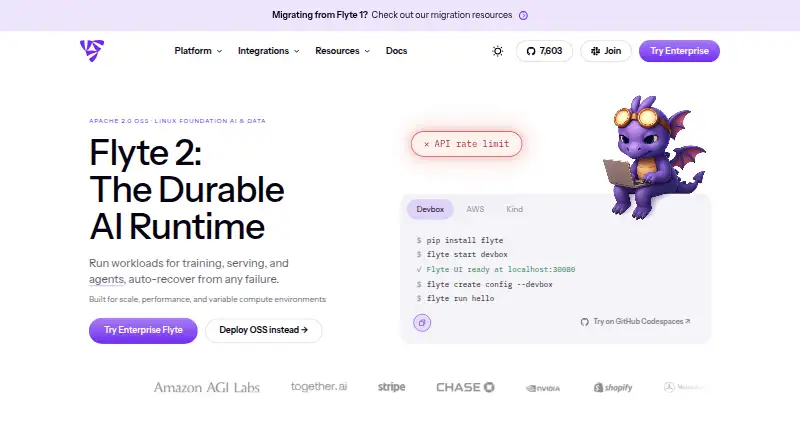
Flyte 2 is a durable runtime for AI workloads involving training, serving, and agents. Workflows are written as plain Python async functions, with a TaskEnvironment used to declare images, resources, secrets, and retry policy. Flyte can resume work from a failed task and recover from infrastructure failures such as out-of-memory kills, preempted nodes, or disappearing GPUs. Its dynamic execution model supports branching, loops, and runtime decisions for workflows and agents. For serving, native app integrations include Streamlit, FastAPI, vLLM, SGLang, and Ollama, with replicas able to scale to zero while idle. The site lists integrations for tools including Apache Spark, Ray, PyTorch Elastic, BigQuery, Snowflake, Weights & Biases, OpenAI Agents SDK, LangGraph, CrewAI, Pydantic AI, MLflow, Dask, and Databricks. Flyte can run locally with a devbox or on a user's cluster. Union.ai says its data plane runs inside the customer's cloud and that workflow inputs, outputs, logs, code, and reports do not pass through its control plane. Flyte began inside Lyft in 2016, became open source in 2020, and joined the Linux Foundation AI & Data in 2022. The OSS runtime is free and Apache 2.0 licensed; paid Team and Enterprise plans are also listed.
Who it suits
Flyte suits developers and teams building Python workflows for AI training, serving, or agents. It can fit users who want to run locally or on their own cluster, with Team and Enterprise plans offering higher-scale and support options.
What it does well
- Free Apache 2.0 runtime for local or cluster use.
- Workflows use Python async functions and TaskEnvironment declarations.
- Resumes failed tasks and recovers from listed infrastructure failures.
- Supports dynamic branching, loops, and runtime decisions.
- Integrates with serving frameworks and AI, data, and ML tools.
- Can scale serving replicas to zero while idle.
What to know first
- Team costs $950 a month plus usage.
- Team limits runs to 25,000 fanout actions and 1,000 concurrent actions.
- Team includes one cluster and 30-day data retention.
- Enterprise pricing is custom.
Limits
The free OSS plan is described as an open-source runtime for local or cluster use. The Team plan has a 25,000 action-per-run fanout limit, 1,000 concurrent actions, 30-day data retention, and one cluster; it costs $950 a month plus usage, with a $950 monthly minimum credited to usage.
Plans
| Plan | Billed and limits | Price |
|---|---|---|
| Flyte OSS | Free and open source; users deploy and manage it themselves · Self-managed infrastructure · Flyte 2 documentation describes deployment on your own cloud infrastructure | Free |
| Team | $950/ mo + usage · 30-day free trial · $950 monthly minimum credited to usage · 1,000 concurrent actions · 30-day data retention · 1 cluster | $950 a month |
| Union.ai Team (enterprise Flyte platform) | Usage-based billing with a $950 monthly minimum credited toward usage; billing starts after the 30-day trial · Metered durable actions · vCPU-hours · memory · GPU-hours · AWS Marketplace availability announced September 30, 2026 | $950 a month |
| Enterprise | Custom · Custom concurrent actions · custom retention · 3+ clusters · white-glove support | On request |
As flyte.org lists them, read 15 Oct 2026. The maker's own page has the final word.
Getting started
- Visit flyte.org.
- Install Flyte with `pip install flyte`.
- Start a local development environment with `flyte start devbox`, or run Flyte on your cluster.
- Write workflows as Python async functions and declare configuration in a TaskEnvironment.
- Choose the free OSS runtime, start the Team plan's 30-day trial, or contact Union.ai about Enterprise.
Flyte 2 is a Python-authored runtime for durable AI workloads, covering training, serving, and agent execution. It is aimed at teams comfortable running software locally or on a cluster and needing workflows that can recover from infrastructure failures. The open-source runtime keeps entry cost at zero, while managed capacity and support become a significant commitment.
Overview
Flyte’s central proposition is durable execution for AI pipelines rather than a general-purpose visual automation tool. You define workflows as Python async functions and run them on a local devbox or your own cluster. That deployment choice suits engineering teams that want control of their environment; it is less suitable for buyers seeking a fully hosted service with no operational responsibility.
Flyte originated inside Lyft in 2016, was open-sourced in 2020, and joined the Linux Foundation AI & Data in 2022. Union.ai presents itself as the enterprise Flyte platform. Its security position is aimed at organizations with strict data boundaries: Union.ai states that the data plane runs in the customer’s cloud and that workflow inputs, outputs, logs, code, and reports do not pass through its control plane. Its security page lists SOC 2 Type I, SOC 2 Type II, and HIPAA.
Key features
Plain Python async functions make workflow authoring familiar to Python developers. A TaskEnvironment puts container images, resource requirements, secrets, and retry policy beside the task definition, so execution needs are explicit rather than hidden in separate configuration. Teams that do not want to write Python will find little reason to select this approach.
Failure recovery is Flyte’s strongest practical differentiator. A failed task can resume, and the runtime can recover from out-of-memory kills, preempted nodes, or disappearing GPUs. That matters when training or agent runs are costly to repeat. Automatic retries, event triggers, and execution observability reinforce the same operational model, although teams still need to manage the underlying deployment.
Branching, loops, and runtime decisions support dynamic workflows whose next actions depend on results produced during execution. This is useful for agents and other workloads that cannot be reduced to a fixed sequence. Native app integrations include Streamlit, FastAPI, vLLM, SGLang, and Ollama, with replicas able to scale to zero while idle. Integrations also include Apache Spark, Ray, PyTorch Elastic, BigQuery, Snowflake, Weights & Biases, OpenAI Agents SDK, LangGraph, CrewAI, Pydantic AI, MLflow, Dask, and Databricks.
Pricing
Flyte OSS — free. The Apache 2.0 open-source runtime runs locally or on your cluster. It is the sensible starting point for individual developers and teams willing to provide their own infrastructure, with no managed-service capacity or support commitment included.
Team — $950 a month. This tier is billed at $950 per month plus usage, with a 30-day free trial. The $950 monthly minimum is credited to usage. It includes 1,000 concurrent actions, 30-day data retention, one cluster, a 25,000-action-per-run fanout limit, and one-business-day Sev 1 support. The minimum makes Team difficult to justify for occasional or small workloads, but it gives an operating team defined concurrency, retention, and response terms.
Enterprise — custom pricing. Enterprise lists custom concurrent actions and retention, 3+ clusters, a 50,000+ actions-per-run fanout limit, and custom white-glove support. It is the appropriate commercial tier when one cluster, Team’s concurrency, or its retention period is insufficient; buyers must obtain a tailored quote.
Platforms
Flyte is available through its API and web interfaces on Linux, with a self-hosted deployment model. The documented local path uses pip install flyte followed by flyte start devbox; production use can run on a user’s cluster. That flexibility helps teams align deployment with existing cloud controls, but it places platform operations in the buyer’s remit.
Who it's for
Choose Flyte for Python-heavy teams building durable training, serving, or agent workflows; workloads exposed to preemption, GPU loss, or memory failures; and organizations that need local or cluster deployment with customer-cloud data handling. The OSS plan fits experimentation and self-managed production. Team fits organizations that can absorb a $950 monthly minimum and need defined managed capacity. Enterprise fits multi-cluster deployments and buyers requiring custom limits or white-glove support.
Pros and cons
- Pros: Python async authoring keeps workflow code close to application logic.
- Pros: Resume and infrastructure-failure recovery reduce expensive reruns.
- Pros: Dynamic branches, loops, and runtime decisions suit agent behavior.
- Pros: Broad AI, data, and serving integrations reduce connector work.
- Pros: Local and cluster deployment, plus customer-cloud data-plane positioning, support controlled environments.
- Cons: Self-hosting means the customer operates the deployment.
- Cons: Team’s $950 monthly minimum is a high floor for modest usage.
- Cons: Team is limited to one cluster, 1,000 concurrent actions, 30-day retention, and 25,000 actions per run.
Alternatives
For a different workflow and data-operations focus, compare DataOps Platforms and Workload Automation Software. Teams specifically evaluating machine-learning lifecycle tooling can review MLOps Platforms, while broader orchestration requirements belong in Workflow Orchestration Software.
Kestra is a free, Apache 2.0 platform available through API, Linux, macOS, self-hosting, and web interfaces; choose it when that broader platform footprint is preferable. Apache NiFi is free to download under Apache License 2.0 across API, Linux, macOS, self-hosting, web, and Windows, making it an alternative for teams prioritizing a no-cost distribution. DataKitchen TestGen offers a free-forever open-source plan with one user, one connection, and one project, suited to a narrower testing scope. Apache Airflow is free to download and use under the Apache License. Apache Hop is an open-source Apache-licensed platform for Linux, macOS, self-hosting, and Windows, with Java 21 required for release 2.19.0. Metaflow is free under Apache 2.0, with production scaling run in your own cloud account or Kubernetes cluster. Keboola has a free tier with 120 compute minutes in the first month, then 60 minutes monthly, plus paid compute. Luigi is a free open-source Python package without registration walls.
Verdict
Flyte is a strong choice for Python teams that need durable, dynamic AI workflows and want to deploy locally or on their own cluster. Its recovery model and integrations are the main reasons to choose it. Look elsewhere if you need a no-operations hosted experience, non-Python workflow authoring, or cannot justify Team’s $950 monthly minimum once self-managed OSS is no longer enough.
Verdict
Pick Flyte if you want a Python-based runtime for durable AI workflows and need local or cluster deployment. The free OSS plan provides the runtime, while teams needing the listed Team capacity, retention, or support should account for the monthly minimum plus usage; Enterprise pricing is custom.
Questions
Is Flyte free?
Flyte OSS is listed as free and uses an Apache 2.0 open-source runtime. Team and Enterprise are also available.
How much does the Team plan cost?
Team costs $950 a month plus usage, with a $950 monthly minimum credited to usage. It includes a 30-day free trial.
Where can Flyte run?
Flyte can run locally with a devbox or on a user's cluster. Its listed platforms include API, Linux, self-hosted, and web.
What are the Team plan limits?
Team includes a 25,000 action-per-run fanout limit, 1,000 concurrent actions, 30-day data retention, and one cluster.
Who makes Flyte?
Union.ai describes itself as the enterprise Flyte platform. Flyte was built internally at Lyft in 2016 and open-sourced in 2020.
Which integrations are listed?
Examples include Apache Spark, Ray, BigQuery, Snowflake, LangGraph, CrewAI, MLflow, and Databricks.
Facts from Flyte's own pages
- Autoscaling
- Long-running apps can scale replicas up or down automatically and scale to zero when idle. · flyte.org, 15 Oct 2026
- Batch inference
- Flyte 2 includes a DynamicBatcher for batching inference requests with configurable batch size, queue size and timeout. · flyte.org, 15 Oct 2026
- Caching and reproducibility
- Executions are automatically logged and versioned, and identical inputs can reuse cached results. · flyte.org, 15 Oct 2026
- Certifications
- Union.ai's security page lists SOC 2 Type II, SOC 2 Type I, and HIPAA. · union.ai, 8 Oct 2026
- CLI
- Flytectl is a Go-based cross-platform command-line client for FlyteAdmin, with Homebrew and shell-script installation instructions. · github.com, 15 Oct 2026
- Company facts
- LinkedIn lists Union.ai as privately held, founded in 2021, headquartered in Seattle and employing 11–50 people. · linkedin.com, 15 Oct 2026
- Company history
- Union.ai's company page says Flyte was open-sourced in 2020 and Union.ai was founded with $10 million in seed funding in 2021. · union.ai, 15 Oct 2026
- Deployment
- Flyte 2 can run locally with a devbox or on a user's cluster; the site provides `pip install flyte` and `flyte start devbox` setup commands. · flyte.org, 8 Oct 2026
- Deployment architecture
- Legacy deployment documentation describes sandbox, single-cluster and multi-cluster Kubernetes deployment paths, with production use requiring a real object store. · docs-flyte-legacy.union.ai, 15 Oct 2026
- Developer requirements
- Legacy development documentation supports Python 3.8 or newer and installs Flytekit with pip. · docs-legacy.flyte.org, 15 Oct 2026
- Documentation depth
- The current documentation includes version selectors for Flyte 2 and Flyte 1 plus guides covering tasks, apps, agents, integrations and CI/CD deployment. · union.ai, 15 Oct 2026
- Durable execution
- Flyte 2 can recover from infrastructure failures including OOM kills, preempted nodes and disappearing GPUs. · flyte.org, 15 Oct 2026
- Dynamic execution
- Flyte supports branching, loops, and runtime decisions for dynamic workflows and agents. · flyte.org, 8 Oct 2026
- Dynamic workflows
- Workflows use ordinary Python control flow for branching, loops and runtime decisions rather than a separate DSL. · flyte.org, 15 Oct 2026
- Extensibility
- Flyte integrations are implemented through a plugin system and the project invites users to build and submit their own integrations. · union.ai, 15 Oct 2026
- Failure recovery
- Flyte can resume from a failed task and automatically recover from infrastructure failures such as OOM kills, preempted nodes, or disappearing GPUs. · flyte.org, 8 Oct 2026
- Independent praise: Kubernetes fit
- Coding Protocols praises Flyte's typed pipelines, Kubernetes execution and per-task resource control, recommending it for teams already deep on Kubernetes. · codingprotocols.com, 15 Oct 2026
- Independent praise: typing and reproducibility
- Reddit users repeatedly praise Flyte's enforced typing, caching, versioning and reproducibility for machine-learning workflows. · reddit.com, 15 Oct 2026
- Integrations
- The Flyte site lists integrations including Apache Spark, Ray, PyTorch Elastic, BigQuery, Snowflake, Weights & Biases, OpenAI Agents SDK, LangGraph, CrewAI, Pydantic AI, MLflow, Dask, and Databricks. · flyte.org, 8 Oct 2026
- License
- The Flyte repositories and SDKs are published under the Apache License 2.0. · github.com, 15 Oct 2026
- Limit: ecosystem gaps
- A Reddit reviewer says some features were missing in Flyte 1 and that they still had to store artifacts in MLflow. · reddit.com, 15 Oct 2026
- Limit: Kubernetes dependency
- Independent comparison guidance positions Flyte primarily for teams already operating Kubernetes, implying a poor fit where that platform expertise is absent. · codingprotocols.com, 15 Oct 2026
- Limit: operational complexity
- Reddit reviewers report setup headaches involving permissions, configuration, firewalls and cloud deployment. · reddit.com, 15 Oct 2026
- Logical recovery
- Failed tasks can be retried and resumed with the same inputs instead of rerunning the whole workflow. · flyte.org, 15 Oct 2026
Where Flyte stands on Freedom251
- MLOps Platforms#1 of 29
- Workflow Orchestration Software#3 of 38
- Workload Automation Software#2 of 24
- DataOps Platforms#4 of 16