Freedom251 › ML Experiment Tracking Software

MLRun
What MLRun is
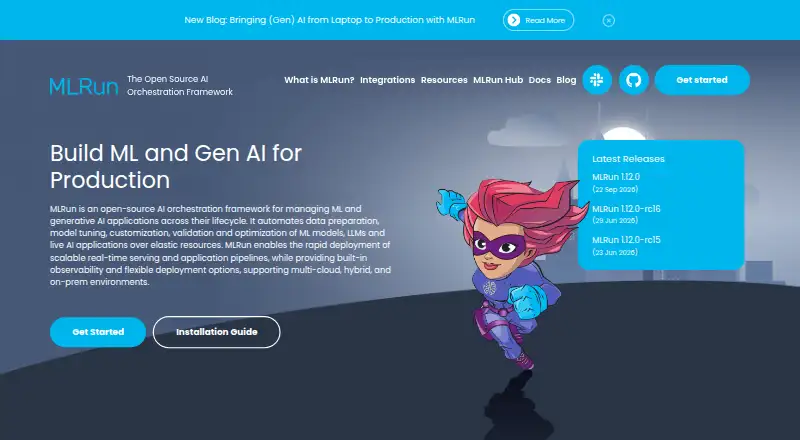
MLRun is an open-source framework for coordinating machine-learning and generative-AI applications across their lifecycles. It automates data preparation, model tuning, customization, validation, and optimization for ML models and large language models, using elastic resources. Its feature store handles data features from collection and transformation through storage, cataloging, serving, and monitoring. MLRun supports model registries, experiment tracking, pipeline orchestration, model serving, data versioning, and managed compute. It can be deployed across multiple clouds, in hybrid environments, or on premises, with built-in observability. Documented routes include Kubernetes, AWS clusters, Azure AKS clusters, and Iguazio’s managed service.
The technology ecosystem includes S3, Google Cloud Storage, Azure, BigQuery, Snowflake, Kafka, Spark, Dask, Horovod, Kubernetes, PyTorch, TensorFlow, XGBoost, and ONNX. CI/CD integrations include GitHub Actions, GitLab CI/CD, Jenkins, and Kubeflow Pipelines. MLRun provides a shared stack for data engineers, data scientists, and machine-learning engineers. The open-source plan is free and includes community support. Managed MLRun on Iguazio adds LDAP integration, user and group management, authentication and authorization controls, service monitoring, log management, and 24/7 enterprise support. Its browser interface runs on Chrome and Firefox.
Who it suits
MLRun suits data engineers, data scientists, and machine-learning engineers coordinating models and generative-AI applications across their lifecycles. Teams that want open-source deployment options and model management capabilities can use the free plan; those seeking managed service monitoring and enterprise support can consider Iguazio’s managed offering.
What it does well
- Automates preparation, tuning, validation, and optimization for ML models and LLMs.
- Feature store covers data features from collection through monitoring.
- Supports multi-cloud, hybrid, and on-premises deployment.
- Includes model registry, experiment tracking, serving, and data versioning.
- Integrates with four listed CI/CD tools.
- Managed service includes 24/7 enterprise support.
What to know first
- Open-source offering includes community support.
- Managed MLRun is the option with LDAP and enterprise support.
- Browser interface supports Chrome and Firefox.
Limits
The free Open Source MLRun plan includes community support. LDAP integration, service monitoring, log management, and 24/7 enterprise support are listed with managed MLRun on Iguazio.
Plans
| Plan | Billed and limits | Price |
|---|---|---|
| Open Source MLRun | Community support | Free |
| Managed MLRun on Iguazio | LDAP integration · 24/7 enterprise support · service monitoring | On request |
As mlrun.org lists them, read 30 Sept 2026. The maker's own page has the final word.
Getting started
- Choose the open-source MLRun plan or the managed MLRun on Iguazio service.
- Select a documented deployment route: Kubernetes, an AWS cluster, an Azure AKS cluster, or Iguazio’s managed service.
- Use the web interface with Chrome or Firefox.
Overview
MLRun is an open-source framework for coordinating machine-learning and generative-AI work across the lifecycle. It suits teams that want data engineers, data scientists and ML engineers working from a shared stack. Its broad scope is the draw; the trade-off is that teams needing enterprise operations must use the managed service.
Key features
MLRun automates data preparation, model tuning, customization, validation and optimization for ML models and LLMs across elastic resources. The feature store covers collection, transformation, storage, cataloging, serving and monitoring of data features, while model registry, experiment tracking, pipeline orchestration, model serving and data versioning support the wider lifecycle. That combination is useful when a team wants to coordinate several stages in one framework; it is more platform than a team seeking only an experiment tracker or registry may need.
Deployment supports multi-cloud, hybrid and on-premises setups, with documented options for Kubernetes, AWS clusters, Azure AKS clusters and Iguazio’s managed service. Built-in observability complements those deployment options. CI/CD integrations include GitHub Actions, GitLab CI/CD, Jenkins and Kubeflow Pipelines. Its supported ecosystem spans storage and data systems such as S3, Google Cloud Storage, BigQuery, Snowflake and Kafka, alongside Spark, Dask, Horovod, Kubernetes, PyTorch, TensorFlow, XGBoost and ONNX.
The browser interface runs on Chrome and Firefox. Managed MLRun adds LDAP integration, user and group management, service authentication and authorization, secured API-gateway authentication, service monitoring, log management and 24/7 enterprise support. Those controls and services matter to organizations that need centralized identity and operational help; the open-source offering includes community support.
Pricing
Open Source MLRun: free, with community support. It is the natural starting point for teams able to operate the framework themselves and comfortable relying on community help. The published plan does not give a seat or usage cap.
Managed MLRun on Iguazio: custom pricing. It adds LDAP integration, service monitoring and 24/7 enterprise support, along with managed security and identity features. This is the better fit for teams that need those operational capabilities, but the price is not published. The pricing model also notes a 14-day trial.
Platforms
MLRun supports API, Linux, macOS, self-hosted, web and Windows. Its documented deployment choices include Kubernetes, AWS and Azure AKS clusters, as well as Iguazio’s managed service. Browser access is supported in Chrome and Firefox.
Who it's for
MLRun is best for organizations assembling a shared ML and generative-AI workflow across data preparation, feature management, experimentation, orchestration and serving. The open-source edition suits teams with the capacity to run their own environment. Teams that require enterprise support, LDAP integration, monitoring and log management have a clearer reason to choose the managed service. A narrower tool is likely a better fit when only one lifecycle function is needed.
Pros and cons
- Broad lifecycle coverage: Feature management, experiment tracking, registry, orchestration, serving and data versioning sit in the same framework, which suits cross-functional ML teams.
- Flexible deployment: Kubernetes, AWS, Azure AKS, hybrid, multi-cloud and on-premises options can fit varied infrastructure choices.
- Open-source entry point: The free plan costs 0.00 USD and includes community support, without a published seat or quota cap.
- Enterprise operations cost extra: LDAP, service monitoring, log management and 24/7 enterprise support are attached to the custom-priced managed service.
- Broad scope brings overhead: Teams seeking only a registry or experiment tracker may not need a framework covering the full lifecycle.
Alternatives
ClearML is another freemium option with a free Community plan and a self-hosted version described as fully open source; consider it when that combination is the priority.
Weights & Biases offers a free plan with five model seats, 5 GB of monthly storage and 1 GB of monthly Weave data ingestion, making those stated allowances relevant when evaluating a hosted free tier.
Paperspace Gradient has a free plan with 5 GB storage and a Pro — User plan at $8 a month; compare it when that storage allowance or paid plan is pertinent.
ZenML has a free, self-hosted Open Source plan with unlimited executions and projects, so it is worth considering when those limits and self-hosting are central.
Metaflow is an Apache License 2.0 open-source option, with production scaling handled in your own cloud account or Kubernetes cluster; choose it when that infrastructure model fits.
Opik makes its core observability and evaluation features available as open-source code for local use, a relevant alternative when that focus is the priority.
Amazon SageMaker Autopilot uses pay-as-you-go pricing with no minimum fees or upfront commitments; consider it when that billing model is preferable.
Databricks Notebooks offers a Free Edition with one serverless workspace and limited compute size and usage, which may suit a reader comparing notebook access.
Explore the MLOps Platforms, Model Registry Software and ML Experiment Tracking Software directories to compare tools by category.
Verdict
Choose MLRun if your team needs an open-source framework to coordinate ML or generative-AI work across feature management, experimentation, orchestration and serving. Its lifecycle breadth and deployment flexibility are the strongest reasons to adopt it. Look elsewhere if you need only a focused tool, or choose managed MLRun on Iguazio when LDAP, operational monitoring, log management or 24/7 enterprise support are requirements and custom pricing fits.
Verdict
Choose MLRun if your team needs an open-source framework for coordinating ML or generative-AI work, with feature management and lifecycle tools. The free plan includes community support; teams seeking LDAP integration, service monitoring, log management, or 24/7 enterprise support should consider managed MLRun on Iguazio.
Questions
Is MLRun free?
Yes. The Open Source MLRun plan is free and includes community support.
Is there a free trial?
Yes. The pricing note lists a 14-day trial.
Where can MLRun be deployed?
Documented options include Kubernetes, an AWS cluster, an Azure AKS cluster, and Iguazio’s managed service. MLRun also supports multi-cloud, hybrid, and on-premises deployment.
What integrations does MLRun offer?
Listed CI/CD integrations are GitHub Actions, GitLab CI/CD, Jenkins, and Kubeflow Pipelines. Its technology ecosystem also includes tools such as Snowflake, Kafka, Spark, PyTorch, and TensorFlow.
What does managed MLRun add?
The managed service includes LDAP integration, user and group management, service authentication and authorization, secured API-gateway authentication, service monitoring, log management, and 24/7 enterprise support.
Who makes MLRun?
The listed managed service is provided by Iguazio. The open-source offering is named Open Source MLRun.
Facts from MLRun's own pages
- Automation
- MLRun automates data preparation, model tuning, customization, validation and optimization of ML models and LLMs over elastic resources. · iguazio.com, 30 Sept 2026
- Browser support
- The MLRun browser interface runs on Chrome and Firefox. · docs.mlrun.org, 30 Sept 2026
- Collaboration
- MLRun provides one technology stack for data engineers, data scientists and machine-learning engineers. · iguazio.com, 30 Sept 2026
- Deployment
- MLRun supports multi-cloud, hybrid and on-premises deployment options with built-in observability. · mlrun.org, 30 Sept 2026
- Deployment options
- The documented deployment options are Kubernetes, an AWS cluster, an Azure AKS cluster and Iguazio's managed service. · docs.mlrun.org, 30 Sept 2026
- Feature store
- The MLRun feature store automates collection, transformation, storage, cataloging, serving and monitoring of data features. · docs.mlrun.org, 30 Sept 2026
- Free trial
- Iguazio provides a 14-day free trial for its managed MLRun service. · docs.mlrun.org, 30 Sept 2026
- Integrations
- The ecosystem lists GitHub Actions, GitLab CI/CD, Jenkins and Kubeflow Pipelines for CI/CD integration. · docs.mlrun.org, 30 Sept 2026
- Purpose
- MLRun is an open-source AI orchestration framework for managing machine-learning and generative-AI applications across their lifecycles. · mlrun.org, 30 Sept 2026
- Security
- Managed MLRun provides LDAP integration, user and group management, service authentication and authorization, and secured API-gateway authentication. · iguazio.com, 30 Sept 2026
- Support
- The open-source offering includes community support, while managed MLRun includes 24/7 enterprise support, service monitoring and log management. · iguazio.com, 30 Sept 2026
- Technology ecosystem
- Supported ecosystem components include S3, Google Cloud Storage, Azure, BigQuery, Snowflake, Kafka, Spark, Dask, Horovod, Kubernetes, PyTorch, TensorFlow, XGBoost and ONNX. · docs.mlrun.org, 30 Sept 2026
Where MLRun stands on Freedom251
- ML Experiment Tracking Software#7 of 39
- Model Registry Software#7 of 36
- MLOps Platforms#6 of 29
- Experiment Tracking#5 of 22
- Model registries#12 of 38