
Comet
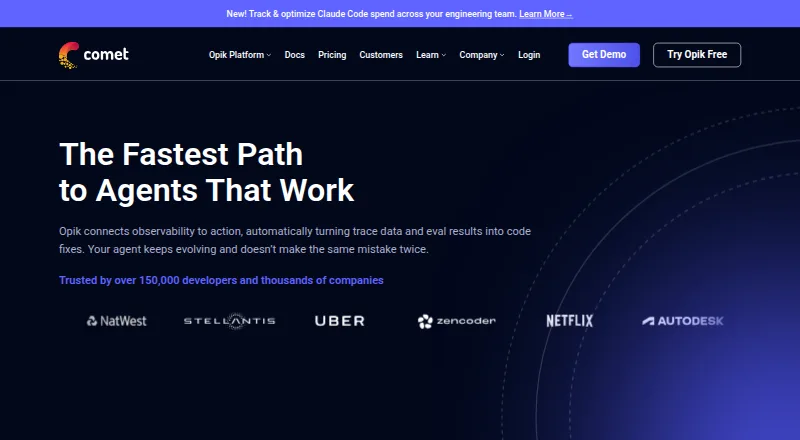
What Comet is
Comet brings together two product families on one platform: Opik for observing and evaluating generative AI applications and agents, and MLOps for machine-learning workflows. Opik traces execution paths, including context retrieval, model responses and tool calls. Its evaluation tools include test suites, datasets, experiments, and built-in LLM-as-a-judge and heuristic metrics. It lists integrations with more than 40 AI frameworks, model providers and gateways, including LangChain, OpenAI, Google ADK, LangGraph and CrewAI, and supports OpenTelemetry for applications written in Ruby, Java and other languages. Comet MLOps provides experiment tracking, dataset management, a model registry and production monitoring. Opik’s open-source version can be self-hosted; Enterprise lists flexible deployment options. Free Cloud allows up to 10 team members, 25k spans per month and 60-day data retention. Pro Cloud costs $19 a month, with limits of 50 team members and 100k spans monthly. MLOps Pro costs $19 per user/month. Comet was founded in 2017 and is headquartered in New York City.
Who it suits
Opik suits teams building applications or agents that make LLM calls. MLOps is designed for teams building and training machine-learning models.
What it does well
- Traces context retrieval, model responses and tool calls
- Evaluation includes test suites, datasets and experiments
- Integrates with more than 40 AI frameworks and providers
- Open-source Opik can be self-hosted
What to know first
- Free Cloud limits teams to 10 members and 25k monthly spans
- Free Cloud retains data for 60 days
- MLOps Pro is $19 per user/month
Limits
Opik Free Cloud allows up to 10 team members, 25k spans per month, and 60-day data retention. MLOps Free allows 1 platform user, fair usage, and 100GB data usage.
Plans
| Plan | Billed and limits | Price |
|---|---|---|
| Opik Open Source | full Opik feature set · self-hosted | Free |
| Opik Free Cloud | up to 10 team members · 25,000 spans/month · 60-day retention | Free |
| Free Cloud | Free plan · Up to 10 team members · 25k spans per month · 60-day data retention | Free |
| Open Source | Free · Full AI observability and agent testing feature set · agent tracing and analysis · test suites and assertions · agent playground | Free |
| MLOps Free | 1 platform user · fair usage · 100GB data · experiment tracking · datasets · model registry | Free |
| Opik Pro Cloud | per month · up to 50 team members · 100,000 spans/month · customizable retention | $19 a month |
| Pro Cloud | Per month · Up to 50 team members · 100k spans per month · 60-day data retention | $19 a month |
| MLOps Pro | per user/month · up to 10 users · 1,500 training hours · 500GB storage · $1 per extra training hour · $3 per extra 100GB/month · email support | $19 a month |
The first 8 of 11 plans, as comet.com lists them, read 15 Oct 2026. The maker's own page has the final word. Every plan
Getting started
- Visit the Comet website.
- Choose Opik or MLOps for your workflow.
- Select Open Source, a free plan, or a paid plan.
- Use Opik's open-source version as a self-hosted deployment if preferred.
- Connect through the listed integrations or OpenTelemetry support.
Comet is a platform for observing and evaluating LLM applications and managing machine-learning workflows. It suits teams building agents or training models, especially when both jobs matter; the trade-off is that Opik and MLOps have separate plans and quotas.
Overview
Comet brings two distinct product families onto one underlying platform. Opik focuses on generative AI applications and agentic systems; MLOps covers experiment tracking, datasets, model management, and production monitoring. That range is useful for organizations working across both disciplines, but it does not make the products interchangeable: choose the plan for the workflow you need.
Founded in 2017, Comet is headquartered in New York City and has offices in Tel Aviv. API and SDK access and hybrid deployment options make it relevant to teams integrating tooling into their own environments.
Key features
Opik observability and evaluation
Opik traces execution paths through context retrieval, model responses, and tool calls. For teams diagnosing agent behavior, connecting these steps can make it easier to see where a run went wrong. Test suites, datasets, and experiments support structured evaluation, while built-in LLM-as-a-judge and heuristic metrics give teams ways to assess changes. Opik integrates with more than 40 AI frameworks, model providers, and gateways, including LangChain, OpenAI, Google ADK, LangGraph, and CrewAI. OpenTelemetry support extends tracking to applications written in Ruby, Java, and other languages.
MLOps workflow
MLOps combines experiment tracking with dataset management, a model registry, and production monitoring. That is a broader lifecycle toolkit than a tracker alone, making it a fit for teams building and training models as well as managing them after training. Run comparison, artifact tracking, dataset versioning, and model registry are supported.
Deployment and security
Opik's open-source version can be self-hosted, while Enterprise offers flexible deployment options. The Trust Center lists ISO 9001:2015, ISO/IEC 27001:2022, and SOC 2 Type 2 compliance. Enterprise access includes single sign-on, service accounts, and view-only users, useful for organizations with access-control requirements.
Pricing
Comet has separate Opik and MLOps tiers, so compare the relevant product's limits rather than treating the entry price as one bundle.
- Open Source: free, billed Free. It includes the full AI observability and agent testing feature set, agent tracing and analysis, test suites and assertions, and an agent playground. Self-hosting is the trade-off for teams that want this route.
- Free Cloud: free, billed Free plan. It allows up to 10 team members, 25k spans per month, and 60-day data retention. It is a practical starting point for smaller teams, but the span ceiling may constrain busier workloads.
- Pro Cloud: $19 a month, billed Per month. The allowance rises to 50 team members and 100k spans per month, with the same 60-day retention. It suits teams that have outgrown Free Cloud's member or span caps.
- MLOps Free: free, billed Free plan. It covers 1 platform user, fair usage, and 100GB data usage, so it is best for an individual exploring the workflow.
- MLOps Pro: $19 a month, billed Per user/month. It supports up to 10 users, includes 1,500 training hours, and allows 500GB data usage. The per-user billing matters for teams budgeting beyond one seat.
- Enterprise: custom pricing, billed Custom, with unlimited team members, custom usage plans, flexible deployments, dedicated support, and SLAs.
- MLOps Enterprise: custom pricing, billed Custom, with unlimited users, unlimited training hours, flexible deployments, dedicated support, and SLAs.
Community support applies to all plans. Paid cloud Pro and Enterprise add email support; Enterprise also includes dedicated support and SLAs. A free trial is offered, but no trial length or renewal terms are stated.
Platforms
Comet supports API, Linux, macOS, web, and Windows, with self-hosted deployment also supported. This mix accommodates teams working across local environments and cloud services.
Who it's for
Opik is the stronger fit for teams whose applications or agents make LLM calls and need tracing plus repeatable evaluation. MLOps is aimed at teams building and training machine-learning models, particularly those needing dataset management, a registry, and production monitoring alongside experiment tracking. Teams that need only one of these workflows should focus on its product-specific limits and price rather than the platform's combined scope.
Pros and cons
- Pro: Opik combines traces, test suites, datasets, experiments, and evaluation metrics, giving agent teams a connected way to inspect and assess runs.
- Pro: More than 40 integrations and OpenTelemetry support cover a broad range of AI stacks and languages.
- Pro: MLOps brings tracking, dataset management, registry, and production monitoring together for model teams.
- Con: Free Cloud tops out at 10 team members and 25k spans per month, while Free MLOps is limited to one platform user and fair usage.
- Con: Pro Cloud's 100k monthly spans and 60-day retention may be limiting for teams with heavier or longer-running observability needs.
- Con: MLOps Pro is priced per user, and both Enterprise tiers use custom pricing, making larger deployments harder to budget from a fixed public rate.
Alternatives
Choose Weights & Biases instead if its free tier's 5 model seats, 5 GB/mo storage, and 1 GB/mo Weave data ingestion better fit your team's needs. ClearML is an alternative with a free Community plan and a self-hosted version it describes as 100% open source on GitHub. For a free option, MLRun offers an open-source plan with community support. TensorBoard is free. Trackio is also free, with its library and Hugging Face hosting included at no charge. ZenML offers an open-source tier with unlimited executions and projects and self-hosting. For a registry-focused alternative, GitLab Package Registry has a free plan for up to 5 users per top-level group, 400 compute minutes/month, and 10 GiB adjustable storage. Hopsworks AI Lakehouse has a free plan with one project, Feature Store, Model Registry, and community support. Readers comparing categories can also browse ML Experiment Tracking Software and Model Registry Software.
Verdict
Comet is a strong choice for teams that need either LLM observability and evaluation or a fuller MLOps workflow, with the added option to use both product families on one platform. Opik's tracing and evaluation depth is its clearest reason to choose it; teams should look elsewhere if its cloud quotas are too tight or if they need a fixed enterprise price before committing.
Verdict
Comet covers both LLM observability and evaluation through Opik and machine-learning workflows through MLOps. Free plans are listed, while paid cloud and MLOps options begin at 19.00 USD at their stated billing terms.
Questions
Does Comet have a free plan?
Yes. It lists Opik Open Source, Opik Free Cloud, and MLOps Free.
What does Comet Pro cost?
Pro Cloud costs $19 a month. MLOps Pro costs $19 per user/month.
Can Opik be self-hosted?
Yes. The open-source version of Opik can be self-hosted. Enterprise also lists flexible deployment options.
What platforms are supported?
Comet lists API, Linux, macOS, self-hosted, web, and Windows.
What is included in Opik Free Cloud?
It includes up to 10 team members, 25k spans per month, and 60-day data retention.
Which integrations does Opik list?
It lists more than 40 AI frameworks, model providers, and gateways, including LangChain, OpenAI, Google ADK, LangGraph, and CrewAI.
Facts from Comet's own pages
- Audience
- Comet describes MLOps as designed for teams building and training machine learning models and Opik as suited to applications or agents that make LLM calls. · comet.com, 28 Sept 2026
- Changelog
- The changelog records updates such as dashboards performance improvements, interactive parallel-coordinates charts, metadata search, and model-registry permission changes. · comet.com, 15 Oct 2026
- Company
- Comet says it is headquartered in New York City, has offices in Tel Aviv, and launched in 2017. · comet.com, 28 Sept 2026
- Company facts
- Comet ML, Inc. launched in 2017, is headquartered in New York City with offices in Tel Aviv, reports 80 employees in 14 countries, and reports $70 million in funding. · comet.com, 15 Oct 2026
- Compliance
- The Trust Center lists ISO 9001:2015, ISO/IEC 27001:2022, and SOC 2 Type 2 compliance. · trust.comet.com, 28 Sept 2026
- Dataset management
- Comet versions datasets and links them to experiments for lineage and reproducibility. · comet.com, 15 Oct 2026
- Documentation
- Comet publishes versioned documentation covering installation, REST and Python APIs, integrations, troubleshooting, on-premises configuration, CLI commands, and release notes. · comet.com, 15 Oct 2026
- Enterprise access
- The Enterprise plan lists single sign-on, service accounts, and view-only users. · comet.com, 28 Sept 2026
- Evaluation
- Opik provides test suites, datasets, experiments, and built-in LLM-as-a-judge and heuristic evaluation metrics. · comet.com, 28 Sept 2026
- Experiment tracking
- The platform records and compares machine-learning training runs, metrics, parameters, code, and outputs. · comet.com, 15 Oct 2026
- Founded
- 2017 · comet.com, 23 Sept 2026
- Headquarters
- New York City, United States · comet.com, 23 Sept 2026
- Hyperparameter search
- Comet includes automated hyperparameter tuning with results tracked in the platform. · comet.com, 15 Oct 2026
- Integrations
- Comet advertises integrations with more than 40 AI frameworks, model providers, and gateways, including PyTorch, TensorFlow, Keras, scikit-learn, XGBoost, Hugging Face, LangChain, and OpenAI. · comet.com, 15 Oct 2026
- Legal name
- Crunchbase lists the legal name as Comet ML Inc. and the founders as Gideon Mendels and Nimrod Lahav. · crunchbase.com, 15 Oct 2026
- Licence
- The core MLOps platform is closed source; the separate Opik project is released under Apache-2.0. · panoply.io, 15 Oct 2026
- Limit: G2 reviewers
- G2 reviewers report a cluttered learning curve, inconsistent logging discipline, limited language support beyond Python, and costs that rise with seats and usage. · g2.com, 15 Oct 2026
- Limit: independent review
- MakerStack says Comet has a smaller community, restrictive lower-tier storage, basic production monitoring, no built-in hyperparameter sweeps, and still-maturing Opik documentation. · makerstack.co, 15 Oct 2026
- Limit: Panoply review
- Panoply reports UI slowdown at high experiment volume, large-file upload restrictions, SDK-versus-UI inconsistencies, and no bulk export API for historical runs. · panoply.io, 15 Oct 2026
- LLM evaluations
- Opik provides test suites, datasets, and LLM-as-a-judge metrics for evaluating applications. · comet.com, 15 Oct 2026
- LLM tracing
- Opik traces LLM inputs, outputs, metadata, tool calls, and multi-step agent execution. · comet.com, 15 Oct 2026
- MCP server
- Comet provides an MCP server installable with pip or Docker for querying and managing Comet data from AI clients. · comet.com, 15 Oct 2026
- MLOps
- Comet MLOps provides experiment tracking, dataset management, model registry, and model production monitoring. · comet.com, 28 Sept 2026
- Model registry
- The model registry centralizes model versions and supports tracking and deployment workflows. · comet.com, 15 Oct 2026
Where Comet stands on Freedom251
- Model registries#1 of 38
- Model Registry Software#2 of 36
- ML Experiment Tracking Software#3 of 39
- Experiment Tracking#3 of 22