Freedom251 › ML Experiment Tracking Software
Metaflow
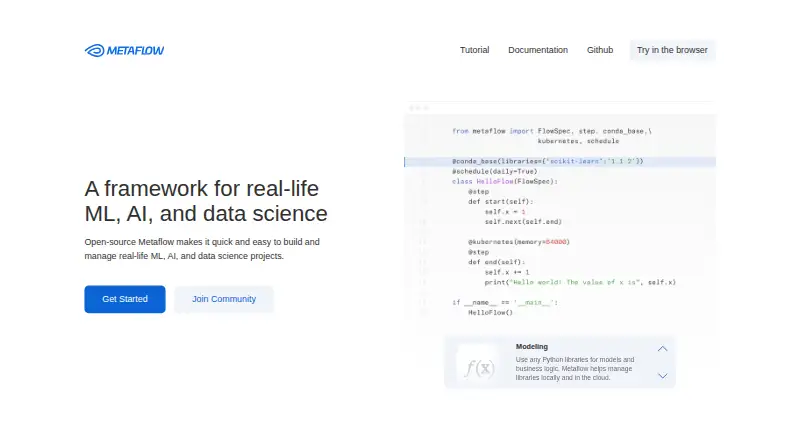
What Metaflow is
Metaflow is a Python library for developing, deploying, and operating data-intensive data science, machine learning, and AI applications. It automatically tracks flows, experiments, and artifacts, and supports building and testing workflows locally. For scaled compute, it can use a customer’s cloud account or Kubernetes clusters. Documented integrations include AWS Batch, AWS Step Functions, Kubernetes, Argo Workflows, and Apache Airflow. Deployment options include AWS, Azure, Google Cloud, Kubernetes, and on-premises clusters; artifact storage can use AWS S3, Azure Blob Storage, or Google Cloud Storage. The library is open source under Apache License 2.0, and its own-cloud model can use existing infrastructure and security policies. The Python package installs on macOS and Linux with pip, while the free Metaflow Sandbox provides browser access to cloud and Kubernetes stacks. The local-only setup does not provide external compute scaling or production-grade deployments. Metaflow is free.
Who it suits
Metaflow is aimed at data scientists and ML or AI engineers building workflows that may need scaling or operational deployment. Its documentation says it offers little benefit for small notebook experiments without scaling, criticality, or complexity needs.
What it does well
- Automatically tracks flows, experiments, and artifacts.
- Supports local workflow construction and testing.
- Can scale compute using cloud accounts or Kubernetes.
- Offers several cloud and workflow integrations.
What to know first
- Local-only setup lacks external compute scaling.
- Local-only setup is not for production-grade deployments.
- The Python package installation page lists macOS and Linux.
Limits
The free local-only setup does not support external compute scaling or production-grade deployments. Production scaling requires infrastructure in your own cloud account or Kubernetes cluster.
Plans
| Plan | Billed and limits | Price |
|---|---|---|
| Open-source Metaflow | Apache-2.0 Python library · self-hosted cloud or Kubernetes infrastructure | Free |
As metaflow.org lists them, read 15 Oct 2026. The maker's own page has the final word.
Getting started
- Open the Metaflow website.
- Install the Python package with pip on macOS or Linux.
- Build and test workflows locally.
- Use Metaflow Sandbox in a browser to explore cloud and Kubernetes stacks for free.
- For production scaling, use infrastructure in your cloud account or Kubernetes cluster.
Metaflow is an open-source Python library for data-intensive data science, machine-learning, and AI applications. It suits data scientists and ML/AI engineers who need tracked, orchestrated workflows that can grow beyond a laptop. The software costs nothing, but serious deployment depends on infrastructure your organization operates.
It is a strong fit when you want one development model spanning experiments, artifacts, and production pipelines while retaining control of cloud or cluster security. A small, self-contained notebook project will gain little from it.
Overview
Originally created at Netflix and released as open source in 2019, Metaflow combines workflow construction with automatic records of flows, experiments, and artifacts. Teams can start locally, then direct compute to their own cloud account or Kubernetes environment. That bring-your-own-infrastructure approach favors organizations with established platform and security policies, but it also makes production adoption an infrastructure project rather than a turnkey service.
Key features
Tracking and orchestration
Automatic tracking covers flows, experiments, and artifacts, with data versioning and pipeline orchestration. This gives teams continuity as datasets and models change, instead of leaving results scattered across notebooks. It is particularly useful for repeatable ML and AI work where lineage matters.
Local development
Workflows can be built and tested on a local machine, and the Python package installs with pip on macOS and Linux. Local iteration is a sensible way to develop, but the local-only setup cannot scale to external compute or deliver production-grade deployments.
Infrastructure choices
Metaflow can use AWS Batch, AWS Step Functions, Kubernetes, Argo Workflows, and Apache Airflow. Its infrastructure guidance covers AWS, Azure, Google Cloud, and Kubernetes, including on-premises clusters. Artifact storage options include Amazon S3, Azure Blob Storage, and Google Cloud Storage. This breadth helps teams fit existing estates; it does not remove the operational work of running those services.
Browser sandbox and support
Metaflow Sandbox lets users explore AWS, Azure, Google Cloud, and Kubernetes stacks in a browser for free.
Pricing
Open-source Metaflow — free. The plan is released under the Apache License 2.0 and includes the software itself without seat charges, quotas, or a time-limited trial. The important cost condition is operational: production scaling requires infrastructure in your own cloud account or Kubernetes cluster. Teams must therefore budget for that infrastructure and its administration even though Metaflow has no license fee.
Platforms
Metaflow is available through an API and supports Linux, macOS, self-hosted deployments, and web access. Local installation targets Linux and macOS; browser exploration is provided through Metaflow Sandbox.
Who it's for
Choose Metaflow if you are a data scientist or ML/AI engineer building workflows that need experiment tracking, data lineage, orchestration, and a route to managed compute on cloud or Kubernetes infrastructure. It is less suitable for a simple notebook experiment with no scaling, criticality, or complexity requirements, where its workflow and infrastructure model adds little benefit.
Pros and cons
Pros
- Free and open source: Apache 2.0 licensing avoids per-seat software fees and permits self-hosting.
- One path from development to scale: Local construction and testing can lead to cloud or Kubernetes compute without abandoning the workflow model.
- Broad infrastructure integration: AWS, Azure, Google Cloud, Kubernetes, Airflow, Argo Workflows, AWS Batch, and Step Functions cover varied platform estates.
- Useful lineage: Automatic flow, experiment, artifact, and data-version tracking supports reproducible work.
Cons
- Production is not turnkey: External scaling and production deployment require your own cloud account or Kubernetes cluster.
- Local-only use is constrained: A laptop setup cannot provide external compute scaling or production-grade operation.
- Support is community-led: Help is directed to Slack rather than a documented paid support tier.
Alternatives
For a broader directory of comparable tooling, see MLOps Platforms, DataOps Platforms, and ML Experiment Tracking Software.
- ClearML is a freemium option with a free community plan, Windows support, and a self-hosted version described as fully open source; choose it when those characteristics matter.
- Weights & Biases offers hosted and self-hosted access, a free plan with five model seats, 5 GB monthly storage, and 1 GB monthly Weave ingestion; pick it when those published quotas fit your team.
- MLRun has a free open-source plan with community support and a separately managed Iguazio offering; consider it when that split matches your operating model.
- Paperspace Gradient provides a free tier with 5 GB storage and a paid per-user tier; choose it when a hosted notebook-oriented service is preferable.
- ZenML offers open source with unlimited executions and projects, plus self-hosting; it is an alternative when those limits are the priority.
- Opik combines an open-source core for local observability and evaluation with a free cloud plan; choose it when observability is the main requirement.
- Amazon SageMaker Autopilot is a paid, pay-as-you-go AWS service with no free plan; select it when managed AWS automation outweighs self-hosting.
- Databricks Notebooks has a free edition with one serverless workspace and limited compute; choose it for a constrained Databricks workspace rather than a self-managed workflow stack.
Verdict
Metaflow is a compelling choice for technical teams that need tracked, versioned, orchestrated data and ML workflows and already operate cloud or Kubernetes infrastructure. Its Apache-licensed, self-hosted model is the main reason to choose it. Look elsewhere if you want production compute and operations delivered without managing your own infrastructure, or if your work is only a small local notebook experiment.
Verdict
Metaflow offers a path from local workflow work to deployments using cloud or Kubernetes infrastructure. The local-only setup is limited, so production scaling requires infrastructure in a cloud account or Kubernetes cluster.
Questions
How much does Metaflow cost?
The open-source plan is free.
Is Metaflow open source?
Yes. It is licensed under Apache License 2.0.
Which platforms can run Metaflow?
The Python package is available for macOS and Linux, and Metaflow also supports API, web, and self-hosted use. Metaflow Sandbox provides browser access to AWS, Azure, Google Cloud, and Kubernetes stacks.
Which tools and infrastructure does it integrate with?
Documented integrations include AWS Batch, AWS Step Functions, Kubernetes, Argo Workflows, and Apache Airflow. Deployment options include AWS, Azure, Google Cloud, Kubernetes, and on-premises clusters.
Where can Metaflow store artifacts?
Listed storage options are AWS S3, Azure Blob Storage, and Google Cloud Storage.
Who developed Metaflow?
Metaflow was originally developed at Netflix and open-sourced in 2019.
Facts from Metaflow's own pages
- API stability
- Metaflow states that documented public APIs are covered by a strong backward-compatibility promise. · docs.metaflow.org, 15 Oct 2026
- Browser access
- The documentation says users can explore the AWS, Azure, Google Cloud, and Kubernetes stack in a browser through Metaflow Sandbox for free. · docs.metaflow.org, 5 Oct 2026
- Browser sandbox
- A Metaflow Sandbox lets users try the infrastructure in a browser without local installation. · docs.metaflow.org, 15 Oct 2026
- Cloud integrations
- Documented infrastructure targets include AWS, Azure, Google Cloud and on-premises Kubernetes. · docs.metaflow.org, 15 Oct 2026
- Cloud platforms
- The infrastructure guide lists deployments on AWS, Azure, Google Cloud, and Kubernetes, including on-premises clusters. · docs.metaflow.org, 5 Oct 2026
- Company founded
- LinkedIn lists Outerbounds’ founding year as 2021. · linkedin.com, 15 Oct 2026
- Company legal name
- Crunchbase lists Outerbounds’ legal name as Step Computing, Inc. · crunchbase.com, 15 Oct 2026
- Company ownership
- Crunchbase states that Outerbounds was acquired by Anaconda. · crunchbase.com, 15 Oct 2026
- Company size and headquarters
- LinkedIn lists Outerbounds as a privately held software company headquartered in San Francisco with 11–50 employees. · linkedin.com, 15 Oct 2026
- Compute
- Metaflow can use a customer’s cloud account and Kubernetes clusters to scale compute. · docs.metaflow.org, 5 Oct 2026
- Compute scaling
- Cloud execution supports CPUs, GPUs, large-memory instances and thousands of parallel tasks. · docs.metaflow.org, 15 Oct 2026
- Data handling
- Metaflow includes patterns for moving data through workflows and accessing warehouses and data lakes. · docs.metaflow.org, 15 Oct 2026
- Data storage
- The infrastructure guide lists AWS S3, Azure Blob Storage, and Google Cloud Storage as artifact storage options. · docs.metaflow.org, 5 Oct 2026
- Dependency environments
- The dependency system can snapshot PyPI or conda packages into an object store and create per-step environments. · docs.metaflow.org, 15 Oct 2026
- Deployment
- Workflows can be deployed to production with one command and can react to events. · metaflow.org, 15 Oct 2026
- Documentation and support
- Documentation covers development, scaling, failure handling, checkpointing, secrets, production scheduling, APIs and internals, with community help through Slack. · docs.metaflow.org, 15 Oct 2026
- Features
- It automatically tracks flows, experiments, and artifacts, and supports local workflow construction and testing. · docs.metaflow.org, 5 Oct 2026
- Independent review praise
- BigData Republic credits Metaflow with reducing infrastructure work through versioning, dependency management and compute-resource management. · bigdatarepublic.nl, 15 Oct 2026
- Installation
- The package is installed with pip, and conda-forge installation is also documented. · docs.metaflow.org, 15 Oct 2026
- Integrations
- Documented integrations include AWS Batch, AWS Step Functions, Kubernetes, Argo Workflows, and Apache Airflow. · docs.metaflow.org, 5 Oct 2026
- Intended users
- Metaflow is aimed at data scientists and ML/AI engineers; its documentation says it offers little benefit for small notebook experiments with no scaling, criticality, or complexity needs. · docs.metaflow.org, 5 Oct 2026
- Licence
- Metaflow is open source under the Apache License 2.0. · docs.metaflow.org, 15 Oct 2026
- Limit: AWS dependence
- BigData Republic’s review says Metaflow is much less useful for teams that do not use AWS. · bigdatarepublic.nl, 15 Oct 2026
- Limit: cloud portability and debugging
- G2 reviewers say the strongest capabilities are AWS-linked, non-AWS complex integrations can feel limiting, and cloud failure logs may lack detail. · g2.com, 15 Oct 2026
Where Metaflow stands on Freedom251
- ML Experiment Tracking Software#1 of 39
- MLOps Platforms#2 of 29
- DataOps Platforms#6 of 16