Freedom251 › Desktop Widget Software
Eww
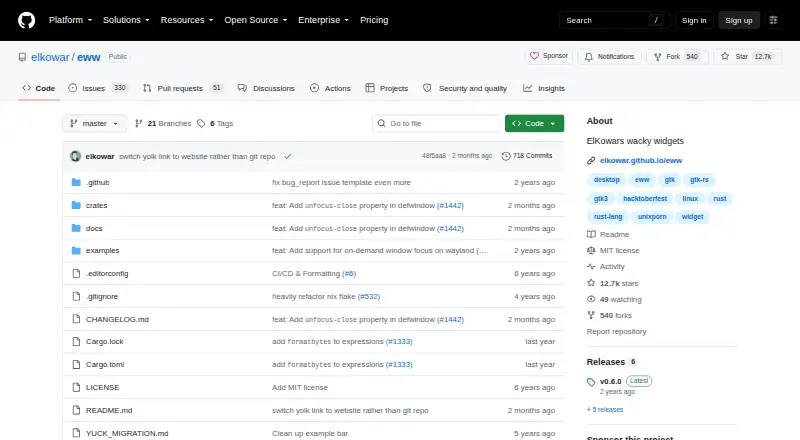
What Eww is
Eww is a standalone Linux widget system for building custom desktop widgets independently of the window manager. Written in Rust, it uses the Yuck language to configure widgets, window geometry, behavior, state, and data. Styling uses CSS or SCSS through GTK’s CSS engine, which does not implement every web CSS feature, including some animations and layout properties. Built-in variables can expose CPU, RAM, disk, battery, network, and time information. Polling variables repeatedly run shell scripts; listening variables update when a script produces a new line. Documentation examples use xprop to track the focused desktop and playerctl to monitor the playing song. Separate installation build commands are provided for X11 and Wayland. Building requires Rust and Cargo, plus dynamic libraries such as GTK3, Pango, Cairo, and GLib. The repository identifies Eww as MIT licensed, and the Free plan is listed as free. One constraint is that window arguments remain constant once a window has opened.
Who it suits
Eww suits Linux users who want to define and customize desktop widgets such as bars or dashboards for a window manager. It is aimed at people comfortable configuring widgets and meeting its build requirements.
What it does well
- Works independently of the window manager.
- Yuck configures widgets, geometry, behavior, state, and data.
- Built-in variables expose common system information.
- Supports polling and listening shell-script variables.
- MIT licensed and listed as free.
What to know first
- GTK CSS omits some web CSS features.
- Window arguments cannot change after opening.
- Building requires Rust, Cargo, and dynamic libraries.
Plans
| Plan | Billed and limits | Price |
|---|---|---|
| Free | Standalone widget system · MIT licensed | Free |
As github.com lists them, read 8 Oct 2026. The maker's own page has the final word.
Getting started
- Visit the Eww GitHub website.
- Choose the build instructions for X11 or Wayland.
- Install Rust, Cargo, GTK3, Pango, Cairo, and GLib as build requirements.
- Configure widgets, geometry, behavior, state, and data in Yuck.
- Style widgets with CSS or SCSS through GTK’s CSS engine.
Verdict
Eww gives Linux users control over custom widget content, layout, and data sources. Its build dependencies and fixed window arguments are worth considering before adopting it.
Questions
How much does Eww cost?
Eww has a free plan listed as free.
Which platforms does Eww support?
Eww is listed for Linux. Its installation guide provides separate build commands for X11 and Wayland.
Is Eww open source?
The GitHub repository identifies Eww as MIT licensed.
What can Eww widgets display?
Built-in variables expose CPU, RAM, disk, battery, network, and time information. The widget categories also include calendars, graphs, progress displays, and many controls and layout elements.
What is required to build Eww?
Building requires Rust and Cargo, plus dynamic libraries including GTK3, Pango, Cairo, and GLib.
Can Eww use changing data from scripts?
Yes. Polling variables repeatedly run shell scripts, and listening variables update when script output produces a new line.
Facts from Eww's own pages
- Build requirements
- Building Eww requires Rust and Cargo, plus dynamic libraries including GTK3, Pango, Cairo, and GLib. · elkowar.github.io, 8 Oct 2026
- Built-in system data
- Built-in variables expose data including CPU, RAM, disk, battery, network, and time information. · elkowar.github.io, 8 Oct 2026
- Configuration
- Widgets, window geometry, behavior, state, and data are configured with Eww’s Yuck language. · elkowar.github.io, 8 Oct 2026
- Display backends
- The installation guide provides separate build commands for X11 and Wayland. · elkowar.github.io, 8 Oct 2026
- Dynamic data
- Polling variables can repeatedly run shell scripts, while listening variables read a script’s output and update when it produces a new line. · elkowar.github.io, 8 Oct 2026
- Efficiency note
- The documentation says dynamically rendering a widget tree with the literal widget is not very efficient and recommends using it only when necessary. · elkowar.github.io, 8 Oct 2026
- Integrations
- The documentation gives examples of using xprop to track the focused desktop and playerctl to monitor the currently playing song. · elkowar.github.io, 8 Oct 2026
- Intended users
- Eww is for people who want to define and customize their own desktop widgets, such as bars and dashboards, for a window manager. · github.com, 8 Oct 2026
- License
- The GitHub repository identifies the project as MIT licensed. · github.com, 8 Oct 2026
- Notable limit
- Window arguments are constant and cannot be updated after a window has opened. · elkowar.github.io, 8 Oct 2026
- Purpose
- Eww is a standalone widget system written in Rust for creating custom widgets in any window manager. · github.com, 8 Oct 2026
- Styling
- Eww uses CSS or SCSS through GTK’s CSS engine, which does not support all web CSS features, including some animations and layout properties. · elkowar.github.io, 8 Oct 2026
- Support and contribution
- The project invites contributions through GitHub pull requests and links to a beginner-friendly introductory guide. · github.com, 8 Oct 2026
- Window manager independence
- Eww lets users create widgets independently of their window manager. · elkowar.github.io, 8 Oct 2026
Where Eww stands on Freedom251
- Desktop Widget Software#13 of 29