Freedom251 › AI Speech Enhancement Software
DPDFNet
What DPDFNet is
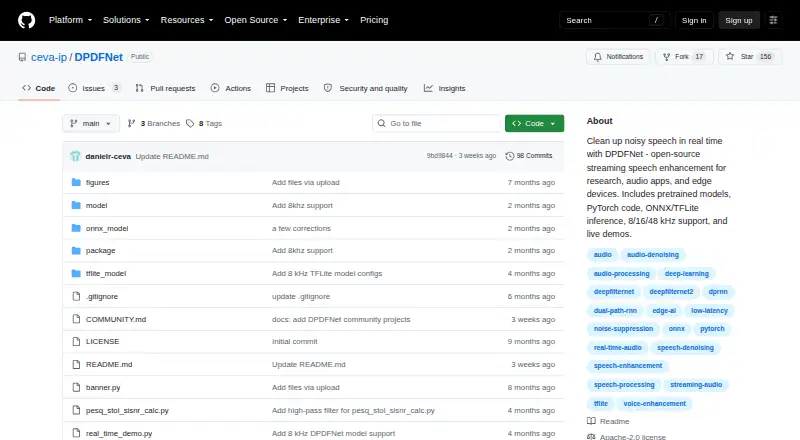
DPDFNet is a causal, single-channel speech-enhancement model for reducing noise in recordings, live streams and edge-device applications. It supports offline and streaming processing. The design extends DeepFilterNet2 with dual-path encoder blocks and an always-on fine-tuning approach intended to reduce over-attenuation. Pretrained variants support 8, 16 and 48 kHz audio. The repository includes PyTorch code and ONNX and TFLite inference models, with command-line, Python and stateful streaming interfaces. For streaming, the first enhanced output follows about 20 ms of buffering, and later blocks add about 10 ms of delay. A hosted Gradio demo and audio examples are linked from the project. Listed community integrations include sherpa-onnx, OBS Studio, VST3 and LADSPA plugins, Core ML ports and WebAssembly. The project page reports a real-time DPDFNet-4 deployment on Ceva-NeuPro-Nano edge NPUs in a benchmark setup using int8 weights and int16 activations. The repository provides Apache License 2.0 code, but model files are not bundled and must be downloaded separately using its instructions.
Who it suits
DPDFNet suits developers building speech enhancement for recordings, live streams or edge devices, including those integrating through its command-line, Python or streaming interfaces. Its multiple inference formats and listed community integrations provide several deployment paths.
What it does well
- Supports 8, 16 and 48 kHz audio.
- Includes PyTorch, ONNX and TFLite options.
- Provides command-line, Python and streaming APIs.
- Apache License 2.0 code and models.
- Hosted Gradio demo is available.
What to know first
- Model files are not bundled in the repository.
- Streaming output has about 20 ms initial buffering.
- Later streaming blocks add about 10 ms delay.
Plans
| Plan | Billed and limits | Price |
|---|---|---|
| Open-source DPDFNet | Apache-2.0 licensed code and models; no commercial pricing or usage limits stated | Free |
As github.com lists them, read 8 Oct 2026. The maker's own page has the final word.
Getting started
- Open the DPDFNet GitHub repository.
- Use the repository commands to download the checkpoints or ONNX or TFLite models from Hugging Face.
- Choose the documented command-line, Python API, or stateful streaming interface.
- Try the hosted Gradio demo linked from the repository or project page.
DPDFNet is a causal, single-channel speech enhancement model for noisy recordings, live streams, and edge devices. It is best suited to developers and audio teams that want to integrate or deploy a model across different runtimes. Its appeal is deployment flexibility; using it requires obtaining the model files separately.
Overview
DPDFNet extends DeepFilterNet2 with dual-path encoder blocks and an always-on fine-tuning approach intended to reduce over-attenuation. That design targets a practical tension in speech cleanup: reducing noise while avoiding excessive suppression of the voice. It is a focused enhancement model, not a general-purpose audio editor.
Pretrained variants support 8, 16, and 48 kHz audio. The project provides PyTorch code and ONNX and TFLite inference models, giving developers several routes to fit a deployment stack. Model files are not bundled with the source repository, however, so setup includes downloading checkpoints or inference models from Hugging Face.
Key features
The command-line interface, Python API, and stateful streaming API cover batch use as well as integration into live audio pipelines. Streaming buffers about 20 ms before its first enhanced output and adds about 10 ms of delay for later blocks. Those figures help teams judge whether it can fit a latency budget, but they do not by themselves establish suitability for every live application.
A hosted Gradio demo and project audio examples offer a way to hear the model's intended use. The maker's community directory includes integrations for sherpa-onnx, OBS Studio, VST3 and LADSPA plugins, Core ML ports, and WebAssembly. That breadth is useful for teams working across audio software and device environments, though the project still expects users to handle model downloads and integration.
The project reports real-time deployment of DPDFNet-4 on Ceva-NeuPro-Nano edge NPUs, with int8 weights and int16 activations in the benchmark setup. Its paper evaluates long, low-SNR recordings in 12 languages across everyday noise scenarios. These details make the project relevant to edge and multilingual use cases, while the reported deployment is tied to that specific benchmark setup.
Pricing
Open-source DPDFNet: free. The Apache-2.0 licensed code and models are free, with no commercial pricing or usage limits stated. This suits developers and organizations that can manage deployment themselves; the lower price does not remove the work of obtaining model files or integrating the software.
Platforms
DPDFNet is listed for Android, iOS, Linux, macOS, and Windows, as well as API and self-hosted use. Its PyTorch, ONNX, and TFLite options and community ports give developers multiple implementation paths, but platform support should not be read as a ready-made consumer app for each system.
Who it's for
DPDFNet fits developers building speech cleanup into recording, streaming, or edge-device workflows, particularly when they need a causal model and can work with downloaded checkpoints and inference formats. It is less suitable for someone seeking a turnkey editor or a workflow that avoids model setup.
Pros and cons
- Pros: PyTorch, ONNX, and TFLite options support varied deployment needs.
- Pros: A documented streaming buffer and block delay help assess live use.
- Pros: Apache-2.0 licensing and a free price make the code and models accessible for integration.
- Cons: Model files require a separate download, adding setup work.
- Cons: The project is a focused model and integration base rather than a finished consumer audio editor.
Alternatives
DeepFilterNet is another free, open-source option under MIT or Apache-2.0, and may suit users who want its established model rather than DPDFNet's dual-path extension and streaming interfaces.
Auphonic is worth considering for a production workflow with AI-based audio algorithms and a free allowance of 2 hours per month; credits do not stack. Adobe Enhance Speech offers a web-based free plan for one audio file at a time, capped at 30 minutes and 500 MB per file, with one hour of enhancement per day.
LALAL.AI has an always-free Starter plan with 10 minutes in the Relaxed Queue and a 200 MB per-file upload limit; full downloads are unavailable. Riverside Magic Audio may suit people already making multi-track recordings: its free plan includes a one-off two hours, up to 720p video, a Riverside watermark, and 44.1 kHz audio.
CrystalSound offers a free Starter plan. Denoise is a mobile option for importing and denoising audio with before-and-after listening, while saving or exporting requires Pro. Chatterbox TTS is a free, MIT-licensed open-source model option for research and development.
Browse AI Speech Enhancement Software to compare more tools in the category.
Verdict
Choose DPDFNet if you are building single-channel speech enhancement into a product or pipeline and value multiple inference formats, a stateful streaming interface, and open-source licensing. Its strongest reason to choose is the combination of deployment options and documented streaming behavior. Look elsewhere if you need a finished audio application with model setup handled for you.
Verdict
DPDFNet offers several interfaces and inference formats for single-channel speech enhancement, including streaming with stated buffering and delay. Users need to download model files separately from the source repository.
Questions
Is DPDFNet free and open source?
Yes. The listed open-source plan costs nothing, and the software is provided under Apache License 2.0.
What audio does it process?
DPDFNet is designed for single-channel speech in recordings, live streams, and edge-device applications. Pretrained variants support 8, 16, and 48 kHz audio.
Which interfaces and inference formats are available?
The repository documents command-line, Python API, and stateful streaming interfaces. It includes PyTorch code and ONNX and TFLite inference models.
What is the streaming delay?
The streaming API buffers about 20 ms before its first enhanced output. Subsequent blocks add about 10 ms of delay.
Are model files included in the repository?
No. The repository provides commands to download checkpoints and ONNX or TFLite models from Hugging Face.
What integrations are listed?
The community directory lists sherpa-onnx, OBS Studio, VST3 and LADSPA plugins, Core ML ports, and a WebAssembly implementation.
Facts from DPDFNet's own pages
- Architecture
- It extends DeepFilterNet2 with dual-path encoder blocks and an always-on fine-tuning approach designed to reduce over-attenuation. · ceva-ip.github.io, 8 Oct 2026
- Deployment
- The project page reports real-time deployment of DPDFNet-4 on Ceva-NeuPro-Nano edge NPUs, using int8 weights and int16 activations in the benchmark setup. · ceva-ip.github.io, 8 Oct 2026
- Evaluation
- The paper describes an evaluation set of long, low-SNR recordings in 12 languages across everyday noise scenarios. · ceva-ip.github.io, 8 Oct 2026
- Founded
- 1999 · github.com, 28 Sept 2026
- Headquarters
- Rockville, Maryland, USA · github.com, 28 Sept 2026
- Inference formats
- The repository includes PyTorch code and ONNX and TFLite inference models. · github.com, 8 Oct 2026
- Integrations
- The maker's community directory lists integrations including sherpa-onnx, OBS Studio, VST3 and LADSPA plugins, Core ML ports, and a WebAssembly implementation. · github.com, 8 Oct 2026
- Interfaces
- The project documents a command-line interface, Python API, and stateful streaming API. · github.com, 8 Oct 2026
- License
- The repository provides the software under the Apache License 2.0. · github.com, 8 Oct 2026
- Live demo
- The repository links to a hosted Gradio demo and a project page with audio examples. · github.com, 8 Oct 2026
- Purpose
- DPDFNet is a causal, single-channel speech-enhancement model for cleaning noisy speech in recordings, live streams, and edge-device applications. · github.com, 8 Oct 2026
- Sample rates
- Pretrained model variants support 8, 16, and 48 kHz audio. · github.com, 8 Oct 2026
- Streaming latency
- The streaming API buffers about 20 ms before its first enhanced output and adds about 10 ms of delay for subsequent blocks. · github.com, 8 Oct 2026
- Support
- The repository directs users to open an issue or submit a pull request to add a DPDFNet integration to its community directory. · github.com, 8 Oct 2026
- Use requirements
- The repository says model files are not bundled in the source repository and provides commands to download checkpoints and ONNX or TFLite models from Hugging Face. · github.com, 8 Oct 2026
Where DPDFNet stands on Freedom251
- AI Speech Enhancement Software#5 of 35