Freedom251 › Development Environment Managers

DDEV
What DDEV is
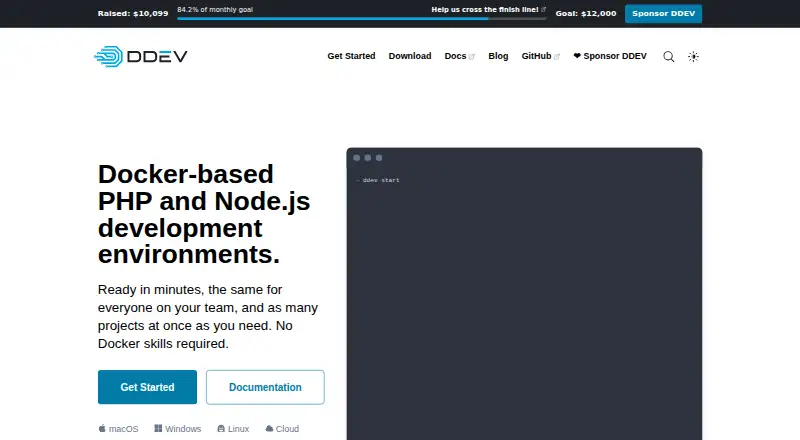
DDEV is a free, open-source local development environment for web developers. It launches Docker-based environments for PHP and Node.js on macOS, Windows, and Linux. Projects can be started, customized, shared, and extended, with presets for Laravel, WordPress, Drupal, TYPO3, Backdrop, Magento, Craft CMS, and more. The supported stack includes MySQL, PostgreSQL, nginx, Apache, Redis, and Mailpit. An included router handles custom domains and HTTPS automatically. Developers can add add-ons, run lifecycle hook scripts, or supply their own Dockerfiles. Provider recipes and integrations include Acquia, Git, Lagoon, local files, Pantheon, Upsun, and rsync. DDEV focuses on local development and does not deploy code. Its documentation describes public hosting with DDEV as experimental and says no security team backs that approach. Support options include documentation, GitHub issues, Discord, and contact channels. DDEV is governed through the DDEV Foundation and funded by recurring sponsorships; its listed plan is free under the Apache 2.0 license.
Who it suits
DDEV suits people building websites who need local Docker-based environments for PHP or Node.js projects. Its presets and integrations may be useful to teams working with the listed frameworks, CMSs, and providers.
What it does well
- Free and open source under Apache 2.0.
- Supports macOS, Windows, and Linux.
- Presets cover several web frameworks and CMSs.
- Router handles custom domains and HTTPS.
- Projects can use add-ons and custom Dockerfiles.
What to know first
- Does not provide code deployment capabilities.
- Public hosting is described as experimental.
- No security team backs the public-hosting approach.
Limits
The free plan is the DDEV project under the Apache 2.0 license. It does not include code deployment or local Kubernetes.
Plans
| Plan | Billed and limits | Price |
|---|---|---|
| DDEV | Free and open source · Apache 2.0 license | Free |
As ddev.com lists them, read 2 Oct 2026. The maker's own page has the final word.
Getting started
- Visit the DDEV website.
- Choose macOS, Windows, or Linux.
- Start with a project preset or set up a project environment.
- Customize and extend the environment as needed.
Overview
DDEV is a free, open-source local development environment for web developers working with Docker-based PHP and Node.js projects. It is especially well suited to people building websites with a supported CMS or framework who want reusable project setups across macOS, Windows, or Linux. Its strength is breadth and customization for local work; deployment is outside its scope.
Key features
DDEV brings PHP, Node.js, MySQL, PostgreSQL, nginx, Apache, Redis, and Mailpit into its project stack. Presets for Laravel, WordPress, Drupal, TYPO3, Backdrop, Magento, Craft CMS, and other projects give teams a practical starting point instead of requiring every environment to be assembled from scratch. Projects can be customized, shared, and extended, which makes the presets useful without forcing a fixed configuration.
The included router manages custom domains and HTTPS automatically, reducing routine setup work for local sites. Add-ons, lifecycle hook scripts, and user-provided Dockerfiles allow more control when a project needs something beyond its preset. Compose workflows, IDE integration, and resource controls round out the environment; local Kubernetes is not supported.
Provider recipes and integrations cover Acquia, Git, Lagoon, local files, Pantheon, Upsun, and rsync. That connects local work with several hosting and project workflows, but it should not be mistaken for deployment: DDEV does not deploy code. Its documentation describes public hosting with DDEV as experimental and warns that no security team backs that approach, so it is not a sound choice for serving public sites.
Pricing
DDEV costs nothing and is free and open source under the Apache 2.0 license. There is no paid tier or trial to weigh against the free plan. This suits individual developers and teams that want a configurable local environment without a software subscription; the trade-off is that the tool itself does not provide deployment capabilities.
Platforms
DDEV is supported and tested on macOS, Windows, and Linux. That cross-platform coverage makes it a reasonable fit for teams with mixed desktop operating systems. It does not offer local Kubernetes, so projects that require that workflow will need another environment.
Who it's for
DDEV is aimed at people who make websites, particularly developers and teams working with PHP or Node.js and common CMS or framework projects. Its presets, shared project setups, and extension points suit teams that want repeatable local environments while retaining room for project-specific configuration. It is not the right fit for someone seeking a deployment platform or a supported public-hosting solution.
The project is governed through the DDEV Foundation and funded by recurring sponsorships. It originated at Drud around 2016; Drud shut down in 2021 after losing venture funding. For ongoing help, DDEV points users to documentation, GitHub issues, Discord, and contact options.
Pros and cons
Pros
- Broad web stack: PHP, Node.js, databases, web servers, Redis, and Mailpit cover many local website needs in one environment.
- Useful starting points: Presets span several major CMS and framework projects, while Dockerfiles, add-ons, and hooks leave room to adapt them.
- Cross-platform support: macOS, Windows, and Linux support can help standardize local work across a mixed team.
Cons
- No deployment: DDEV handles local development only, so teams still need a separate way to deploy code.
- Not for public hosting: Public use is described as experimental and lacks security-team backing.
- No local Kubernetes: Developers needing Kubernetes locally will have to choose another tool or workflow.
Alternatives
For a different open-source local environment, Lando is free on Linux, macOS, and Windows. Choose it if you want to evaluate another free tool in this category rather than DDEV's specific stack and presets.
devenv is a free, MIT-licensed option for Linux, macOS, and Windows, but requires Nix. It may suit developers already using Nix; DDEV is the more natural fit when Docker-based web projects and its CMS presets are the priority.
ActiveState Platform has a free organization plan limited to public projects and a paid enterprise plan with custom pricing. It is worth considering when those terms suit your project; DDEV is a straightforward free choice for local website environments.
Flox offers a free Personal plan with its CLI, catalog access, unlimited public FloxHub environments, and three private environments. Consider it if those environment-sharing limits and features match your needs; DDEV focuses specifically on local web development.
vfox is another free, Apache 2.0-licensed option for Linux, macOS, and Windows.
Devilbox is a free alternative supporting Linux, macOS, Windows, self-hosted, and web platforms.
DevPod is free, open source, and described as client-only; consider it if that model is what you need.
FlyEnv has a free plan with caps including three local sites and three custom projects per runtime. It may fit a smaller set of local projects; DDEV's free plan is suited to its Docker-based web-development workflow.
Browse Development Environment Management Tools, Development Environment Managers, and Container Development Environments for more options.
Verdict
Choose DDEV if you build websites and want a free, extensible Docker-based local environment with presets for widely used PHP and Node.js projects across macOS, Windows, or Linux. Its main advantage is combining broad web-stack support with reusable project setups and room to customize. Look elsewhere if you need deployment, public hosting, or local Kubernetes.
Verdict
DDEV provides configurable local environments across the three listed desktop platforms, with presets and integrations for common web projects. It is for local development rather than deployment, and its documentation cautions against relying on it for public hosting.
Questions
How much does DDEV cost?
DDEV is free. Its listed plan is free.
Is DDEV open source?
Yes. DDEV is free and open source under the Apache 2.0 license.
Which platforms does DDEV support?
DDEV is supported on macOS, Windows, and Linux.
What does DDEV do?
It creates Docker-based local development environments for PHP and Node.js, with support for stacks including MySQL, PostgreSQL, nginx, Apache, Redis, and Mailpit.
Can DDEV deploy code?
No. DDEV focuses on local development and does not provide code deployment capabilities.
Who governs and funds DDEV?
DDEV is governed through the DDEV Foundation and funded by recurring sponsorships.
Facts from DDEV's own pages
- Audience
- DDEV describes itself as made for people who make websites and says it handles Docker so teams can focus on their work. · ddev.com, 2 Oct 2026
- Deployment limit
- DDEV focuses on local development and does not provide capabilities for deploying code. · docs.ddev.com, 2 Oct 2026
- Domains and HTTPS
- Its included router handles custom domain names and HTTPS automatically. · ddev.com, 2 Oct 2026
- Extensibility
- Users can add add-ons, run lifecycle hook scripts, and provide their own Dockerfiles. · ddev.com, 2 Oct 2026
- Founded
- 2016 · ddev.com, 28 Sept 2026
- Governance and funding
- DDEV is an open-source project governed through the DDEV Foundation and funded by recurring sponsorships. · ddev.com, 2 Oct 2026
- History
- DDEV originated at Drud around 2016, and the company shut down in 2021 after losing venture funding. · ddev.com, 2 Oct 2026
- Hosting integrations
- Provider recipes and integrations include Acquia, Git, Lagoon, local files, Pantheon, Upsun, and rsync. · docs.ddev.com, 2 Oct 2026
- Project presets
- Presets are available for Laravel, WordPress, Drupal, TYPO3, Backdrop, Magento, Craft CMS, and more. · ddev.com, 2 Oct 2026
- Project setup
- Projects can be started in seconds, customized, shared, and extended. · ddev.com, 2 Oct 2026
- Purpose
- DDEV is a local development environment for web developers that launches Docker based environments for PHP and Node.js. · ddev.com, 2 Oct 2026
- Security note
- The documentation says public hosting with DDEV is experimental and that no security team backs that approach. · docs.ddev.com, 2 Oct 2026
- Support
- The project points users to documentation, GitHub issues, Discord, and contact options for support. · ddev.com, 2 Oct 2026
- Supported platforms
- DDEV is supported and tested on macOS, Windows, and Linux. · ddev.com, 2 Oct 2026
- Supported stack
- The stack includes PHP, Node.js, MySQL, PostgreSQL, nginx, Apache, Redis, and Mailpit. · ddev.com, 2 Oct 2026