Freedom251 › Python Package Managers

ActiveState Platform
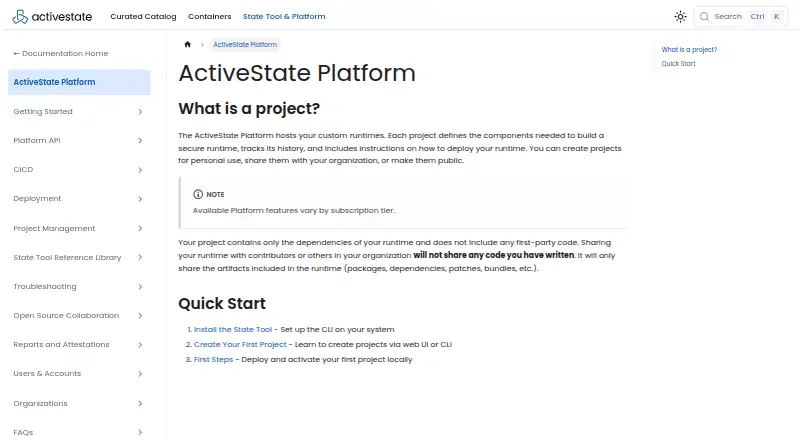
What ActiveState Platform is
ActiveState Platform hosts custom runtimes assembled from source. Each project defines runtime components, records project history, and provides deployment instructions; its artifacts can include packages, dependencies, patches, and bundles, but not contributors’ first-party code. Projects can be personal, shared with an organization, or public, and users can create and manage them through the web interface or the State Tool CLI for Windows, Linux, and macOS. Users can select language and package source versions in a browser, then deploy and activate projects locally. Supported deployment systems include Windows 10/11 and Windows Server, macOS 10.15 or later on Intel and Apple Silicon, and Linux distributions with compatible glibc. The GraphQL API supports programmatic builds for open source software across operating systems and languages without users managing build infrastructure. ActiveState describes its build service as using reproducible builds, checksum checks, and isolated containers. The platform provides immutable SBOMs in SPDX formats. The free organization plan costs nothing and permits public projects only; paid subscription pricing is not listed. Published annual per-language Curated Catalog tiers are $25,000, $50,000, and $150,000 based on organization size; these prices do not apply to legacy Platform subscriptions.
Who it suits
It suits organizations managing runtime projects and permissions across a company, department, or team. Development teams can use its CLI, web interface, integrations, and GraphQL API to build and deploy runtimes.
What it does well
- Projects can be personal, organization-shared, or public.
- State Tool supports Windows, Linux, and macOS.
- Immutable SBOMs are available in SPDX formats.
- Builds use checksum verification and isolated containers.
What to know first
- The free plan permits public projects only.
- Paid subscription pricing is available by contacting sales.
- Docker deployment with the State Tool is limited to Linux containers.
Limits
The free organization plan costs nothing and allows public projects only. Paid organizations can use private and public projects, but features vary by subscription tier; pricing is available by contacting sales.
Plans
| Plan | Billed and limits | Price |
|---|---|---|
| Free organization | Public projects only | Free |
| Paid organization | Contact sales for Platform Enterprise or Business Tier pricing · Supports private and public projects · Features vary by subscription tier | On request |
As docs.activestate.com lists them, read 30 Sept 2026. The maker's own page has the final word.
Getting started
- Open https://docs.activestate.com/platform/.
- Create a project through the web interface or install the State Tool CLI on Windows, Linux, or macOS.
- Select a language and package source versions through the browser.
- Choose personal, organization-shared, or public project visibility.
- Deploy and activate the project locally.
Overview
ActiveState Platform gives teams a way to assemble language runtimes from source and manage the resulting projects through a web interface, CLI, or API. It is best suited to organizations that need managed runtime builds, deployment guidance, and supply-chain controls; teams seeking a self-hosted service or automated dependency updates should look elsewhere.
Projects capture runtime components and history, not the application code built with them. That boundary makes the Platform useful for sharing and deploying environments without placing contributors’ first-party code in the project.
Key features
- Runtime projects and builds: Projects can include packages, dependencies, patches, and bundles, with deployment instructions and project history. Users select language and package source versions in a browser, and runtimes are built from source. The build service is designed around reproducibility, checksum verification, and isolated build containers—a meaningful foundation for teams that need to control how runtime artifacts are produced.
- Project and team controls: Projects can be personal, public, or shared with an organization. Organizations can group projects by company, department, or team and manage member access and runtime permissions by role. Sharing a project does not share contributors’ first-party code.
- Build and deployment interfaces: Users can create projects in the web UI or with the State Tool CLI, then deploy and activate them locally. The CLI runs on Windows, Linux, and macOS. Docker deployment through the State Tool is limited to Linux containers, which matters for teams whose container workflows depend on other host platforms.
- Integrations and API: ActiveState lists JFrog Artifactory, Sonatype Nexus, Kubernetes, Cloudera, CI/CD pipelines, IDEs, Trivy, and Wiz as integrations. IDEs that support standard package managers can resolve packages from the Curated Catalog; named examples include VS Code, PyCharm, IntelliJ IDEA, Eclipse, Visual Studio, and Cursor. Documentation also describes Visual Studio Code, PyCharm, and Jupyter Notebook or JupyterLab integrations, with Jupyter support limited to Python projects. A GraphQL API can programmatically build open source software for different operating systems and languages without requiring teams to manage build infrastructure.
- Security and reporting: Deployment documentation says ActiveState builds and tests packages and cryptographically verifies downloads. The Platform provides immutable SBOMs in SPDX JSON and tag-value formats conforming to SPDX 2.2. ActiveState says it holds SOC 2 Type 2 certification and provides its audit report and third-party penetration-testing results through its Trust Center, with some materials available on request.
- Update and supply-chain controls: Vulnerability alerts, license compliance, and SBOM support are included among its capabilities, while update automation is limited to alerts. This is a stronger fit for inventory and controlled runtime assembly than for teams wanting dependencies updated automatically.
Pricing
The Platform uses a freemium model, with a free plan and a 14-day trial. The Free organization plan costs nothing and allows public projects only. That cap makes it suitable for public work, but not for organizations that need private projects.
The Paid organization plan has custom pricing and supports private and public projects; features vary by subscription tier. Legacy Platform Enterprise or Business Tier pricing is available through an account representative or sales team. Organizations should confirm which project and support features their tier includes before committing.
Published Curated Catalog pricing is separate from legacy Platform subscription pricing. Annual per-language tiers are $25,000 for fewer than 100 employees, $50,000 for 100–999 employees, and $150,000 for 1,000 or more employees. These prices apply to the Curated Catalog, not legacy Platform subscriptions, so they should not be treated as a quoted Platform subscription price.
Platforms
The Platform is available through the web and API, and the State Tool runs on Windows, Linux, and macOS. Projects support Windows 10/11 and Windows Server; macOS 10.15 or later on Intel and Apple Silicon; and Linux distributions with compatible glibc. Docker deployment through the State Tool supports Linux containers only. Self-hosted deployment is not offered.
Who it's for
ActiveState Platform is a practical option for organizations that need to assemble source-built runtimes, keep project components and history together, manage access by role, and produce SBOMs. Its API and ecosystem integrations also suit teams connecting runtime builds to existing development and security workflows. The public-only free organization plan works for public projects; teams requiring private projects need a paid tier.
It is less suitable for users looking for a self-hosted platform, or for teams that want dependency updates applied automatically rather than alerts. Python teams can use its documented Jupyter integration; teams using other languages should not assume that integration covers them.
Pros and cons
Pros
- Source-built runtimes with reproducibility controls: Build design includes checksum verification and isolated containers, while downloads are cryptographically verified.
- Useful project separation: Runtime artifacts and deployment guidance can be shared without including contributors’ first-party code.
- Security inventory: Immutable SPDX 2.2 SBOMs, vulnerability alerts, and license compliance support supply-chain oversight.
- Multiple workflow entry points: Web, CLI, GraphQL API, IDE compatibility, and named integrations can fit into different development environments.
Cons
- Free projects must be public: Organizations with private runtime projects need a paid tier.
- Paid tier features vary: Teams need to establish which subscription tier covers their requirements; legacy Platform pricing is custom.
- Catalog prices are substantial and scoped separately: Published annual Curated Catalog tiers start at $25,000 per language, and are not prices for legacy Platform subscriptions.
- Automation and container limits: Update automation is alerts-only, and State Tool Docker deployment is limited to Linux containers.
Alternatives
For a broader comparison, see Dependency Management Software, Software Supply Chain Security Software, Development Environment Management Tools, Python Package Managers, and Development Environment Managers.
- Sonatype Nexus Repository is an alternative with a free Community Edition, full ecosystem support, CI/CD integration, and an external PostgreSQL database option.
- DepsHub is an alternative with a free Open Source plan for unlimited public repositories, team members, and security alerts.
- Endor Labs offers a free Developer plan for individual developers, with local scans through its AURI MCP server and no account required.
- Snyk Open Source has a free plan capped at five projects for access to Snyk Open Source (SCA).
- Socket offers a Team plan at $25 a month per developer, with a five-developer minimum.
- Updatecli is a free, Apache-2.0-licensed single binary that runs locally or in CI.
- Depfu offers a free Open Source/Personal plan for public and personal account repositories with unlimited dependency updates.
- FOSSA is another alternative for teams comparing supply-chain and dependency tools.
Verdict
Choose ActiveState Platform if your organization needs source-built runtimes, managed project access, and traceable package inventory with SBOM and compliance support. Its strongest case is bringing runtime construction and deployment controls together without bundling first-party code into shared projects. Look elsewhere if you need self-hosting, automated updates, or private projects without moving to a paid tier.
Verdict
ActiveState Platform organizes custom runtime projects and provides build, deployment, and inventory capabilities. Organizations should note that project features vary by subscription tier and published catalog prices are separate from legacy subscription pricing.
Questions
Is there a free plan?
Yes. The Free organization plan costs nothing and supports public projects only.
How is paid organization pricing provided?
The maker directs buyers to contact sales for Platform Enterprise or Business Tier pricing. Features vary by subscription tier.
Which platforms are supported?
The listed platforms are API, Linux, macOS, web, and Windows. Projects support Windows 10/11 and Windows Server, macOS 10.15 or later on Intel and Apple Silicon, and Linux distributions with compatible glibc.
Does the platform support private projects?
The free organization plan is limited to public projects. Paid organization subscriptions support private and public projects.
What integrations are listed?
The maker lists JFrog Artifactory, Sonatype Nexus, Kubernetes, Cloudera, CI/CD pipelines, IDEs, Trivy, and Wiz.
Does the platform provide SBOMs?
Yes. It provides immutable SBOMs in SPDX JSON and tag-value formats, conforming to SPDX 2.2.
Facts from ActiveState Platform's own pages
- API
- The Platform API uses GraphQL to programmatically build open source software for different operating systems and languages without managing build infrastructure. · docs.activestate.com, 30 Sept 2026
- Build security
- The maker describes the Platform build service as designed around reproducible builds, checksum verification, and isolated containers for build steps. · docs.activestate.com, 30 Sept 2026
- CLI
- The State Tool command line interface can be installed on Windows, Linux, and macOS. · docs.activestate.com, 30 Sept 2026
- Company history
- ActiveState says it has secured open source since 1997. · activestate.com, 30 Sept 2026
- Compliance
- ActiveState says it achieved SOC 2 Type 2 certification and provides access to its audit report and third-party penetration testing results through its Trust Center, with some materials available on request. · activestate.com, 30 Sept 2026
- Founded
- 1997 · docs.activestate.com, 28 Sept 2026
- Headquarters
- Vancouver, BC, Canada · docs.activestate.com, 28 Sept 2026
- IDE compatibility
- The maker says any IDE that supports standard package managers can resolve packages from its Curated Catalog, including VS Code, PyCharm, IntelliJ IDEA, Eclipse, Visual Studio, and Cursor. · activestate.com, 30 Sept 2026
- IDE integrations
- The documentation describes integrations for Visual Studio Code, PyCharm, and Jupyter Notebook or JupyterLab; the Jupyter integration is currently for Python projects only. · docs.activestate.com, 30 Sept 2026
- Integrations
- The maker lists JFrog Artifactory, Sonatype Nexus, Kubernetes, Cloudera, CI/CD pipelines, IDEs, Trivy, and Wiz as integrations. · activestate.com, 30 Sept 2026
- Notable limit
- Docker deployment with the State Tool is currently available only for Linux containers. · docs.activestate.com, 30 Sept 2026
- Pricing scope
- The published annual per-language Curated Catalog tiers are $25,000 for fewer than 100 employees, $50,000 for 100–999 employees, and $150,000 for 1,000 or more employees; the maker says these prices do not apply to legacy Platform subscriptions. · activestate.com, 30 Sept 2026
- Project management
- Users can create projects through the web UI or CLI and deploy and activate projects locally. · docs.activestate.com, 30 Sept 2026
- Project sharing
- Projects can be personal, shared with an organization, or public, and sharing a project does not share first-party code written by its contributors. · docs.activestate.com, 30 Sept 2026
- Project visibility
- Projects can be created for personal use, shared with an organization, or made public. · docs.activestate.com, 30 Sept 2026
- Purpose
- The Platform hosts custom runtimes whose projects define runtime components, track project history, and provide deployment instructions. · docs.activestate.com, 30 Sept 2026
- Reports
- The Platform provides immutable SBOMs in SPDX JSON and tag-value formats, conforming to SPDX 2.2. · docs.activestate.com, 30 Sept 2026
- Runtime building
- Runtimes on the Platform are built from source, with users selecting language and package source versions through the browser. · docs.activestate.com, 30 Sept 2026
- Runtime builds
- Runtimes created on the Platform are built from source. · docs.activestate.com, 30 Sept 2026
- Runtime contents
- A project contains runtime artifacts such as packages, dependencies, patches, and bundles, but does not include first-party code. · docs.activestate.com, 30 Sept 2026
- Security
- The deployment documentation says packages are built and tested by ActiveState and downloads are cryptographically verified. · docs.activestate.com, 30 Sept 2026
- Support
- The State Tool troubleshooting documentation directs users with errors to [email protected]. · docs.activestate.com, 30 Sept 2026
- Supported systems
- Projects support deployment on Windows 10/11 and Windows Server, macOS 10.15 or later on Intel and Apple Silicon, and Linux distributions with compatible glibc. · docs.activestate.com, 30 Sept 2026
- Support limits
- Platform features vary by subscription tier, and legacy Platform Enterprise or Business Tier subscription pricing is available by contacting an account representative or sales team. · activestate.com, 30 Sept 2026