Freedom251 › Software Composition Analysis Software

Socket
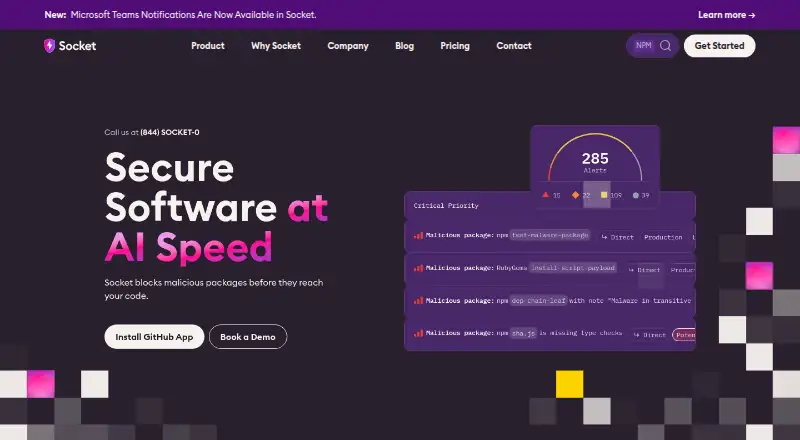
What Socket is
Socket is a developer-first security platform for protecting code from vulnerable and malicious dependencies. Its GitHub App scans dependency changes in pull requests and gives feedback before merging. Socket Firewall intercepts package-manager requests to block malicious direct or transitive dependencies before installation; the free Firewall supports JavaScript and TypeScript package managers, Python pip and uv, and Rust cargo. Reachability analysis can eliminate up to 90% of irrelevant CVEs through full application analysis. Socket lists integrations including AWS CodePipeline, Azure Pipelines, Bitbucket Pipelines, CircleCI, Jenkins, Vanta, and Drata, and offers a REST API and JavaScript SDK for custom integrations and automation. It says it analyzes dependency manifests and lockfiles rather than uploading source code, and that server communications use TLS. Socket’s Free plan includes 1,000 scans per month. Open-source projects can use Socket for free. Team costs $25 a month per developer with a five-developer minimum; Business costs $50 a month per developer with a 20-developer minimum.
Who it suits
Socket suits development teams that want dependency checks in pull requests or package installation, along with integrations or automation. Its free use for open-source projects may suit maintainers of open-source software.
What it does well
- Scans dependency changes in pull requests
- Firewall blocks malicious dependencies before installation
- Reachability can eliminate up to 90% of irrelevant CVEs
- Free for open-source projects
What to know first
- Team requires at least five developers
- Business requires at least 20 developers
- CLI requires Node.js 18.20.8 or newer
Limits
The Free plan includes 1,000 scans per month, 500 API quota per hour, three members, and one repository label. Team costs $25 a month per developer with a five developer minimum, while Business costs $50 a month per developer with a 20 developer minimum.
Plans
| Plan | Billed and limits | Price |
|---|---|---|
| Team | per developer; minimum 5 developers; yearly plan saves 20% · 5,000 scans/month · 2,500 API quota/hour · unlimited members · 3 repository labels · precomputed reachability | $25 a month |
| Business | per developer; minimum 20 developers; yearly plan saves 20% · 10,000 API quota/hour · unlimited members · unlimited repository labels · compliance integrations · SBOM import/export · SSO/SAML · webhook automation | $50 a month |
| Free | per developer · Unlimited developers & repos · 1,000 scans/month · 500 API quota/hour · 3 members · 1 repository label | On request |
| Enterprise | Full application function-level reachability · GitLab/Bitbucket/Azure DevOps/self-hosted integrations · SCIM · audit logs · IP restrictions · named account manager | On request |
As socket.dev lists them, read 1 Oct 2026. The maker's own page has the final word.
Getting started
- Visit the Socket website.
- Choose the Free plan or a paid plan for your team.
- Connect the GitHub App to scan dependency changes in pull requests.
- Use Socket Firewall with a supported package manager.
- Install the CLI with npm on a system running Node.js 18.20.8 or newer.
- Use the REST API or JavaScript SDK for custom automation.
Socket is a developer-focused platform for finding and stopping vulnerable or malicious software dependencies. It suits engineering teams that want security checks inside pull requests and package installation, while open-source projects can use it without charge. The main trade-off is that paid plans charge per developer and impose minimum team sizes.
Overview
Socket combines dependency analysis with prevention. Its GitHub App reviews dependency changes before a pull request is merged, and Socket Firewall blocks dangerous packages before they reach a workstation, CI job or production environment. That makes it a better fit for teams seeking to stop supply-chain threats early than for buyers wanting only a retrospective vulnerability report.
The service is cloud-deployed and was founded in 2021 in San Francisco. Socket says it does not upload source code; analysis uses dependency manifests and lockfiles. Communications use TLS, with manifest files protected in transit by HTTPS. Its pricing matrix lists SOC 2 Type II compliance, which may help organizations with formal vendor requirements.
Key features
The GitHub App puts findings in code review, where dependency changes can be fixed before merge. Firewall protection works at installation time by intercepting package-manager requests and rejecting malicious direct or transitive dependencies. The free Firewall coverage supports JavaScript and TypeScript package managers, Python pip and uv, and Rust cargo.
Analysis covers JavaScript and TypeScript, Python, Go, Java, Ruby, .NET, Scala, Kotlin, Rust, PHP, Swift, C and C++, Julia, Dart, Elixir and Erlang, plus GitHub Actions. Reachability analysis examines the full application and can remove up to 90% of irrelevant CVEs, a useful advantage for teams overwhelmed by findings that their code never calls. Socket also provides SBOM generation.
For automation, there is a REST API and JavaScript SDK, alongside integrations for AWS CodePipeline, Azure Pipelines, Bitbucket Pipelines, CircleCI, Jenkins, Vanta and Drata. The Socket CLI installs through npm and requires Node.js 18.20.8 or newer. That requirement is straightforward for current Node environments but adds a compatibility check for older build systems.
Pricing
Socket has a free plan and paid plans from $25/mo. It says the service will always be free for open-source projects, making it especially attractive for maintainers of public software.
Free
The Free plan has unlimited developers and repositories, 1,000 scans per month, a 500 API quota per hour, three members and one repository label. It is a practical starting point for small private projects or evaluation, but the scan, API, member and labeling caps limit larger teams and more elaborate governance.
Team
Team costs $25 a month per developer, with a minimum of five developers; annual billing saves 20%. It includes 5,000 scans per month, a 2,500 API quota per hour, unlimited members, three repository labels and precomputed reachability. The higher quotas and unlimited membership suit a small engineering organization, although the five-seat minimum makes it expensive for a solo developer or two-person team.
Business
Business costs $50 a month per developer, requires at least 20 developers and offers a 20% annual-billing saving. It raises the API quota to 10,000 per hour and adds unlimited repository labels, compliance integrations, SBOM import and export, SSO/SAML and webhook automation. Those controls are relevant to larger security and compliance programs; the 20-developer floor rules it out for most small companies.
Enterprise
Enterprise uses custom pricing. It adds full application function-level reachability, GitLab, Bitbucket, Azure DevOps and self-hosted integrations, SCIM, audit logs, IP restrictions and a named account manager. Organizations with identity, network and audit requirements are the natural audience.
Platforms
Socket supports API, browser extension, Linux, macOS, self-hosted, web and Windows environments. Its dependency coverage spans a broad set of language ecosystems, while deployment is cloud-based. The self-hosted platform listing may appeal to teams with controlled infrastructure needs, but Enterprise is the plan that explicitly adds self-hosted source-control integrations.
Who it's for
Choose Socket if your developers use GitHub pull requests and package managers and you want malicious dependencies blocked before installation, not merely reported afterward. It is also a strong match for organizations needing SBOMs, reachability prioritization, API-driven workflows or compliance integrations. Open-source maintainers get an unusually clear cost advantage because Socket commits to free use for open-source projects.
Look elsewhere if you need a low-cost commercial plan for fewer than five developers, or if your workflow does not use the supported CI and package ecosystems. Business and Enterprise capabilities are aimed at larger organizations rather than individual developers.
Pros and cons
Pros
- Blocks before installation: Firewall can stop malicious direct and transitive packages from entering development, CI or production.
- Broad ecosystem analysis: Coverage includes major compiled and interpreted languages as well as GitHub Actions.
- Actionable prioritization: Reachability analysis can eliminate up to 90% of irrelevant CVEs.
- Open-source commitment: Open-source projects can use Socket free of charge.
- Automation options: REST, JavaScript SDK and numerous pipeline integrations support custom delivery workflows.
Cons
- Minimum paid seats: Team requires five developers and Business requires 20, excluding many smaller commercial teams.
- Free-plan ceilings: 1,000 scans monthly, 500 API calls per hour, three members and one label can constrain growing projects.
- CLI prerequisite: Socket CLI requires Node.js 18.20.8 or newer.
- Key controls cost more: SSO/SAML, compliance integrations, SBOM exchange and webhooks begin on Business.
Alternatives
ActiveState Platform is worth considering when you want a freemium platform with a free organization tier for public projects and support for API, desktop and web environments.
Sonatype Nexus Repository is the alternative for teams prioritizing a repository manager, with a free Community Edition offering full ecosystem support, CI/CD integration and an external PostgreSQL option.
DepsHub fits open-source teams seeking unlimited public repositories, team members and security alerts on its free tier.
Endor Labs suits individual developers who want free local scans without an account or user interface.
Snyk Open Source is an option for buyers who prefer a free tier capped at five projects and a paid team plan.
OSS Review Toolkit is a free open-source toolkit with no paid limits stated.
Updatecli is a free Apache-2.0 single binary that runs locally or in CI.
Depfu is aimed at dependency-update workflows, with a free public or personal-account tier and unlimited dependency updates.
For broader category comparisons, see Dependency Management Software and Software Composition Analysis Software.
Verdict
Socket is a strong choice for development teams that want dependency security to prevent threats at pull-request and installation time, with reachability analysis and extensive automation as useful complements. Its free open-source policy is compelling, but small commercial teams should look elsewhere if five paid seats are too many or if they need advanced controls without moving to a 20-developer Business plan.
Verdict
Socket focuses on identifying and blocking dependency risks during development and installation. Its Free plan and open-source terms differ from paid per-developer plans, which have minimum team sizes.
Questions
Is Socket free?
Socket has a Free plan with unlimited developers and repositories, up to 1,000 scans per month, 500 API quota per hour, three members, and one repository label. Socket says open-source projects can always use the service for free.
How much do the paid plans cost?
Team is $25 a month per developer, with a five developer minimum. Business is $50 a month per developer, with a 20 developer minimum; yearly plans save 20%.
Which platforms does Socket support?
Socket lists API, extension, Linux, macOS, self-hosted, web, and Windows platforms.
Does Socket support pull request scanning and SBOMs?
Yes. Socket lists pull request scanning and SBOM generation.
Which integrations does Socket list?
Listed integrations include AWS CodePipeline, Azure Pipelines, Bitbucket Pipelines, CircleCI, Jenkins, Vanta, and Drata.
What does Socket collect for analysis?
Socket says it collects dependency manifests and lockfiles and does not upload source code.
Facts from Socket's own pages
- API
- Socket provides a REST API and a JavaScript SDK for customized integrations and automation. · docs.socket.dev, 1 Oct 2026
- CLI
- Socket CLI is installed with npm and requires Node.js 18.20.8 or newer. · docs.socket.dev, 1 Oct 2026
- Compliance
- Socket's pricing feature matrix lists SOC 2 Type II compliance. · socket.dev, 1 Oct 2026
- Data handling
- Socket says it never uploads source code and collects dependency manifests and lockfiles for analysis. · socket.dev, 1 Oct 2026
- Encryption
- Socket states that communications with its servers use TLS and that manifest files are protected in transit with HTTPS. · socket.dev, 1 Oct 2026
- Firewall
- Socket Firewall intercepts package-manager requests and blocks malicious direct or transitive dependencies before installation. · docs.socket.dev, 1 Oct 2026
- Firewall ecosystems
- Socket Firewall Free supports JavaScript and TypeScript package managers, Python pip and uv, and Rust cargo. · docs.socket.dev, 1 Oct 2026
- Founded
- 2021 · socket.dev, 28 Sept 2026
- GitHub workflow
- The Socket GitHub App scans dependency changes in pull requests and provides feedback before merging. · docs.socket.dev, 1 Oct 2026
- Headquarters
- San Francisco, California, United States · socket.dev, 28 Sept 2026
- Integrations
- Socket lists integrations including AWS CodePipeline, Azure Pipelines, Bitbucket Pipelines, CircleCI, Jenkins, Vanta, and Drata. · socket.dev, 1 Oct 2026
- Open-source pricing
- Socket says it is and will always be free to use for open-source projects. · socket.dev, 1 Oct 2026
- Reachability
- Socket reachability analysis can eliminate up to 90% of irrelevant CVEs through full application analysis. · docs.socket.dev, 1 Oct 2026
- Threat prevention
- Socket detects and blocks malicious packages before they reach a developer machine, CI, or production. · socket.dev, 1 Oct 2026
- What it does
- Socket is a developer-first security platform that protects code from vulnerable and malicious dependencies. · socket.dev, 1 Oct 2026
Where Socket stands on Freedom251
- Software Composition Analysis Software#31 of 65
- Dependency Management Software#13 of 27