Freedom251 › Dependency Management Software

DepsHub
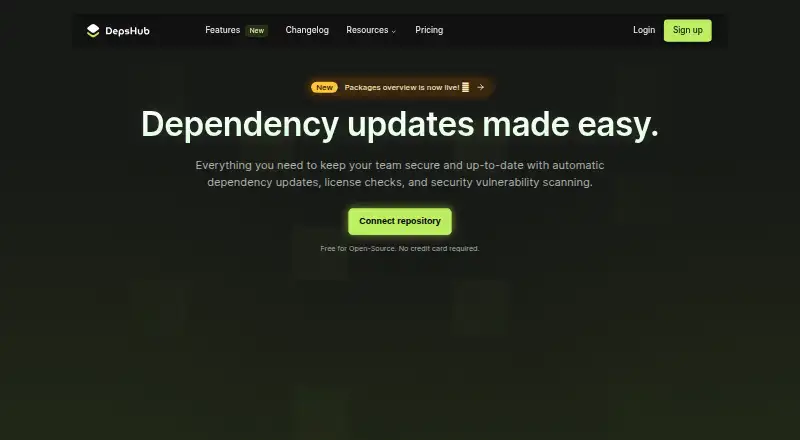
What DepsHub is
DepsHub automates dependency maintenance with update pull requests, license checks and vulnerability scanning. Its Autopilot checks for newer versions and creates pull requests, while the feature page says AI updates can handle major updates automatically. Smart scheduling is intended to keep dependencies reasonably current while reducing unnecessary updates, and Autopilot supports monorepos and multi-language projects. The pricing FAQ lists JavaScript, Python, Go, Rust, Java and PHP as supported languages. DepsHub monitors license changes, provides license details and can export an SBOM in CycloneDX format. It scans for known vulnerabilities and says it integrates with popular security advisories. Listed integrations include GitHub, GitLab, Bitbucket, Linear, Jira and Zapier. The Open Source plan is free for open-source repositories; the homepage also describes free access for personal projects. Professional costs $19 a month per code contributor and includes unlimited public and private repositories, team members, security alerts and integrations. DepsHub lists Linux, macOS, Windows and web platforms, as well as self-hosted deployment.
Who it suits
It suits developers and teams maintaining dependencies across supported languages, including projects organized as monorepos. Open-source repositories and personal projects may qualify for free access; teams with private repositories can consider Professional.
What it does well
- Autopilot creates pull requests for dependency updates.
- Supports monorepos and multi-language projects.
- Exports SBOMs in CycloneDX format.
- Professional includes unlimited private repositories and integrations.
What to know first
- Professional costs $19 a month per code contributor.
- Listed language support covers six languages.
- Self-hosting FAQ has no displayed answer.
Limits
The Open Source plan is free for open-source repositories and includes unlimited public repositories. Professional costs $19 a month per code contributor and adds unlimited public and private repositories, team members, security alerts, and integrations.
Plans
| Plan | Billed and limits | Price |
|---|---|---|
| Open Source | Unlimited public repositories · Unlimited team members · Unlimited security alerts · Basic integrations · Basic chat support | Free |
| Professional | $19/ per month · Per code contributor · Unlimited public and private repositories · Unlimited team members · Unlimited security alerts · Unlimited integrations · 24/7 chat support | $19 a month |
| Enterprise | Custom plan · Contact for a custom plan | On request |
As depshub.com lists them, read 29 Sept 2026. The maker's own page has the final word.
Getting started
- Visit the DepsHub website.
- Connect a supported repository service such as GitHub, GitLab, or Bitbucket.
- Choose Open Source for an open-source repository or Professional for public and private repositories.
- Use Autopilot to check for dependency updates and create pull requests.
Overview
DepsHub is a repository service for dependency updates, license checks, and vulnerability scanning. It suits teams that want these jobs grouped around their code repositories, especially when they need more than one language or a monorepo. Its strongest case is the combination of update pull requests with license and security checks; teams weighing self-hosting should first confirm the deployment terms.
Key features
Updates that remain reviewable
Autopilot checks for newer dependency versions and opens pull requests, giving maintainers a chance to review proposed changes. Smart scheduling is designed to keep dependencies reasonably current while avoiding unnecessary update activity, a useful balance for teams that want regular upkeep without a constant stream of changes. AI updates can handle major updates automatically, while Autopilot supports monorepos and multi-language projects.
License and vulnerability checks
DepsHub monitors dependencies for license changes, provides license details, and can export an SBOM in CycloneDX format. That makes it relevant to teams tracking licensing as part of dependency management, not just version updates. It also scans for known vulnerabilities and integrates with popular security advisories, adding another check to the same workflow.
Repository and project integrations
Integrations include GitHub, GitLab, and Bitbucket, plus Linear, Jira, and Zapier. This range can suit teams that want repository activity connected to project-management or automation tools. Supported languages include JavaScript, Python, Go, Rust, Java, and PHP; teams using other languages should confirm coverage before choosing it. Ecosystem coverage also includes containers.
Pricing
Open Source
The Open Source plan costs nothing and is free for Open Source repositories; the homepage also describes free access for personal projects. It includes unlimited public repositories, unlimited team members, unlimited security alerts, basic integrations, and basic chat support. Its public-repository scope and basic integrations make it a fit for open-source maintainers, but not a substitute for the private-repository access in Professional.
Professional
Professional costs $19 a month, billed $19/ per month, per code contributor. It includes unlimited public and private repositories, unlimited team members, unlimited security alerts, unlimited integrations, and 24/7 chat support. Private repositories and broader integrations are the practical reasons to move up; the per-contributor price means teams should account for their code contributors when comparing cost.
Enterprise
Enterprise has custom pricing, with a custom plan available by contacting the provider. Choose it only if a custom arrangement is appropriate; no plan inclusions are stated here to compare with Professional.
Platforms
DepsHub supports Linux, macOS, Windows, and web. Self-hosted deployment is also indicated, but the deployment terms should be confirmed before making it a requirement. The privacy policy says it takes reasonable measures to protect personal information and does not sell, trade, or rent it to third parties.
Who it's for
DepsHub is best suited to repository owners and teams who want automated update pull requests alongside license and known-vulnerability checks. Its monorepo and multi-language support, plus Git hosting integrations, make it particularly relevant to teams managing varied codebases. Open-source repositories can use the free plan; teams needing private repositories, unlimited integrations, or 24/7 chat support should consider Professional. It is less suitable when a team needs a confirmed self-hosted arrangement or language coverage beyond the supported set.
Pros and cons
- Pros: Update pull requests, scheduling, license monitoring, CycloneDX SBOM export, and vulnerability scanning bring several dependency tasks into one service.
- Pros: Monorepo and multi-language support, along with GitHub, GitLab, and Bitbucket integrations, fit teams managing code across repositories and languages.
- Cons: The free plan is for Open Source repositories, while private repositories require Professional at $19 a month per code contributor.
- Cons: Language coverage is limited to JavaScript, Python, Go, Rust, Java, and PHP; teams outside that set should verify fit.
- Cons: Self-hosted deployment is indicated, but its terms are not clear enough to rely on without confirmation.
Alternatives
ActiveState Platform is another freemium option, with a free organization plan for public projects; consider it if that public-project scope fits better.
Sonatype Nexus Repository offers a free Community Edition with full ecosystem support and CI/CD integration, making it an option when that repository-focused package is a better match.
Endor Labs has a free Developer plan for individual developers with local scans via AURI MCP server; choose it if that individual, local-scan workflow suits you.
Snyk Open Source has a free plan capped at 5 projects for access to Snyk Open Source (SCA), with a Team plan at $25 a month; consider it if that project-based plan fits your needs.
Socket offers a Team plan at $25 per developer, with a minimum of 5 developers and 5,000 scans per month; it may suit teams whose needs align with those terms.
OSS Review Toolkit is a free open-source toolkit with no paid limits stated.
Updatecli is a free Apache-2.0 licensed single binary that runs locally or in CI.
Depfu has a free Open Source/Personal plan for public and personal account repositories with unlimited dependency updates, as well as a Starter plan at $29 a month; consider it if that repository scope and update allowance suit your use.
Verdict
Choose DepsHub if you want automated, reviewable dependency updates alongside license visibility and vulnerability scanning, particularly across monorepos or multi-language projects. Its free Open Source plan is useful for public code, while private-repository access and unlimited integrations start with Professional. Look elsewhere if your language needs fall outside its supported set or self-hosting is essential and you cannot confirm the deployment terms.
Verdict
DepsHub combines automated updates with license and vulnerability checks, plus repository and project-management integrations. Check whether its listed language coverage meets your needs and confirm deployment details if self-hosting matters.
Questions
Is DepsHub free?
The Open Source plan is free for open-source repositories. The homepage also describes free access for personal projects.
How much does Professional cost?
Professional costs $19 a month per code contributor.
Which programming languages are supported?
The pricing FAQ lists JavaScript, Python, Go, Rust, Java, and PHP.
Which integrations does DepsHub list?
Listed integrations include GitHub, GitLab, Bitbucket, Linear, Jira, and Zapier.
Can DepsHub create dependency update pull requests?
Yes. Autopilot checks for updates and creates pull requests when it finds newer versions.
Does DepsHub support self-hosted deployment?
Yes. DepsHub lists self-hosted deployment.
Facts from DepsHub's own pages
- AI updates
- The feature page says AI updates can handle major updates automatically. · depshub.com, 29 Sept 2026
- Automatic updates
- Autopilot checks for updates and creates pull requests when new versions are found. · depshub.com, 29 Sept 2026
- Free eligibility
- The Open Source plan is free for Open Source repositories, and the homepage also describes free access for personal projects. · depshub.com, 29 Sept 2026
- Integrations
- The site lists GitHub, GitLab, Bitbucket, Linear, Jira, and Zapier integrations. · depshub.com, 29 Sept 2026
- License checks
- DepsHub monitors dependencies for license changes, provides license details, and can export an SBOM in CycloneDX format. · depshub.com, 29 Sept 2026
- Monorepos
- The autopilot feature supports monorepos and multi-language projects. · depshub.com, 29 Sept 2026
- Purpose
- DepsHub provides automatic dependency updates, license checks, and security vulnerability scanning. · depshub.com, 29 Sept 2026
- Scheduling
- Smart scheduling keeps dependencies reasonably fresh while reducing unnecessary updates. · depshub.com, 29 Sept 2026
- Security and privacy
- The privacy policy says DepsHub takes reasonable measures to protect personal information and does not sell, trade, or rent it to third parties. · depshub.com, 29 Sept 2026
- Self-hosting
- The pricing page includes a self-hosted FAQ question but does not display an answer. · depshub.com, 29 Sept 2026
- Support
- The pricing page lists basic chat support for Open Source and 24/7 chat support for Professional. · depshub.com, 29 Sept 2026
- Supported languages
- The pricing FAQ lists JavaScript, Python, Go, Rust, Java, and PHP as currently supported languages. · depshub.com, 29 Sept 2026
- Vulnerability scanning
- DepsHub scans dependencies for known vulnerabilities and says it integrates with popular security advisories. · depshub.com, 29 Sept 2026
Where DepsHub stands on Freedom251
- Dependency Management Software#3 of 27